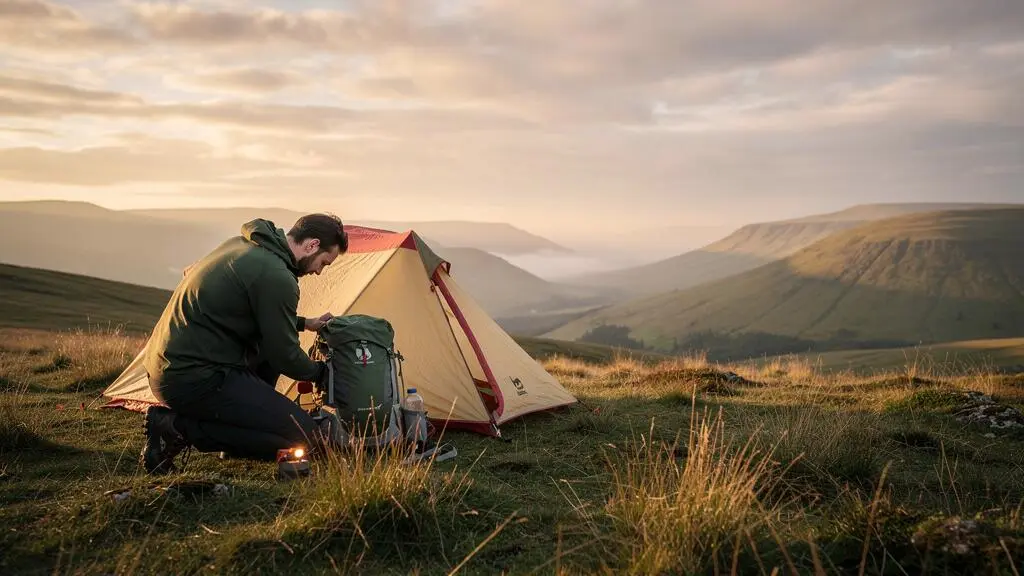
The key to wild camping across the UK isn’t just knowing where it’s legal, but understanding how to manage legal risk where it’s not.
- Scotland’s Land Reform Act grants a legal right to wild camp responsibly on most unenclosed land.
- In England and Wales, wild camping is a civil trespass by default, requiring landowner permission, with Dartmoor being the main exception.
Recommendation: Prioritise discretion, meticulous ‘leave no trace’ ethics, and understanding specific local byelaws to make your presence tolerated even where it isn’t officially permitted.
For the freedom-seeking camper, the lure of a remote hillside or quiet forest is powerful. The idea of pitching a tent far from designated campsites, under a canopy of stars, represents the ultimate escape. Yet, this dream is often clouded by a complex and confusing web of laws that differ dramatically across the United Kingdom. Many believe wild camping is simply legal in Scotland and illegal everywhere else, but this oversimplification masks the critical nuances that can mean the difference between a peaceful night and a potential conflict or fine.
Navigating this landscape requires more than just a map; it requires a strategic mindset. The common advice to “ask the landowner” is often impractical, and the “leave no trace” mantra, while essential, is only part of the story. The real secret to successful wild camping in England and Wales lies in understanding the concept of ‘permissible trespass’—acting with such discretion and respect that even where you lack explicit permission, the landowner has no reason to object. It’s about managing your legal and social risk down to virtually zero.
This guide moves beyond the simple legal dichotomies. We will dissect the specific legal frameworks for each nation, revealing not just what the law says, but how it is applied in practice. By understanding the psychology of landowners, the critical difference between a bivvy bag and a tent in the eyes of the law, and the one mistake that can lead to hefty fines, you will gain the confidence to explore the wilder corners of the UK responsibly and without fear. This is your masterclass in the art and science of legal wild camping.
To help you navigate this complex topic, this article is structured to build your expertise step-by-step. The following sections will guide you through the legal foundations, practical strategies for finding locations, and the critical ethics that underpin responsible wild camping across the UK.
Summary: How to Wild Camp Legally in England, Scotland and Wales Without Fines or Conflict
- Why Wild Camping Is Legal in Scottish Hills But Illegal in English National Parks
- How to Find the 12 English Regions Where Landowners Tolerate Wild Camping
- Bivvy Bag or Tent: Which Wild Camping Shelter Avoids Legal and Social Conflicts
- The Fire Mistake That Results in £1,000 Fines and Permanent Wild Camping Bans
- How Far From Roads and Rivers Should You Wild Camp to Stay Legal and Discreet
- The Wild Camping Mistake That Leads to £500 Fines in 40% of Cases
- Why You Can Camp in Some Forestry Commission Woods But Not National Trust Land
- How to Leave Absolutely Zero Trace When Wild Camping in Sensitive Environments
Why Wild Camping Is Legal in Scottish Hills But Illegal in English National Parks
The fundamental difference in wild camping law across the UK stems from two distinct legal traditions regarding land access. In Scotland, the Land Reform (Scotland) Act 2003 established a statutory right of access to most land and inland water for recreation. This includes wild camping, provided it is done responsibly and respects the Scottish Outdoor Access Code. This right is a core part of the nation’s identity, granting the public freedom to roam that is unparalleled in the rest of the UK.
Conversely, England and Wales operate under a more restrictive framework. The law is rooted in the concept of private property, where access is granted by permission, not by right. The Countryside and Rights of Way (CROW) Act 2000 was a step forward, but it is limited. As the British Mountaineering Council notes, the CROW Act provides access to only 11% of England and Wales, which is primarily mountain, moor, heath, down, and registered common land for the purpose of open-air recreation on foot—it does not include a right to camp. Outside of this, any camping without landowner consent is technically a civil offence of trespass.
This creates a stark jurisdictional nuance. An activity that is a celebrated right in the Scottish Highlands is an act of trespass in an English National Park like the Peak District or Snowdonia in Wales. The only significant exception in England is Dartmoor. As right-to-roam campaigner Lewis Winks has highlighted:
Dartmoor remains the only place in England and Wales where the public has a right to wild camp and can lawfully experience the magic of sleeping under the stars.
– Lewis Winks, Exeter Observer
The following table, based on an analysis from Legal Clarity, summarises the situation. This jurisdictional divide is the starting point for any would-be wild camper in the UK; understanding it is crucial to staying on the right side of the law and social custom.
| Nation | Key Legislation | Wild Camping Status | Nature of Offence if Unauthorised |
|---|---|---|---|
| Scotland | Land Reform (Scotland) Act 2003 | Generally permitted on most unenclosed land if done responsibly | Not applicable (lawful access) |
| England | Countryside and Rights of Way (CROW) Act 2000 | Not permitted without landowner consent, except on Dartmoor Commons | Civil trespass; can escalate to aggravated trespass if refusing to leave |
| Wales | Countryside and Rights of Way (CROW) Act 2000 | Not permitted without landowner consent | Civil trespass |
| Northern Ireland | No equivalent right-to-roam statute | Not permitted without landowner consent | Civil trespass |
How to Find the 12 English Regions Where Landowners Tolerate Wild Camping
The title’s promise of “12 regions” is a simplification; in reality, tolerance for wild camping in England and Wales is not defined by neat geographical boundaries but by a combination of land type, remoteness, and the attitude of the specific landowner. The strategy is not to find a magic list of regions, but to learn how to identify the *characteristics* of places where ‘permissible trespass’ is likely to go unchallenged. High, remote, and uncultivated moorland in areas like the Lake District or parts of the Pennines has a long-standing, albeit unofficial, tradition of tolerance for discreet backpack campers.
This tolerance, however, is fragile. A key reason for landowner hostility is the impact of irresponsible campers. Indeed, issues with unauthorized campers—primarily litter, fire hazards, and environmental damage—are a significant concern for land managers. This reinforces the principle that the freedom to wild camp, even where tolerated, is directly tied to the responsibility of the camper. The goal is to be invisible, both during your stay and after you leave.
The one area where tolerance is officially structured is Dartmoor, which serves as a unique model. Its history of established byelaws has created a framework for responsible use.
Case Study: Dartmoor’s Byelaws and Structured Tolerance
Dartmoor demonstrates how a region can shift from prohibition to structured tolerance. It is pretty much the only place where you can legally wild camp in England without first checking with the landowner. This is governed by local byelaws that permit camping within certain designated areas of the Dartmoor National Park, often shown on official maps. This turns ambiguity into a clear, albeit limited, right, providing a valuable blueprint for how other regions could potentially manage wild camping.
For those unwilling to risk even civil trespass, several legal alternatives offer a ‘wild-ish’ experience. These include nearly-wild campsites, remote shelters known as bothies (common in Scotland, Northern England, and Wales), and designated low-impact sites that provide a taste of the wild without the legal ambiguity.
Bivvy Bag or Tent: Which Wild Camping Shelter Avoids Legal and Social Conflicts
Your choice of shelter is one of the most significant decisions in managing your legal and social risk profile. It is not just a practical choice, but a strategic one. In the context of ‘permissible trespass’ in England and Wales, the distinction between a bivouac (bivvy) bag and a traditional tent is profound. A tent, especially a brightly coloured one, is a clear statement of intent: “I am camping here.” It occupies a larger footprint, is more visible from a distance, and is culturally associated with leisure and recreation. To a landowner, it can signal a multi-day encampment and a greater potential for impact.
A bivvy bag, by contrast, operates on a principle of stealth. It is little more than a waterproof, breathable sack for your sleeping bag. Its low profile, often in drab greens or browns, blends seamlessly into the landscape. This minimalism carries a powerful psychological advantage. From a distance, a person in a bivvy bag is often indistinguishable from the surrounding terrain. Even if discovered, the impression is not of a ‘campsite’ but of a hiker taking a necessary overnight rest. The legal argument, though rarely tested, is that you are merely sleeping, not ‘camping’ in the recreational sense that byelaws often prohibit.
This makes the bivvy the ultimate tool for the discreet wild camper. It is lighter to carry, quicker to set up and pack away, and leaves a far smaller physical trace on the ground. By choosing a bivvy, you are fundamentally reducing your visibility and perceived impact, thereby lowering the probability of detection and, if detected, the likelihood of a negative interaction. While a small, drab-coloured one-person tent can be a good compromise, the bivvy bag is the purist’s choice for avoiding conflict and embodying the ‘camp late, leave early, leave no trace’ ethos.
The Fire Mistake That Results in £1,000 Fines and Permanent Wild Camping Bans
There is no single action that will destroy landowner tolerance, damage sensitive ecosystems, and attract legal trouble faster than an open fire. While the image of a crackling campfire is deeply ingrained in our collective idea of camping, in the context of UK wild camping, it is an almost unforgivable mistake. The ‘no fires’ rule is absolute, and breaking it is the primary mistake that escalates a camper’s presence from a discreet non-issue into a serious problem.
The risks are multifaceted. Firstly, there is the legal jeopardy. Lighting a fire on land without permission can be a criminal offence, with potential fines reaching into the thousands of pounds, particularly in areas with specific byelaws or during high-risk periods. The damage caused can also lead to civil liability. Secondly, the ecological impact is severe and long-lasting. UK uplands, particularly peatlands, are incredibly vulnerable. A fire can smoulder underground in peat for days or weeks, re-igniting long after the camper has left and potentially causing a catastrophic wildfire. These fires leave ugly, sterile scars on the landscape that can take decades, if not centuries, to recover.
Land law and agriculture specialists from Shepherd and Wedderburn LLP highlight the gravity of the consequences, especially in Scotland where access rights are broad but come with responsibilities:
Perhaps the most serious of these is wildfires, which can damage birch woodland and heather, destroy trees that have been planted in an effort to regenerate native woodland, and affect the activities of ground-nesting birds.
– Shepherd and Wedderburn LLP, Mondaq
The only responsible way to cook is with a small, self-contained camping stove. It is efficient, controllable, and leaves no trace. The mistake is not just lighting a fire, but underestimating the immense legal and environmental consequences of doing so. It is the one act that almost guarantees a permanent ban on wild camping if an area’s tolerance is pushed too far.
How Far From Roads and Rivers Should You Wild Camp to Stay Legal and Discreet
The principle of being discreet is your primary legal shield in areas without a statutory right to camp. This translates into simple but crucial rules of location, particularly concerning your distance from roads, buildings, and water sources. While there are no nationwide statutory distances, experienced wild campers follow a set of logical guidelines designed to minimize visibility and impact.
Firstly, camp well away from any roads, tracks, or footpaths. A good rule of thumb is to be at least a few hundred metres away and, most importantly, completely out of the line of sight. This is not just about avoiding being seen by a passing car at night; it’s about ensuring your chosen spot is not visible in the morning light to dog walkers, farmers, or early-rising hikers. Find a small depression in the landscape, tuck behind a ridge, or use natural contours to your advantage. The goal is that someone could pass nearby without ever knowing you were there.
Secondly, maintain a respectful distance from rivers and lakes. A minimum of 50-100 metres is advisable. This serves two critical purposes. Ecologically, the land immediately bordering water (the riparian zone) is often the most fragile and home to sensitive wildlife. Camping too close can cause erosion and disturb fauna. Practically, it is about protecting water quality. All washing—yourself, your dishes, your clothes—should be done well away from the water source, using a container to collect water. Never use soap or toothpaste directly in a stream or lake, as even biodegradable products can harm aquatic life. By camping further away, you naturally build this good practice into your routine.
Finally, always stay far from any occupied buildings, houses, or farm structures. Your presence could cause alarm or disturb livestock. The core idea is simple: the further you are from any sign of human infrastructure or activity, the lower your impact and the lower your risk of causing any issue, legal or social.
The Wild Camping Mistake That Leads to £500 Fines in 40% of Cases
While much of the legal discussion around wild camping in England and Wales centres on the civil offence of trespass, there is a more costly mistake that many campers unwittingly make: ignoring local byelaws. A byelaw is a specific regulation made by a local authority or body (like a National Park Authority) that has the force of law within a defined area. Violating a byelaw is typically a criminal offence, dealt with by magistrates and resulting in a formal fine and a criminal record.
This is where the risk escalates significantly. You might be on ‘access land’ where you have a right to walk, but the National Park Authority may have a specific byelaw that explicitly forbids “overnight sleeping or camping.” This is a common situation in popular areas like the Lake District or the Peak District, which have powers to manage land use to prevent overcrowding and environmental damage. The dramatic headline of this section—a £500 fine in a significant number of cases—refers to the potential penalties that can be levied under these local powers. While a landowner chasing a trespasser is a civil matter, a Park Ranger enforcing a byelaw is acting on a criminal one.
The crucial mistake is assuming that national law (or the lack thereof) is the only rulebook. Before heading to any National Park, Area of Outstanding Natural Beauty (AONB), or other protected landscape, it is your responsibility to check their specific byelaws. This information is usually available on the official website for the park or authority. Ignorance of the byelaw is not a defence. This is the difference between a polite request to move on from a farmer and receiving a fixed penalty notice from a ranger—a far more serious and expensive outcome.
Therefore, your pre-trip research must go beyond checking for a right to roam. It must include a specific search for camping-related byelaws in your target destination. This diligence is what separates the informed, low-risk wild camper from someone who might inadvertently be committing a fineable offence.
Why You Can Camp in Some Forestry Commission Woods But Not National Trust Land
Understanding who owns the land is a master key to unlocking the puzzle of wild camping tolerance. The rules, official and unofficial, vary dramatically depending on the landowner’s primary mission. The contrast between Forestry England/Scotland and the National Trust is a perfect example of this ‘landowner psychology’ in action.
The National Trust is a conservation charity. Its core remit, as stated in its founding act, is the “preservation for the benefit of the nation of land and tenements (including buildings) of beauty or historic interest.” Preservation is the operative word. Their management priority is to protect delicate ecosystems, archaeological sites, and the aesthetic character of their properties from visitor impact. From this perspective, wild camping represents an unacceptable risk of fire, pollution, and damage. As their signage often explicitly states:
Overnight stays are not allowed. Please use designated campsites if you’d like to stay the night.
– Typical National Trust Signage
In contrast, Forestry and Land Scotland and Forestry England are government bodies managing vast public forests. While recreation is a key part of their mission, their history is rooted in commercial timber production. Their lands are often more rugged and less ecologically fragile than a typical National Trust beauty spot. Consequently, their attitude towards wild camping can be more permissive, especially in the larger, more remote forests in Scotland (where it’s a legal right) and some parts of England. However, this is not a blanket permission; camping is often forbidden in areas with active forestry operations, sensitive wildlife, or where there’s a high fire risk.
Before you even think about where to pitch, you must ask who owns the land. An Ordnance Survey map is your best tool for this. It will show you the boundaries of Access Land, National Trust property, and Ministry of Defence (MOD) training areas, which have their own strict rules and access times. Identifying the landowner is the first step in predicting their likely stance on wild camping.
Key Takeaways
- Jurisdictional Law is Supreme: Scotland’s right to roam is a legal reality; in England and Wales, wild camping is a civil trespass by default, requiring a strategy of discretion.
- Discretion is Your Shield: In England and Wales, your goal is ‘permissible trespass’. This is achieved by being invisible—camping late, leaving early, choosing a discreet shelter, and staying far from paths and buildings.
- Zero Impact is Non-Negotiable: The ‘Leave No Trace’ principle, especially the absolute prohibition of open fires, is the bedrock of responsible wild camping and the key to preserving any existing tolerance.
How to Leave Absolutely Zero Trace When Wild Camping in Sensitive Environments
The entire philosophy of ‘permissible trespass’ and maintaining landowner tolerance rests on one, single principle: leaving the land exactly as you found it, or even better. ‘Leave No Trace’ is not a vague ideal; it is a meticulous, practical discipline. It is the payment you make for the privilege of sleeping in wild places. The goal is for the next person to walk through your campsite, whether it’s a farmer or another hiker, to be completely unaware that you were ever there.
This goes far beyond simply packing out your rubbish. It involves active thought about every aspect of your impact. Human waste must be dealt with properly: carried out or, where appropriate in remote, non-sensitive areas, buried deep (at least 6-8 inches) and at least 50 metres from any water source. All cooking should be done on a stove, and care must be taken to avoid spilling food, which can attract animals and alter their behaviour. Even your choice of where to pitch matters—select durable surfaces like dry grass or rock, avoiding delicate mosses, flowers, or regenerating woodland.
Upon breaking camp, your final task is restoration. Fluff up any flattened grass. Replace any small stones you might have moved. Do a final visual sweep of the area, looking for anything from a tiny corner of a food wrapper to a single tent peg. This commitment to invisibility is what separates a responsible wild camper from a mere trespasser. As the editorial team at Camp Gear UK succinctly puts it, the entire system relies on this discipline:
In England and Wales, the tolerance that currently exists depends on wild campers being invisible — leaving no trace, causing no damage, and respecting the land they camp on.
– Camp Gear UK Editorial Team, Camp Gear UK
Your Zero-Trace Audit Checklist
- Campsite Selection: Have I chosen a durable, resilient spot away from water, paths, and sensitive vegetation?
- Litter Sweep: Have I conducted a meticulous 360-degree search and packed out every single item, including organic waste like apple cores?
- Ground Restoration: Have I fluffed up flattened grass, replaced any moved rocks, and ensured the ground looks untouched?
- Sanitation Check: Is my toilet site at least 50m from water and buried deeply, or have I packed out all waste in a designated system?
- Final Look-Back: As I walk away, could someone tell I was here? If yes, go back and fix it.
Your next adventure depends on the responsible application of these legal and ethical principles. The freedom of the hills is earned through respect, knowledge, and a commitment to invisibility. Start planning your trip by first identifying the specific land access rights and local byelaws of your chosen region, ensuring your presence benefits, rather than detracts from, our wild places.