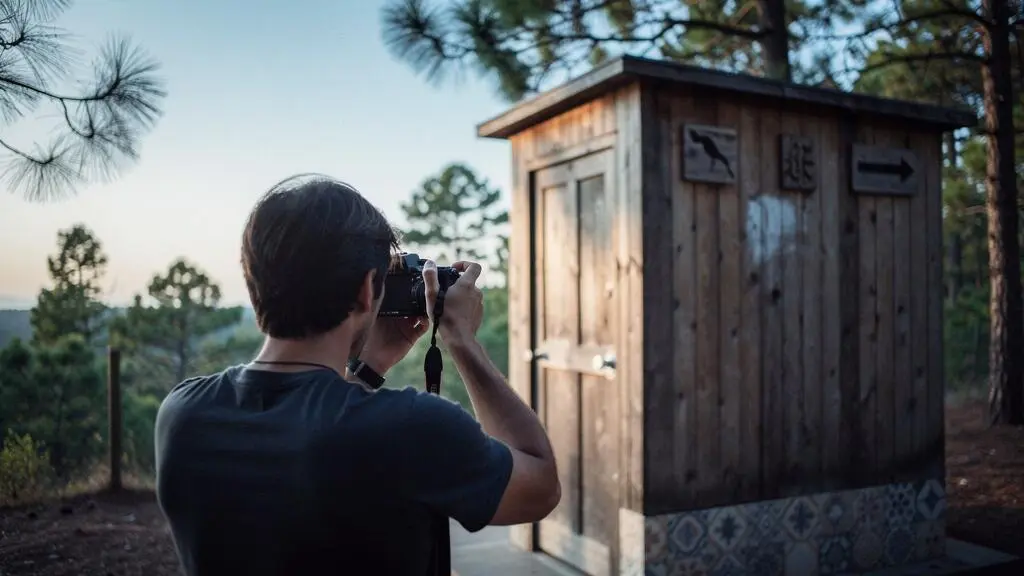
The true quality of campsite bathrooms is revealed not by star ratings, but by specific operational indicators you can evaluate from afar.
- An acceptable pitch-to-toilet ratio (ideally under 15:1) is a foundational metric for preventing queues and overuse.
- Specific keywords in reviews (e.g., “mold,” “blocked,” “smell”) are more reliable red flags than generic negative feedback.
Recommendation: Stop trusting glossy marketing photos and start performing forensic analysis of user reviews and facility specs to match a campsite’s real hygiene standards to your personal comfort requirements.
The promise of the great outdoors can quickly fade at the door of a grim, overcrowded, or unclean campsite bathroom. For any camper who prioritises hygiene, the fear of discovering substandard facilities upon arrival is a significant source of pre-trip anxiety. The common advice—to simply “read reviews” or “look at photos”—is often too vague to be truly useful. Most travellers don’t know what to look for, leaving them to gamble on vague star ratings and polished marketing images.
But what if you could assess the situation with the discerning eye of a public health inspector? The key isn’t just to look, but to know *how* to look. It’s about shifting your perspective from that of a casual holidaymaker to a sanitation facility evaluator. The real story of a campsite’s commitment to cleanliness isn’t in the wide-angle shots of the whole block, but in the close-up of the tile grout. It’s not in the overall 4.5-star rating, but in the specific, repeated keywords used by reviewers.
This guide will not rehash generic tips. Instead, it will equip you with a set of criteria to forensically analyse a campsite’s sanitation before you even book. We will delve into the critical metrics, decode the language of reviews, and reveal the operational signs that separate a truly hygienic campsite from one that simply looks good on the surface. By the end, you’ll have a practical framework for ensuring a campsite’s facilities meet your standards for comfort and cleanliness.
To help you navigate this evaluative process, this article is structured to build your assessment skills step by step. The following summary outlines the key criteria we will cover, from quantitative ratios to qualitative review analysis.
Summary: Assessing Campsite Sanitation Like a Professional
- Why Campsites With More Than 15 Pitches Per Toilet Create Morning Queue Misery
- What Review Keywords Reveal Genuinely Dirty Bathrooms Versus Unfair Complaints
- Once-Daily or Three-Times-Daily Cleaning: Which Campsite Standard Maintains Hygiene
- The Peak Weekend Mistake When Campsites Exceed Safe Sanitation Capacity by 30%
- Private Bathroom Pitches or Shared Facilities: Which Option Suits Your Standards
- How to Check Campsite Bathroom Cleanliness and Sufficiency Before You Arrive
- Wild Camping or Campsites: Which Strategy Sustains Energy Over 3 Weeks
- How to Choose Campsites With Facilities That Match Your Comfort Requirements
Why Campsites With More Than 15 Pitches Per Toilet Create Morning Queue Misery
The most fundamental—and often overlooked—metric for bathroom adequacy is the pitch-to-toilet ratio. Before you analyse a single photo, this number provides a stark indicator of potential comfort or chaos. A campsite might look pristine, but if it has 100 pitches served by only two toilets, you are virtually guaranteed to experience long morning and evening queues. This not only causes frustration but also places immense strain on the facilities, making them harder to keep clean throughout the day.
Industry guidance and regulatory standards often point to a specific threshold. For instance, some regulations mandate a minimum number of fixtures based on campsite numbers. While standards vary, a ratio of more than 15 pitches per single toilet is a significant red flag for hygiene-conscious campers. Considering that an average person might use the toilet up to five times a day, a high ratio inevitably leads to overuse, increased mess, and a higher probability of plumbing issues. It is a simple equation: the more people per fixture, the faster the decline in cleanliness between cleaning cycles.
This quantitative assessment should be your first step. Before getting lost in subjective reviews, look for a campsite map or facilities list. Count the pitches and count the toilets. If the site doesn’t provide this information, it’s a transparency issue in itself. Some of the most well-managed sites are proud of their high-quality facilities and will clearly state the provision levels.
The following table shows how different regulatory bodies approach this issue, highlighting the importance of a clear standard for facility provision. As evidenced by a benchmark like the Colorado Campground Regulation’s 1-per-15 ratio, there’s a recognized need to match infrastructure to user volume.
| Regulatory Standard | Toilet Provision | Shower Provision |
|---|---|---|
| UK Model Standards (sites up to 120 pitches) | 2 women’s toilets + 1 men’s toilet/urinal per 30 pitches | 2 showers each for men and women per 60 pitches |
| Colorado (US) Campground Regulation | 1 sanitary unit per 15 campsites | Not separately specified |
| Virginia (US) Sanitary Facilities Code | Ratio calculated per building within a 500-ft radius of campsites | Minimum 1,024 sq. in. floor area per shower compartment |
Therefore, treat the pitch-to-toilet ratio as a non-negotiable qualifying factor. If the numbers don’t add up, no amount of positive reviews can alter the mathematical certainty of a queue.
What Review Keywords Reveal Genuinely Dirty Bathrooms Versus Unfair Complaints
Once you’ve established a campsite has a reasonable pitch-to-toilet ratio, the next step is to perform ‘keyword forensics’ on user reviews. An overall star rating is a blunt instrument; the real intelligence lies in the specific language used by multiple, independent visitors. The goal is to distinguish between a genuine, systemic hygiene problem and a one-off complaint from a particularly picky guest. The fact that overall cleanliness and sanitary facilities rank among the most important satisfaction factors means campers will talk about them.
Pay less attention to vague, subjective complaints like “the bathrooms weren’t great.” Instead, search for repeated, objective descriptions. A single mention of “a bit dirty” could be a fluke. Three separate reviews from different months mentioning a “persistent smell of drains,” “black mold on the shower curtains,” or “constantly blocked toilets” points to a chronic maintenance failure. These are the operational red flags that management cannot easily hide. A large-scale analysis of over 111,000 campground reviews confirmed the power of this method, using 89 distinct keywords to build objective scores that cut through the noise of simple star ratings.
Conversely, learn to calibrate for “unfair” complaints. A review complaining that facilities are “dated” or “rustic” may not indicate poor hygiene, especially if the same reviewer adds that they were “spotlessly clean.” This simply signals an older building, which may be perfectly acceptable for your standards. The key is to look for patterns. One person’s bad day is an anecdote; multiple people independently describing the same specific failure is data. This forensic approach turns a sea of subjective opinion into a valuable intelligence-gathering exercise.
Your Audit Checklist: Verifying Bathroom Quality
- Information Sources: Identify all channels where sanitation quality is mentioned (official site, booking platforms, review sites, forums).
- Evidence Collection: Inventory existing evidence by taking screenshots of specific photos (fixtures, grout, drains) and copying revealing review keywords (“mold,” “queue,” “smell”).
- Coherence Check: Cross-reference the collected evidence against your personal standards. Does the campsite’s definition of “clean” match yours? Is the pitch-to-toilet ratio acceptable?
- Signal vs. Noise: Distinguish between objective red flags (multiple, specific complaints about “blocked drains”) and subjective, one-off comments (“the tiles weren’t my favorite color”).
- Decision & Integration: Make a go/no-go decision based on your findings. If you decide to book, use the information to plan ahead (e.g., strategize to shower at off-peak times).
By focusing on specific, repeated keywords, you move beyond the emotional reaction of a single camper and begin to see the underlying operational reality of the campsite’s hygiene.
Once-Daily or Three-Times-Daily Cleaning: Which Campsite Standard Maintains Hygiene
A frequently advertised selling point for campsites is the cleaning schedule, often proudly stating “cleaned daily” or even “three times a day.” While this sounds reassuring, an expert evaluator knows that a rigid schedule is less important than a dynamic and responsive cleaning strategy. A single daily clean at 8 AM is of little use if a large group checks out at 11 AM, leaving the facilities in disarray for hours. The true measure of a campsite’s commitment is not the fixed number of cleans, but its ability to maintain standards during periods of high use.
High-authority guidance, such as that provided by the US Forest Service for its recreation sites, emphasizes adjusting cleaning frequency based on observed occupancy and use patterns. A well-managed site will have staff who perform spot-checks and address issues as they arise, especially during peak hours. This is far more effective than a “tick-box” approach of cleaning at set times regardless of need. Look for reviews that mention the *presence* of cleaning staff throughout the day or comments like “the facilities were always being attended to.”
The scale of the operation is also a critical factor. Commercial data from portable restroom providers for large events shows that cleaning frequency is determined by visitor volume, not a universal rule. A small, low-traffic site might be perfectly maintained with one or two thorough cleanings a day. A large, family-oriented resort with a water park, however, will require a near-constant sanitation presence to remain hygienic. Therefore, instead of being impressed by the *number* of cleanings, ask yourself if the advertised frequency is appropriate for the size and type of campsite, especially during its busiest periods.
The ultimate sign of a quality operation is not a rigid schedule, but a flexible system that maintains cleanliness regardless of how busy it gets.
The Peak Weekend Mistake When Campsites Exceed Safe Sanitation Capacity by 30%
Every system has a breaking point. For campsite sanitation, that point is often reached during a sunny bank holiday weekend. A facility that is perfectly adequate for 100 people during a normal week can descend into chaos when occupancy surges and the system is pushed beyond its safe sanitation capacity. This is the peak weekend mistake: booking a site based on its off-season reputation without considering how its infrastructure will cope under maximum stress.
When visitor numbers swell, every potential weakness is magnified. Queues for toilets and showers become intolerably long. Hot water runs out. Bins overflow, and cleaning staff, however diligent, can’t keep pace with the sheer volume of use. The system is no longer just stressed; it has failed. An extreme but illustrative example occurred during a period of reduced staffing in major US national parks. Despite high visitor numbers, sanitation services were minimal. The result was a rapid breakdown of hygiene, with overflowing toilets and accumulated waste forcing officials to close entire campgrounds. It was a stark demonstration of what happens when demand completely overwhelms capacity.
This is where the evaluator’s mindset is crucial. When planning a trip for a peak period, you must be even more stringent in your assessment. That 20:1 pitch-to-toilet ratio you might tolerate in the off-season becomes an absolute deal-breaker. Look for reviews from previous peak seasons. Do they mention the site hiring extra portable toilets or increasing cleaning staff to cope? This is a sign of proactive management. A failure to plan for a surge is a failure of the campsite’s core responsibility.
It’s so heartbreaking. There is more trash and human waste and disregard for the rules than I’ve seen in my four years living here.
– Dakota Snider, Fox News Travel
Don’t assume a campsite that shines in May will cope in August. The best-managed sites anticipate the surge and scale their operations accordingly; the poorly managed ones simply hope for the best, leaving campers to deal with the consequences.
Private Bathroom Pitches or Shared Facilities: Which Option Suits Your Standards
For campers whose hygiene standards are non-negotiable, the rise of the private sanitary pitch offers a compelling solution. This option provides a dedicated toilet, shower, and sink for your exclusive use, effectively eliminating all the variables and risks associated with shared facilities. You are no longer dependent on the cleaning schedule of the site or the considerate behavior of fellow campers. The cleanliness of the facility is entirely within your control.
These premium pitches come in various forms. Some, like those at Wooda in the UK, provide a self-contained unit with a WC, basin, and shower, which is cleaned by staff only between guests. Others, like at the 5-star Lez-Eaux in France, offer a more luxurious cabin with kitchen facilities and optional daily cleaning services. These pitches command a higher price, but for many, the guaranteed privacy, convenience, and hygiene are worth the investment. It transforms the camping experience from a communal negotiation to a private retreat.
Choosing this option is a strategic decision to buy your way out of the shared-facility lottery. However, it’s essential to read the fine print. Does “private” mean a fully-plumbed cabin or a chemical toilet in a tent? Are cleaning products provided for you to maintain the unit during your stay? Is there a separate area for dishwashing? While it removes the risk of other people’s mess, it places the responsibility for day-to-day cleanliness squarely on you. For the hygiene-prioritizing camper, this is often a welcome trade-off, granting control and peace of mind that shared facilities can never truly offer.
Ultimately, this choice depends on your budget and your personal threshold for compromise. If the thought of a shared shower sends a shiver down your spine, a private bathroom pitch might be the single most important factor in ensuring an enjoyable trip.
How to Check Campsite Bathroom Cleanliness and Sufficiency Before You Arrive
The most powerful tool for pre-arrival assessment is the user-submitted photo. While official campsite pictures are professionally lit and staged, photos taken by fellow campers offer an unvarnished glimpse of reality. Your task is to become a forensic photo analyst. Ignore the wide shots and zoom in on the details that reveal the true state of maintenance and cleanliness. With research suggesting that 84% of people trust online reviews as much as personal recommendations, the visual evidence accompanying those reviews is invaluable.
This paragraph introduces a complex concept. To well understand it, it is useful to visualize its main components. The illustration below breaks down this process.
As this image demonstrates, every surface tells a story. Look at the corners of the shower floor. Is there a build-up of dark grout or mold? Check the base of the toilet. Are there signs of long-term grime or discoloration? Inspect metal fixtures like taps and shower heads. Are they clean and shiny, or are they covered in limescale or rust? These are the details that daily cleaning might miss and which point to a deeper lack of deep-cleaning and long-term maintenance. A pristine-looking facility with decaying grout is a classic sign of superficial cleaning.
When analysing photos, you are not looking for a five-star hotel. You are looking for signs of care and consistent maintenance. Clean grout, well-maintained sealant around sinks and showers, and fixtures free from heavy mineral build-up are all positive indicators. Conversely, cracked tiles, peeling paint, and visible mold are significant red flags that no glowing review can erase. Combine this visual analysis with your keyword forensics for a comprehensive picture. If a review mentions “low water pressure” and a photo shows a heavily calcified shower head, you have successfully cross-referenced two sources of data to confirm a likely problem.
This detailed scrutiny turns you from a passive viewer into an active investigator, capable of spotting the difference between a campsite that is genuinely clean and one that just photographs well.
Wild Camping or Campsites: Which Strategy Sustains Energy Over 3 Weeks
For extended trips lasting several weeks, the question of energy management becomes paramount. The romantic ideal of wild camping, with its promise of solitude and self-sufficiency, can be alluring. However, the daily reality of managing hygiene without facilities—digging cat holes, washing in cold streams, carrying out all waste—is a significant energy drain. Over a long period, this can lead to what is known as ‘hygiene fatigue’, where the constant effort detracts from the enjoyment of the trip.
This paragraph introduces a complex concept. To well understand it, it is useful to visualize its main components. The illustration below breaks down this process.
As this image contrasts, serviced campsites offer a crucial resource: reliable infrastructure. Access to clean, functioning toilets and, most importantly, hot showers, is not a luxury on a long trip; it is a vital tool for physical and mental recovery. A hot shower can ease sore muscles, wash away the day’s grime, and provide a powerful psychological reset. Academic studies have repeatedly found that the quality of sanitary facilities is one of the most important factors for overall camper satisfaction. Denying yourself this for three weeks in the name of ‘authenticity’ can be a false economy, leading to burnout.
A more sustainable strategy for a long journey is often a hybrid approach. Plan periods of wild camping interspersed with stays at well-chosen, quality campsites to ‘recharge’. Use the evaluation techniques in this guide to find sites that guarantee a high standard of comfort and cleanliness. This allows you to enjoy the best of both worlds: the freedom of the wilderness and the restorative power of reliable facilities. Over three weeks, the ability to get properly clean and comfortable is what will sustain your energy and enthusiasm, not your ability to endure hardship.
On a long journey, don’t underestimate the profound impact that a simple, clean, hot shower can have on your overall energy and morale.
Key Takeaways
- The pitch-to-toilet ratio is a critical, non-negotiable metric; aim for under 15 pitches per toilet to avoid queues.
- Analyse reviews for specific, repeated keywords like “mold,” “smell,” or “blocked” rather than relying on generic star ratings.
- Effective sanitation relies on a dynamic, responsive cleaning strategy that adapts to user volume, not just a fixed daily schedule.
How to Choose Campsites With Facilities That Match Your Comfort Requirements
Ultimately, the goal of this entire evaluation process is to align a campsite’s facilities with your personal comfort requirements. To do this effectively, you must move beyond the vague “star rating” system and adopt a more granular, tiered approach to your thinking. Not all “clean” facilities are created equal. It’s more useful to categorise them into tiers of quality and provision, from basic to premium.
A useful mental model is a three-tier system:
- Tier 3 (Basic): This is the minimum legal provision. It might involve portable toilets or very basic blocks with cold water only. These facilities may be functional and clean but lack any creature comforts. You’ll spot them by their utilitarian appearance in photos and a lack of any official accreditation signage.
- Tier 2 (Standard): This tier meets the official minimums for a star-rated campsite. You can expect adequately lit blocks with reliable hot and cold water. Reviews will confirm these basics are in place, even if they don’t rave about luxury.
- Tier 1 (Premium): This represents a high standard, often found at sites with top-tier accreditation. Expect heated blocks, powerful showers, disabled access, baby changing stations, and thoughtful design. Photos will show official rating badges, and reviews will consistently praise the facilities as a standout feature.
This tiered framework, inspired by systems used by platforms like Hipcamp, allows you to make a more informed choice. You are no longer asking “is it clean?” but rather “what level of facility am I paying for, and does it meet my needs?”
Recognise that facility quality is often the single biggest driver of campsite pricing. A basic pitch with a portable toilet is a different product entirely from a premium pitch with access to a heated sanitary block. By identifying which tier a campsite’s facilities fall into—based on your forensic analysis of photos, reviews, and specs—you can judge if its pricing is fair and, more importantly, if it will deliver the level of comfort you require to have an enjoyable trip.
Now equipped with this evaluative toolkit, the next step is to apply these principles to your own trip planning. Start scrutinising your next potential campsite not as a tourist, but as the sanitation evaluator you now are, ensuring your standards are met every time.