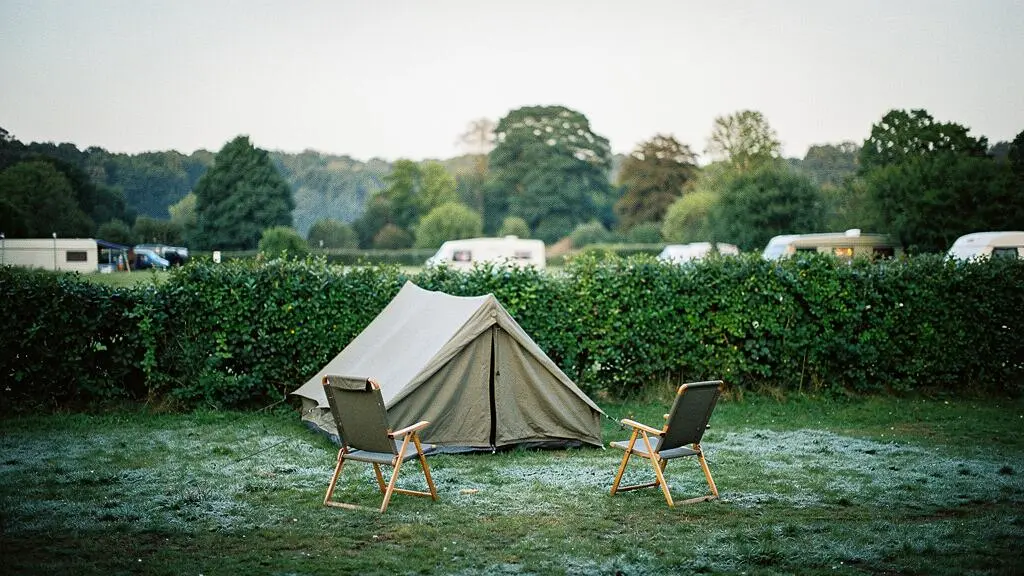
Choosing the right campsite isn’t about the longest facility list, but about decoding the hidden signals of quality and comfort.
- Pitch size is less important than layout and privacy; a large, exposed pitch can feel more cramped than a smaller, well-screened one.
- Bathroom quality can be verified remotely by checking for “facility proxies” like heated blocks, self-contained cubicles, and recent, positive reviews mentioning cleanliness.
- Official awards like AA Pennants are reliable indicators of overall site investment, often correlating with lower density and higher-quality amenities.
Recommendation: Prioritise verifiable quality markers over simple amenity checklists to guarantee a comfortable and relaxing stay.
The dream is a serene escape. The reality can often be a cramped, noisy, and uncomfortable campsite that looked perfect on the website. For families and couples looking to book a trip, the sheer variation in campsite facilities is overwhelming. You scroll through endless lists of amenities—”electric hook-up,” “shower block,” “laundry”—but these words tell you nothing about the actual quality or experience. You’re left wondering which features truly matter and how to avoid the disappointment of a poor choice.
The common advice is to read reviews or check the campsite’s website. But this often leads to more confusion. A five-star review might be from a hardy camper whose needs are completely different from yours. A website will always show its facilities in the best possible light. This approach is a gamble, treating all listed amenities as equal and failing to account for the crucial details that define a comfortable stay: space, cleanliness, and peace.
What if the key wasn’t just to find a site with the right facilities, but to learn how to decode the hidden signals that reveal their true quality? This guide moves beyond simple checklists. It’s a consultant’s approach to facility selection, teaching you to identify the “facility proxies” and “comfort density” metrics that separate a truly great campsite from a merely adequate one. We will explore how to assess space, verify bathroom quality from afar, understand the real meaning of campsite awards, and strategically choose a location that becomes the perfect base for your adventure.
By learning to read between the lines of a campsite’s marketing, you can move from being an overwhelmed camper to a savvy selector, ensuring your next trip matches your expectations for comfort and tranquility. This article provides a structured framework to help you make informed decisions every time.
Summary: A Strategic Guide to Selecting the Perfect Campsite
- Why 80m² pitches feel luxurious while 40m² pitches create claustrophobic camping
- How to check campsite bathroom cleanliness and sufficiency before you arrive
- Adult-only or family-friendly: which campsite type delivers the peace you need
- The school holiday mistake that packs campsites to 150% capacity with noise
- What campsite awards and certifications actually mean for facility quality
- Why 70% of “secluded” campsites are actually crowded during peak season
- How to plot your planned activities on a map to find the perfect accommodation triangle
- How to assess campsite toilet and shower quality from photos and reviews
Why 80m² pitches feel luxurious while 40m² pitches create claustrophobic camping
When choosing a campsite, it’s easy to get fixated on the raw square meterage of a pitch. An 80m² pitch sounds twice as good as a 40m² one, but this number is often misleading. True comfort isn’t just about size; it’s about perceived privacy and psychological space, a concept we can call “comfort density.” A larger pitch that’s open and overlooked on all sides can feel more claustrophobic than a smaller, well-defined pitch enclosed by hedges or trees. The benchmark for a typical standard pitch measures around 78.5m² (based on a 10m diameter circle), but how this space is configured is what truly matters.
The layout of the entire campground has a profound impact on this feeling of space. Key factors to consider are the separation between sites, the width of internal roads, and the placement of amenities. A well-designed site provides enough distance between pitches to create a sense of seclusion without making the walk to the facilities a trek. Wide internal roads prevent the feeling of cars constantly passing right by your tent, which can shrink your perceived personal space dramatically. It’s the balance between convenience and tranquility that defines a luxurious camping experience, not just the number on a booking page.
Before booking, go beyond the listed pitch size. Use satellite views on mapping services to assess the campground’s layout. Look for natural barriers like hedges, trees, or terracing between pitches. Are they arranged in uniform, tightly packed rows, or is there a more organic, spacious design? A campsite that has invested in landscaping to create individual, private spaces understands the real meaning of camping comfort. This visual reconnaissance is your best tool for gauging the true “comfort density” of a site.
How to check campsite bathroom cleanliness and sufficiency before you arrive
Clean and accessible bathrooms are a non-negotiable for most campers, yet they are one of the hardest things to verify before arrival. Website photos are often outdated or strategically cropped, and a single “showers available” checkbox tells you nothing about quality, quantity, or cleanliness. The key is to look for “facility proxies”—indicators that suggest a higher level of investment and care. According to AA quality standards, the gold standard is not open-plan facilities but sites offering designated, self-contained cubicles that include a WC, washbasin, and shower.
Another powerful proxy is heating. The presence of heated toilet blocks is a significant marker of a higher-tier campsite. It shows an investment in year-round comfort and is often a requirement for higher official ratings. For instance, to achieve a 4-star VisitEngland rating, sites need to score at least a 90% on cleanliness, and heated, well-maintained facilities are a huge part of that assessment. Similarly, the prevalence of fully-serviced pitches and electric hook-ups across the site indicates a willingness to invest in infrastructure, which almost always extends to the quality of the shared amenity blocks.
Case Study: How an Independent AA Inspection Verified Shower Block Quality
After a site inspection, an AA assessor upgraded a Dorset touring park from 4 to 5 Pennants. According to the operator, the inspector was particularly impressed by the quality of the shower blocks and amenities. This demonstrates how a genuine, independent inspection can validate bathroom quality claims before you book, giving you confidence that the facilities will meet a high standard.
Your task as a “facility consultant” is to piece together these clues. Don’t just ask if they have showers. Scour the website gallery and recent visitor photos for evidence of these quality markers. Do the washbasins appear to be in private cubicles or in an exposed row? Can you spot any radiators or heating vents? Answering these questions before you book is far more effective than just hoping for the best when you arrive.
Adult-only or family-friendly: which campsite type delivers the peace you need
Beyond physical facilities, the social atmosphere of a campsite is a critical component of comfort. The choice between an adult-only and a family-friendly site is one of the most impactful decisions you can make to tailor a trip to your needs. For couples or individuals seeking tranquility, the promise of an adult-only park is powerful. These sites are specifically designed to be quiet retreats, often with rules against group noise and an emphasis on peaceful surroundings. The appeal is so strong that dedicated groups like Tranquil Parks have built their entire brand around this guarantee.
This lovely adults-only park, a member of the Tranquil Parks group, is set in 30 acres of woodland and offers plenty of pleasant walks.
– AA Caravan & Camping Guide inspector
However, it’s a mistake to assume all family-friendly sites are loud and chaotic. While the potential for noise from children playing is higher, many family-oriented sites are exceptionally well-managed with designated quiet hours and large pitches that provide a buffer. Furthermore, an industry survey shows that only 20% of camping groups include children. This means the majority of your neighbours, even at a family site, will likely be other adults. The key is to assess the campsite’s specific policies and layout. A family site with a dedicated, boisterous play area far from the main pitches can be just as peaceful as an adult-only one.
The decision ultimately comes down to your personal tolerance and priorities. If your primary goal is guaranteed peace and quiet with minimal risk of disturbance, an adult-only site is the most straightforward choice. However, if you’ve found a family-friendly site that is perfect in all other aspects (location, facilities, pitch size), don’t dismiss it outright. Instead, investigate its layout, read reviews that mention noise levels, and check its policies on quiet times. You may find that a well-run family park offers the perfect balance of excellent amenities and a peaceful environment.
The school holiday mistake that packs campsites to 150% capacity with noise
Even the most spacious, well-equipped campsite can feel crowded and uncomfortable under the immense pressure of peak season. The single biggest factor influencing a campsite’s atmosphere is timing, and the most common mistake campers make is underestimating the dramatic impact of school holidays. In England alone, there are tens of millions of domestic camping trips each year, and a huge proportion of this demand is concentrated into just a few weeks in the summer, as well as during half-term breaks.
During these periods, campsites are often operating at or even beyond their comfortable capacity. Pitches are fully booked, facilities face constant queues, and the overall noise level rises significantly. The serene retreat you saw on the website can transform into a bustling, noisy village. Many campers book their main summer holiday and only then consider the implications, by which time it’s too late. The choice is not just between a good or bad campsite, but between a campsite at 60% capacity in June and the exact same campsite at 150% perceived capacity in August.
Testimonial: The Deciding Factor of Timing
The difference between a peaceful stay and a packed site is often just a matter of a few weeks. As one experienced camper noted in a forum discussion, “Not had any issues so far in booking sites for weekends in the south of England during the summer, though most of our trips are outside of the school holidays.” This simple observation highlights a powerful strategy: if you have the flexibility, shifting your travel dates to just outside the main school holidays is the most effective way to guarantee a more peaceful experience.
If you must travel during school holidays, your facility-auditing skills become even more critical. You need to prioritise sites that are better equipped to handle the surge. Look for sites with a higher ratio of facilities to pitches. Multiple, geographically dispersed toilet blocks are better than one central block. A larger number of water points and waste disposal areas will reduce bottlenecks. In essence, during peak season, you are not just choosing a campsite; you are choosing a campsite that has invested in the infrastructure to gracefully manage high-density periods without a catastrophic drop in the quality of experience.
What campsite awards and certifications actually mean for facility quality
In a sea of marketing claims, official awards and certifications can be powerful “signals” to cut through the “noise.” Badges from organisations like the AA, VisitEngland, or other official tourist boards are not just decorative; they are earned through rigorous, in-person inspections. Unlike user reviews, which can be subjective, these ratings are based on a comprehensive set of objective and subjective criteria. As one industry expert notes regarding the AA Pennant scheme, inspectors make a “subjective assessment on the quality of facilities, customer care and the park’s overall landscaping, which is based on their experience.” This expert judgement is invaluable.
These schemes provide a reliable proxy for quality across the board. For example, the highest-rated parks are often required to adhere to strict density limits; top-tier AA parks must maintain a maximum density of 25 touring pitches per acre. This is a tangible metric that directly relates to the feeling of space and comfort discussed earlier. A high rating is therefore a strong indicator that the site not only has good facilities but also isn’t overcrowded. This is a shortcut to finding sites that have already been vetted for the very things you are looking for.
However, not all badges are created equal. Your role as a facility consultant is to differentiate between a meaningful, verifiable award and a generic “quality” or “eco” badge a site may have created for itself. Always look for the name of a recognized inspection body and, if in doubt, cross-reference it on the awarding body’s own website to ensure it’s current. A high official rating is one of the strongest guarantees of a well-run, high-quality site.
Your action plan: Verifying campsite award legitimacy
- Check whether a badge is from an official tourist board or the AA, not a generic marketing scheme.
- Look at what the scheme actually measures, such as cleanliness, heating, maintenance, recreation, and pitch-level services.
- Cross-reference the rating body’s website to confirm the badge displayed on a campsite’s page is current and verifiable.
- Treat unnamed or vague ‘eco’ or ‘quality’ badges with caution unless they are linked to a recognized inspection body.
- Prioritise sites with higher-tier ratings (e.g., 4-5 Pennants) as a reliable proxy for lower density and better overall investment.
Why 70% of “secluded” campsites are actually crowded during peak season
The promise of a “secluded” or “hidden gem” campsite is one of the most powerful draws in travel. We’re all searching for that quiet spot, away from the crowds. However, the title of this section, while provocative, points to a frustrating modern truth: in the digital age, true seclusion is becoming a paradox. The very tools we use to find these hidden spots are often responsible for their overcrowding. Many campsites marketed as “secluded” are simply smaller or more remote, but during peak season, they attract a concentrated influx of people all seeking the same thing, leading to a surprisingly crowded experience.
This phenomenon is amplified by what industry analysts at Roland Berger call the “Instagram effect.” When a beautiful, remote location is geotagged on social media, it can trigger a wave of visitors all wanting to replicate the same perfect photo. A once-quiet campsite can become a “must-visit” destination overnight, completely eroding the seclusion it was once known for. The path to the “hidden” waterfall or the “secret” beach becomes a well-trodden highway, and the peace is shattered.
To find genuine seclusion, you must think counter-intuitively. Instead of searching for sites explicitly labeled “secluded”—a term that has become a marketing buzzword—look for proxies for quietness. Consider larger parks that have designated “quiet zones” or adult-only sections. These areas are often contractually obligated to be peaceful. Alternatively, look at the site’s own rules. A long list of regulations about noise, group sizes, and late arrivals might seem restrictive, but it’s a strong signal that the management actively protects a tranquil atmosphere. True seclusion is no longer found by looking at a map, but by understanding the management philosophy of the campsite.
How to plot your planned activities on a map to find the perfect accommodation triangle
So far, we’ve focused on the campsite itself—the facilities, the space, the atmosphere. But a campsite is also a basecamp. Its location is just as critical to your overall holiday comfort as its shower block. A common mistake is to pick the “perfect” campsite, only to realize it’s a 45-minute drive in the wrong direction from all the beaches, hiking trails, and attractions you want to visit. This adds hours of driving time and stress to your trip, effectively negating the relaxation you were seeking.
The strategic solution is to create an “accommodation triangle.” Before you even start looking at campsites, open a map and plot the top three to five locations or activities you know you want to visit. This could be a specific beach, a national park entrance, a historic town, and a highly-recommended restaurant. These points will form the corners of your activity zone. Your goal is to find a campsite located centrally within this geographic shape, minimizing travel time to all your desired destinations. This turns your accommodation into a strategic asset, not just a place to sleep.
This method forces you to prioritise your itinerary upfront and makes the campsite selection process far more efficient. Instead of searching a wide, overwhelming area, you can now focus your search within your specific, smaller “triangle.” You can then apply all the facility-auditing techniques we’ve discussed to the shortlist of geographically desirable sites. This two-step process—define the location first, then audit the facilities—is the most effective way to find a campsite that is not only comfortable but also perfectly positioned to make your entire holiday more enjoyable and efficient.
Key Takeaways
- Focus on “Comfort Density”: Prioritise pitch privacy, separation, and layout over raw square meterage.
- Use “Facility Proxies”: Look for verifiable quality signals like heated bathrooms and official awards (e.g., AA Pennants) as indicators of overall site investment.
- Master Timing and Location: Avoid peak school holidays if possible and choose your campsite’s location strategically based on your planned activities.
How to assess campsite toilet and shower quality from photos and reviews
You’ve narrowed down your choices, but the nagging doubt about bathroom quality remains. This is where you put on your detective hat and engage in “review forensics.” Instead of just looking at the overall star rating, you need to mine the text of visitor reviews for specific keywords. A study on analysing TripAdvisor reviews published by the National Center for Biotechnology Information found that topics related to overtourism, such as “queuing,” “safety,” and “service,” were highly indicative of negative guest experiences. Search reviews for terms like “queue,” “cold,” “dirty,” “wait,” and “pressure” in relation to showers. The recurring presence of these words is a major red flag that star ratings might hide.
Conversely, look for positive signals. Reviews that specifically mention “hot showers,” “powerful,” “spotless,” or “always clean” are incredibly valuable. Pay more attention to reviews from your own travel season; cleanliness can vary dramatically between a quiet May weekend and a packed August bank holiday. This forensic approach turns vague reviews into actionable data, allowing you to build a much more accurate picture of the day-to-day reality of the facilities.
Combine this with “photo forensics.” Scrutinise every official and user-submitted photo of the amenity blocks. Are the tiles clean and the grout lines crisp? This close-up detail can reveal more than a wide-angle shot. Look for the quality markers we discussed earlier: are there radiators or heating vents visible? Do you see evidence of self-contained cubicles or just open rows of sinks? Note the presence of a motor-home service point; these are expensive to install and often signal a well-maintained, fully-serviced site that takes its facilities seriously. By cross-referencing clues from photos and text, you can build a comprehensive and reliable assessment of what to expect, leaving nothing to chance.
Now, apply this new mindset. Start your next campsite search not by looking at what’s offered, but by investigating the evidence. Become the facility consultant for your own holiday and book your next trip with the confidence that you’ve made the best possible choice for your comfort.