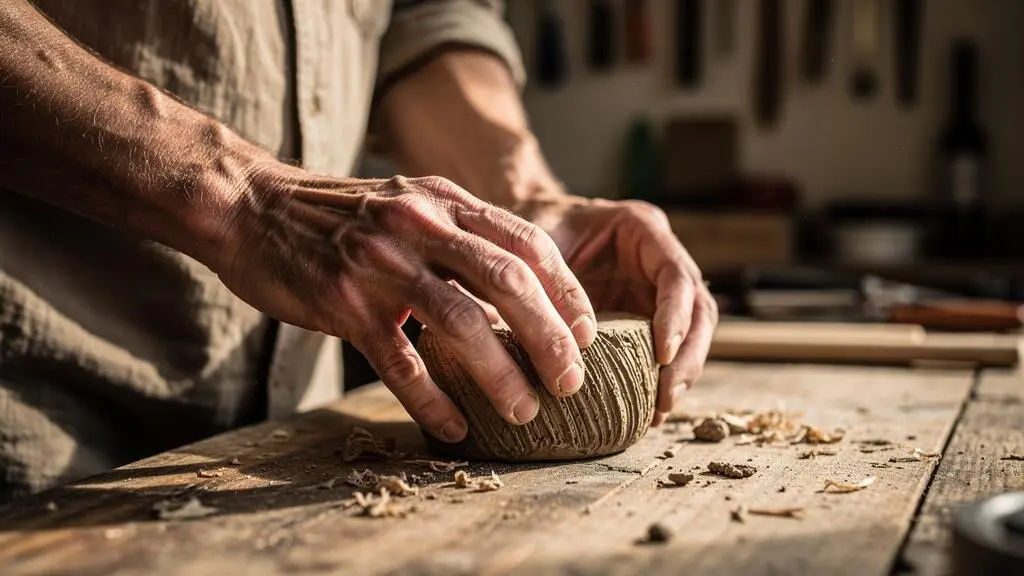
The key to finding authentic crafts is to stop looking for a finished product and start identifying the non-falsifiable “ecosystem of creation” around it.
- Mass-produced items are defined by uniformity and ubiquity; true crafts are defined by the visible evidence of their making—tools, materials, and imperfections.
- Authenticity is confirmed through verifiable systems, from official artisan directories to the unfiltered, working chaos of a genuine studio.
Recommendation: Shift your mindset from a souvenir hunter to a craft detective. Look for the process, not just the price tag, to guarantee you bring home a story, not just an object.
You’ve felt it before: the satisfaction of buying a “locally made” souvenir, only to see the exact same item in a dozen other shops as you walk down the street. That initial joy sours into the quiet disappointment of having fallen for a tourist trap. The common advice—”go to local markets,” “avoid the main square”—is well-meaning but ultimately fails the modern traveler. In a globalized world, mass-produced trinkets disguised as local heritage are the default, not the exception.
These generic tips miss the fundamental truth about craftsmanship. They teach you to judge a book by its cover, or rather, a craft by its location. But what if the secret wasn’t about *where* you look, but *how* you look? What if the most reliable method was to ignore the finished object and instead search for the undeniable evidence of its creation? This guide is built on that premise. It’s not about finding a better shop; it’s about learning to see the ecosystem of creation—the tools, the mess, the specialized focus, and the maker’s story—that mass production can never replicate.
We will explore how to distinguish a working studio from a staged storefront, use official directories to find verified masters, and understand the subtle clues that separate a true cultural artifact from a factory-made lie. By the end, you will have a new framework for seeing, a reliable method for detecting authenticity that works in any market, in any country.
Contents: How to Find Genuinely Handmade Crafts
- Why Seeing the Workspace and Tools Guarantees You’re Buying Genuinely Handmade Items
- How to Find Verified Artisan Directories That List Genuine Craftspeople by Region
- Gallery Artisan Goods or Direct Workshop Purchase: Which Guarantees Authentic Handmade Items
- The Craft Shop Lie That Sells Chinese Factory Goods as Local Handmade Items
- What Price Range Reflects True Artisan Labour Versus Exploitative Tourist Premiums
- Why Unmarked Standing Stones and Village Crosses Reveal Deeper History Than Tourist Castles
- Why Ticketed Folk Performances Rarely Reflect Actual Living Cultural Practices
- How to Participate in Regional Traditions Without Offending Locals or Appearing Exploitative
Why Seeing the Workspace and Tools Guarantees You’re Buying Genuinely Handmade Items
The most powerful tool for verifying authenticity isn’t an app or a guidebook; it’s your own eyes. A genuine artisan’s workspace is an ecosystem of creation, and it’s nearly impossible to fake convincingly. It’s characterized by a functional, often chaotic, collection of tools, raw materials in various stages of completion, dust, scraps, and the beautiful imperfections of work-in-progress. This environment is the production signature of a real maker, something a mere reseller can never replicate. A retailer’s space is designed for selling; an artisan’s space is designed for making.
Look for specificity. Does the person work with a single material, like leather, silver, or a particular type of wood? True artisans are specialists. A shop selling pottery alongside screen-printed t-shirts and plastic keychains is a retail outlet, not a workshop. The presence of well-worn tools, a dedicated workbench, and half-finished pieces are undeniable proof of an active creator. The air might smell of sawdust, clay, or turpentine—the authentic perfume of craft.
This focus on the process over the product is a core principle. A real workspace tells a story of skill, time, and dedication that a sterile, perfectly arranged shop cannot. This is perfectly illustrated by organizations that build their model around this transparency.
Case Study: Artisans Angkor, Cambodia
Artisans Angkor in Cambodia offers a powerful example of this principle in action. It stands in stark contrast to the nearby tourist markets filled with knock-offs. The organization provides guided tours where visitors can observe the entire production line, from stone carving to silk painting. While there is a stylish shop attached with slightly higher prices, the value comes from witnessing the full creation process. As travel logs note, these guided tours of workshops showcase traditional crafts, proving that a genuine workspace, even one open to the public, is the ultimate guarantee of authenticity.
How to Find Verified Artisan Directories That List Genuine Craftspeople by Region
While on-the-ground detection is crucial, your search for authentic crafts can begin long before you travel. Many countries and international bodies maintain official registers of recognized artisans, providing a pre-vetted list of genuine makers. These directories cut through the noise of the tourist market by elevating craftspeople who have been certified for their skill and commitment to traditional techniques. They are the antithesis of an anonymous souvenir stall.
A prime example is the UNESCO Intangible Cultural Heritage list. While broad, it serves as a massive database of cultural practices worth preserving, from specific weaving techniques to unique pottery styles. A search of this list for your destination can reveal traditions you may not have known about, giving you a specific craft to look for. According to its own records, the list now includes more than 678 elements across 140 countries, making it an invaluable starting point for your research.
On a national level, some countries have highly structured systems for recognizing master craftspeople. These titles are not handed out lightly; they often represent a lifetime of dedication and a formal commitment to passing on skills to the next generation. Researching these systems for your destination can lead you directly to the studios of the most respected artisans in the nation.
A comparison of two such systems highlights their value for the authenticity-seeking traveler. Both serve as a powerful filter, ensuring that anyone holding the title is a practitioner of the highest caliber, as a comparative look at national systems reveals.
| System | Country | Managing Body | Year Established | Distinguishing Feature |
|---|---|---|---|---|
| Ningen Kokuhō (Living National Treasure) | Japan | Ministry of Education, Culture, Sports, Science and Technology | 1950 (law) / term formalized 1993 | State-designated individuals certified to safeguard and transmit skills; comes with an annual government subsidy |
| Maître d’Art | France | French Ministry of Culture | 1994 | Title awarded for life, requires a formal three-year master-apprentice transmission commitment backed by financial support |
Gallery Artisan Goods or Direct Workshop Purchase: Which Guarantees Authentic Handmade Items
Once you are on the ground, you face a choice: buy from a curated gallery or seek out the artisan’s workshop directly. While buying directly from the maker you’ve just watched work is the gold standard, it’s not always practical. This is where a good curator—be it a gallery owner, a cooperative manager, or a specialized tour guide—can act as a trusted bridge to authenticity. The key is to distinguish a true curator from a simple reseller.
A high-quality craft gallery operates on a foundation of trust and expertise. The owner has a personal relationship with the artists they represent. They can tell you the story behind each piece, the materials used, and the history of the artisan. Their reputation is built on the authenticity of their collection. In contrast, a reseller’s shop feels impersonal, with staff who lack deep knowledge of the items. If they can’t tell you who made it and how, it’s a red flag.
Specialized tour guides and travel companies can also provide this curated access. They invest time in finding and vetting real artisans, opening doors to studios that a normal traveler would never find. As one curated travel specialist explains, the goal is to provide genuine entry into real working spaces where people make their living, ensuring every studio reflects the culture and materials of the place.
With so many artisans in Florence, she took us to true experts in their craft… it was the opportunity of a lifetime to visit places and get to see things made by hand.
– Traveler review of a curator-led tour
This testimony highlights the value of a passionate curator. They don’t just sell you an object; they provide access to an experience and a story. This is the crucial difference. A purchase from a trusted gallery or through a curated tour still connects you to the maker’s story, even if you’re not in the workshop itself. It’s a far cry from an anonymous transaction in a souvenir shop.
The Craft Shop Lie That Sells Chinese Factory Goods as Local Handmade Items
The biggest threat to finding authentic crafts is the “Identikit Souvenir.” This is the industry term for mass-produced items made in large, often overseas, factories and then stamped with different city or country names to be sold as local products. Whether it’s a “traditional” mask, a “hand-painted” ceramic, or a “local” textile, these items are designed to deceive. They look just plausible enough to fool an unsuspecting tourist, but they lack any real connection to the place they are sold.
The most telling sign of an Identikit Souvenir is uniformity. Hand-making things is an imperfect process; no two pieces are ever identical. If you see shelves lined with dozens of objects that are carbon copies of each other, you are looking at factory products. The lack of variation is the fingerprint of the machine. Real handmade items will have slight differences in size, color, or finish—the unique production signature of the human hand.
Another dead giveaway is ubiquity. If you see the exact same “handmade” item in multiple, unaffiliated shops along a tourist street, it’s a clear signal of mass distribution. A true artisan’s work is typically sold in one place: their studio, a specific gallery, or a cooperative they belong to. They do not have the capacity or the business model to supply every souvenir shop in town.
Case Study: The ‘Identikit Souvenir’ Supply Chain
Investigations into tourist shop inventory reveal a consistent pattern of deception. Items made in the same factories are distributed globally and branded locally. An analysis of this trend confirms that whether it’s a plastic Eiffel Tower or a so-called ‘traditional’ mask that was actually mass-produced in Asia, these items are designed to sever the connection between product and place. The context of where an item is sold—surrounded by other generic tourist goods—is often the most reliable warning sign of its factory origin.
To avoid this trap, train your eye to look for the subtle imperfections and variations that signal human creation. Run the “duplicate test”: if you see it everywhere, it’s from nowhere. Trust shops that have a narrow, specialized focus over those that sell a little bit of everything. A shop dedicated only to handmade lace is far more likely to be authentic than one that also sells magnets and t-shirts.
What Price Range Reflects True Artisan Labour Versus Exploitative Tourist Premiums
Price is often the most confusing part of buying handmade goods. How do you know if you’re paying a fair price for an artisan’s skill or just an inflated “tourist premium”? The answer lies in shifting your mindset from material cost to labor value. You are not just buying wood, clay, or thread; you are buying the hours, days, or even months of a skilled person’s life that went into transforming those materials.
A price that seems high for a small object might be entirely reasonable when you consider the labor involved. A tiny, intricately woven basket could represent days of focused work. Before you balk at a price, respectfully ask about the process. “How long did this take to make?” or “What are the steps involved?” A genuine artisan will be proud to share their process, and their answer will instantly reframe the value of the object. A reseller will have no idea and will likely pivot to a generic sales pitch.
Case Study: A Hand-Woven Rug in Mexico
One traveler’s experience in Mexico perfectly illustrates this concept. After spending a day at a natural dyeing and weaving workshop with a women’s co-operative, the traveler decided to buy a piece. As they recounted, they were happy to pay the asking price after purchasing a rug from the artisan who had spent six months weaving it. The understanding of the immense time and skill invested made the price more than fair. The traveler explained that the piece was far more special than any other because the story and the labor behind it were known.
Haggling can also be a minefield. In many cultures, bargaining is expected, but in an artisan’s studio, it can be insulting. A good local guide can tell you when it’s appropriate. As a general rule, if a price is clearly marked and the seller is the creator, it’s best to assume the price is fixed. Aggressive haggling over a few dollars devalues the artisan’s life’s work. Instead of asking for a discount, consider buying multiple items or simply paying the fair price for a unique piece of art.
Action plan: Calibrating a Fair Price Before You Buy
- Initial Reconnaissance: Before committing, visit several different outlets (workshops, galleries, markets) to get a baseline understanding of prices for similar types of work.
- Assess the Seller’s Demeanor: Be wary of high-pressure tactics. A confident artisan with fair prices will let you browse calmly and appreciate the work without rushing you.
- Ask About the Process, Not the Price: Inquire about the time, materials, and techniques involved. This demonstrates respect and helps you understand the object’s intrinsic value.
- Understand Haggling Etiquette: Ask a local guide or hotel concierge when bargaining is culturally appropriate and when it’s considered an insult to the maker. Never haggle in a high-end gallery or if prices are clearly marked in a studio.
- Final Value Judgment: Make your decision based on the story, the connection to the maker, and the perceived labor, not just the raw material cost.
Why Unmarked Standing Stones and Village Crosses Reveal Deeper History Than Tourist Castles
This title, though seemingly about historical sites, offers a powerful metaphor for finding authentic crafts. Tourist castles are the big, loud, obvious attractions. They are the equivalent of the sprawling souvenir emporiums with bright lights and “Handmade” signs. They are designed for mass consumption. In contrast, an unmarked standing stone or an old village cross is a quiet, subtle testament to a deeper, more authentic history. It requires a keener eye and a bit of knowledge to appreciate, but the connection it offers is far more profound.
The same is true in the world of crafts. The “tourist castles” are the generic products—the vaguely “celtic” knotwork made in a factory, the “tribal” mask that has no tribe. The “unmarked stones” are the subtle details that prove authenticity to a trained eye. These are the specific types of local wood an artisan uses, a regional weaving pattern that tells a story, or a glazing technique unique to a single village. These are details a mass-producer would never bother to replicate because they have no meaning to a mass audience.
To find these “unmarked stones,” you must do a little homework. Before you travel, research the specific craft traditions of the region. Don’t just search for “pottery in Tuscany”; search for “Montelupo ceramics” or “the Zaffera a Rilievo technique.” Knowing these specifics transforms you from a generic tourist into a knowledgeable seeker. When you walk into a workshop and can recognize a specific local detail, you are no longer just a customer. You are an appreciative observer, and this shared knowledge can create an instant bond with the artisan.
So, learn to walk past the tourist castles. Tune your senses to the quieter, more telling signs of authenticity. Look for the potter who uses a local clay you’ve read about, or the weaver whose patterns match the historical textiles in the local museum. These are the true artifacts, the unmarked stones that hold the real story of a place and its people.
Why Ticketed Folk Performances Rarely Reflect Actual Living Cultural Practices
A “traditional” folk dance performed on a stage for a ticketed audience is a performance, not a practice. It is culture packaged for consumption. The same distinction exists in the world of crafts. Beware the “artisan performance”—the person sitting in a pristine shop window, listlessly weaving a few threads or painting a pre-made pot. This is often just a marketing gimmick, a human diorama designed to create a false impression of authenticity.
A real working artisan is not performing. They are working. Their focus is on the object in their hands, not on the tourists watching them. The environment will be one of function, not presentation. There might be loud machinery, focused silence, or chatter with fellow workers. They might not even notice you at first. This is a good sign. You have stumbled upon real practice, not a staged performance. The goal is creation, not entertainment.
A staged performance is clean, predictable, and repetitive. The “artisan” might perform the same simple action over and over. A real workshop is dynamic and varied. You might see an artisan wrestling with a difficult piece, carefully measuring, or switching between different tools and tasks. You will see the full lifecycle of the craft: the raw materials, the messy middle stages, and the finished products. The performance shows you a single, sanitized step; the practice reveals the entire, complex process.
To avoid being fooled by these displays, apply the same logic you would to a folk performance. Ask yourself: is this for me, or was it happening anyway? If the activity would stop the second tourists left, it’s a performance. If the work is the primary reason for the activity, you are likely witnessing a genuine living tradition. Seek out the spaces where the work itself is the star of the show, not the maker.
Key Takeaways
- Authenticity is proven by the “ecosystem of creation”: look for tools, raw materials, and a workspace designed for making, not just selling.
- Uniformity is the signature of the machine. Seek out the slight imperfections and variations that are the hallmarks of the human hand.
- Shift your valuation from material cost to labor value. A fair price reflects the hours of skill and dedication invested in the craft.
How to Participate in Regional Traditions Without Offending Locals or Appearing Exploitative
Once you’ve found a genuine artisan, the final step is to engage respectfully. Your goal is to be a welcome guest, not an intrusive tourist. This requires awareness and a shift in posture from a consumer to a respectful observer. The most rewarding interactions are not transactions; they are exchanges of appreciation and understanding.
The best way to start is often through an intermediary. As leading travel guides suggest, an excellent way to discover hidden artisan treasures is by hiring a local guide who has existing relationships. They can make introductions, translate, and explain cultural etiquette, ensuring your visit is welcome. If you approach a studio on your own, always ask permission before entering or taking photos. A simple, polite gesture like “Hello, may I look?” goes a long way.
Show genuine interest in the process, not just the product. Ask questions about the craft, the materials, or the history. Listen more than you talk. This demonstrates that you value their skill and heritage. This approach can transform a simple shopping trip into a memorable cultural exchange. Many artisans are the last practitioners of their craft and are eager to share their knowledge with someone who is genuinely curious.
Finally, when it comes to purchasing, do so with grace. If prices are fixed, pay them without argument. If you choose not to buy, thank the artisan for their time. Your respectful engagement is a form of support in itself. By prioritizing ethical engagement and genuine connection, you not only acquire a beautiful, authentic object, but you also contribute positively to the preservation of a cultural tradition. Consider these steps for a more meaningful interaction:
- Start with a Guide: Use a knowledgeable local guide to make introductions and bridge any language or cultural gaps.
- Ask for Permission: Always ask before entering a private workshop, taking photographs, or handling objects.
- Show Genuine Curiosity: Ask about the process, the materials, and the history of the craft. Listen intently to the answers.
- Consider a Commission: For a truly unique souvenir and a deeper connection, ask about commissioning a custom piece.
- Purchase Respectfully: Pay the asking price without aggressive haggling, and thank the artisan for their time, whether you buy something or not.
Now that you are equipped with this new lens, your next trip can be different. Instead of passively consuming, you can actively engage, appreciate, and support the living traditions that make our world so rich. Apply this mindset, and you will not only bring home a more meaningful souvenir, but you will also become a better, more conscious traveler.