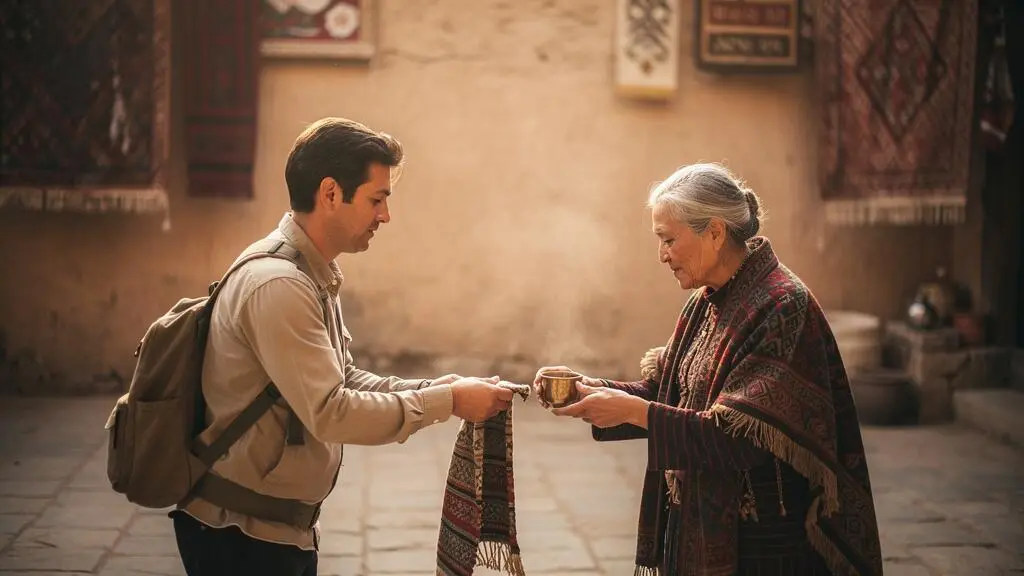
Contrary to popular belief, respectful travel isn’t about memorising a list of rules. It’s about understanding the crucial difference between a performance staged for tourists and authentic, living culture. The key lies in mastering a framework of ethical judgment to know your role—when to be a quiet observer versus an invited participant. This guide provides the tools to shift from a consumer of culture to a truly respectful guest.
For the culture-curious traveller, the desire to connect with a place on a deeper level is a powerful motivator. You’ve journeyed thousands of miles not just to see the sights, but to experience the pulse of a community, to witness its traditions, and maybe even share in a moment of its daily life. Yet, this desire is often shadowed by a significant fear: the fear of getting it wrong. The dread of being perceived as an intrusive, clumsy, or exploitative tourist—the very thing you are trying not to be—can be paralysing.
Standard travel advice often provides a superficial checklist: learn a few phrases, dress modestly, ask before taking photos. While well-intentioned, these rules are merely the starting point. They don’t equip you with the nuanced understanding needed to navigate complex social situations. They don’t explain the vast difference between a ticketed, polished folk dance and a spontaneous village ceremony, or why your presence might be welcomed at one and feel intrusive at the other. True cultural engagement isn’t about following rules; it’s about developing an ethical intuition.
But what if the key wasn’t in having all the answers, but in learning how to ask the right questions? What if the most respectful act was not always participation, but thoughtful observation? This article moves beyond the platitudes to offer a durable framework for what we’ll call calibrated engagement. It’s a mindset focused on understanding context, discerning your role, and knowing when to step forward and when to hold back. We will explore how to differentiate between staged attractions and living culture, master the art of ethical research, and ultimately find a more authentic connection by sometimes seeking out the quiet history hidden just off the main road.
This guide is structured to build your confidence as a respectful traveller, moving from the philosophical ‘why’ to the practical ‘how’. The following sections will equip you with the insights and tools needed to engage with local traditions authentically and ethically.
Summary: A Traveller’s Guide to Ethical Cultural Engagement
- Why Ticketed Folk Performances Rarely Reflect Actual Living Cultural Practices
- How to Research Cultural Event Etiquette to Avoid 5 Common Tourist Mistakes
- Festival Attendance or Daily Life Observation: Which Reveals Deeper Cultural Understanding
- The Photo-Taking Mistake That Offends Participants in 60% of Cultural Events
- When Should You Join Cultural Activities Versus Respectfully Observe From Distance
- Why Unmarked Standing Stones and Village Crosses Reveal Deeper History Than Tourist Castles
- How to Check if a Destination Has Active Cultural Life or Just Tourist-Facing Attractions
- How to Find Untouristed Historical Landmarks Within 5 Miles of Major Routes
Why Ticketed Folk Performances Rarely Reflect Actual Living Cultural Practices
The colourful flyer promises an “authentic evening of traditional dance,” complete with dinner and transportation from your hotel. For many travellers, this is the most direct and accessible way to engage with local culture. However, it’s crucial to understand that what you are often witnessing is a phenomenon sociologists call “staged authenticity.” This isn’t necessarily a deceit; it’s a performance created specifically for an audience, packaged for consumption. The traditions on display are real, but they have been removed from their original context, timing, and community-centric purpose to fit a tourist’s schedule and expectations.
The sociologist Dean MacCannell first explored this concept, which cultural preservationists continue to debate. As Cultural Survival magazine notes, this is often about “the staging of local culture to create an impression of authenticity for a tourist audience.” A ritual that might have originally lasted for days, involved specific families, and occurred at a certain time of year is condensed into a 90-minute spectacle. The meaning changes when the audience shifts from community members reaffirming their heritage to paying visitors seeking entertainment. It becomes a cultural product rather than a living practice.
the staging of local culture to create an impression of authenticity for a tourist audience
– Dean MacCannell (concept as described by Cultural Survival), Cultural Survival Quarterly — “Cultural Authenticity”
This does not mean these events have no value. In many cases, as illustrated by events like the Deccan Festival in Hyderabad, the revenue from ticketed performances can be a vital economic engine. It can provide income for artists and fund the preservation of the very crafts and traditions being showcased. The key for the respectful traveller is to see these events for what they are: a curated introduction, a “cultural appetizer.” They are a valid part of the tourism ecosystem, but they are not a substitute for witnessing culture as it is lived and practised organically within the community.
How to Research Cultural Event Etiquette to Avoid 5 Common Tourist Mistakes
Once you move beyond staged performances and seek out more authentic cultural events—a local festival, a market day, a religious procession—the need for preparation intensifies. Entering a space where you are a guest, not a ticket-holder, requires a proactive effort to understand the local norms. Failure to do so is the source of the most common and cringe-worthy tourist mistakes: inappropriate dress, disruptive behaviour, misinterpreting gestures, violating sacred spaces, and, of course, thoughtless photography. The antidote to all five is rigorous, multi-layered research before you even arrive.
Your research should go beyond a quick search for the “Top 10 Rules.” Start with broad-stroke resources and then drill down. As travel experts at Tohu Travellers suggest, you should consult cultural etiquette guides, travel forums or apps like Culture Trip or TripLingo for foundational knowledge. These provide the general “dos and don’ts” regarding greetings, dress codes, and gift-giving. This first layer of research helps you avoid the most obvious blunders.
Next, dig deeper by cross-checking information on forums like Tripadvisor or local expat blogs. Here, you’ll often find nuanced advice from other travellers and locals who flag specific behaviours relevant to the event you plan to attend. For example, they might mention that while photography is generally allowed, it’s deeply offensive during a specific portion of a ceremony. Pay attention not just to what is said, but what is conspicuously absent from tourist promotions. If official materials show photos of the vibrant parade but none of the quiet temple ritual that precedes it, that silence is a powerful clue that the latter is a private, community-only moment. This deep research is your ethical compass, guiding you toward respectful observation.
Festival Attendance or Daily Life Observation: Which Reveals Deeper Cultural Understanding
Festivals are dazzling, concentrated bursts of culture. They offer a spectacle of colour, sound, and tradition that can be an unforgettable highlight of any trip. Yet, they are, by their nature, exceptional moments. A far deeper, if quieter, understanding of a culture often comes from observing the subtle rhythms of everyday life. The way people greet each other in a market, the posture of prayer at a local shrine, the social dynamics of a family meal—these small, un-staged moments reveal the cultural baseline from which festivals erupt.
Observing daily life is an exercise in mindfulness and adaptation. It requires you to slow down and pay attention. Spend an afternoon in a public square or a local café, not with a checklist of sights, but with the simple goal of observing. Notice the non-verbal cues: how close do people stand when they talk? Are interactions boisterous or reserved? How are elders treated? This practice of passive observation helps you absorb the unspoken rules of a society. You begin to understand the context behind the traditions you might see later.
A simple checklist can guide this process:
- Learn Basic Phrases: A simple “hello,” “thank you,” or “excuse me” in the local language signals respect before you even begin an interaction.
- Dress for Context: Observe how locals dress not for a party, but for a normal Tuesday. Aim to blend in, especially when visiting religious or culturally significant areas.
- Observe, then Adapt: Watch how people behave in markets, on public transport, and in queues. By mirroring these patterns, you demonstrate a willingness to adapt rather than impose your own norms.
- Withhold Judgment: Avoid making assumptions about gestures or customs you don’t understand. A gesture that is friendly in your culture might be rude in another. Assume you are the one who lacks context.
Ultimately, a festival and daily life offer two different lenses. The festival is the culture’s exclamation point; daily life is its grammar. To truly understand the language of a place, you need both.
The Photo-Taking Mistake That Offends Participants in 60% of Cultural Events
The title’s “60%” figure isn’t a verifiable statistic, but a representation of a widespread problem: the act of raising a camera without first establishing a human connection. The single greatest mistake a traveller can make is viewing a cultural moment as a photo opportunity first and a human experience second. In that instant, the camera ceases to be a tool for memory and becomes a barrier, a psychological wall that transforms participants into subjects and the photographer into an extractor. It breaks the very connection the traveller was hoping to feel.
This is especially true in sacred ceremonies or intimate community gatherings. Asking for permission is the absolute minimum, but even a “yes” can be given reluctantly out of politeness. The ethical traveller must go further, understanding that, as the experts at Crooked Compass Travel put it, ethical photography “is an exchange of trust, responsibility, and respect.” It’s not a transaction. The most meaningful photographs often come after you’ve put the camera down, engaged with people, shared a smile, and shown genuine interest in what they are doing. Permission is then given not to a tourist, but to a person who has taken a moment to connect.
This image of the camera’s shadow creating a barrier between two hands poignantly illustrates the psychological distance a lens can create. It interrupts the flow of human interaction, turning a shared moment into a one-sided observation.
Before raising your camera, ask yourself: Why do I want this photo? Is it to prove I was here, or is it to remember a genuine connection I have made? Often, the most powerful and respectful decision is to leave the camera in your bag and simply be present. The memory of the moment, unfiltered by a lens, is frequently more valuable than the picture. Your ethical gaze is more important than your photographic one.
When Should You Join Cultural Activities Versus Respectfully Observe From Distance
You’re at a local celebration. There’s music, dancing, and an infectious energy. An inner voice urges you to join in, to be part of the moment. But another voice whispers a warning: are you welcome? Is this an open invitation, or are you about to intrude on something deeply personal? This is the central dilemma of calibrated engagement, and navigating it is an art, not a science. There is no universal rule; the answer depends entirely on context, and your primary role is to learn to read it.
The default and most respectful stance is always that of a quiet observer. Your presence should be small and unobtrusive. From a distance, you can watch for cues. Is the event demarcated, with clear areas for onlookers? Are other outsiders present, and how are they behaving? Most importantly, watch for invitations, both verbal and non-verbal. A direct “Come, join us!” is unambiguous. But so is a warm, repeated smile, a nod of the head in your direction, or a gesture to come closer. These are signs that your presence has been noted and is welcomed.
Conversely, you must be equally attuned to signals of exclusion. A lack of eye contact, people turning their backs, or a sudden quietness as you approach are clear indicators to keep your distance. As travel experts note, a request to participate or take a photo might be accepted in one context but “could be refused, especially when it comes to elders or sacred ceremonies.” The sanctity of a moment always outweighs your desire for an experience. If you are unsure, the answer is always to observe. There is immense value and respect in being a silent, appreciative witness.
Your Action Plan: Assessing Your Role in a Cultural Moment
- Identify Points of Contact: Who are the hosts or leaders? Is there an official information point, or is it an informal gathering where you must rely on observing social cues?
- Collect Contextual Clues: Take inventory. Are there designated tourist areas? Are locals and outsiders mixing freely? Is the atmosphere solemn or celebratory?
- Check for Coherence: How does the activity align with what you researched? If you read that a ceremony is private, but it appears open, err on the side of caution. Your research provides the baseline.
- Gauge Emotional Tone: Look for signs of reciprocity versus tolerance. Are people making warm eye contact and smiling (invitation), or are they politely ignoring you (tolerance)? This is your most important signal.
- Formulate a Participation Plan: If you receive a clear invitation, your plan is to accept gracefully. If signals are ambiguous or negative, your plan is to remain a respectful observer, perhaps smiling and nodding to show appreciation from a distance.
Why Unmarked Standing Stones and Village Crosses Reveal Deeper History Than Tourist Castles
Grand tourist castles, with their imposing walls and reconstructed battlements, tell a story of power, conflict, and nobility. They are the headline acts of history, designed to impress and dominate the landscape. While fascinating, they often represent the history of a tiny, elite fraction of the population. A deeper, more intimate history—the story of everyday people, their beliefs, their boundaries, and their daily journeys—is often found in much quieter, humbler landmarks: the unmarked standing stone in a farmer’s field, the weathered market cross in a village square, or the worn steps of an ancient chapel.
These landmarks are history written into the landscape at a human scale. A standing stone may have marked a seasonal gathering place, a territorial boundary, or a celestial alignment for an ancient community. A village cross wasn’t just a religious symbol; it was the heart of the market, the place for public proclamations, and the starting point for local processions. Unlike a castle, which was built to exclude, these markers were points of congregation and daily interaction. They speak to a history of community, not of conquest.
The absence of signposts, ticket booths, and audio guides is precisely what makes these sites so powerful. They demand more from the traveller: imagination, research, and a moment of quiet contemplation.
Standing before an ancient, lichen-covered stone in the morning mist, you are not a consumer of history; you are a visitor in its presence. It forces you to wonder: who placed it here? What did it mean to them? What seasons has it witnessed? It connects you to the timeless, cyclical, and anonymous history of the land itself, a story far older and more universal than that of any single king or battle.
How to Check if a Destination Has Active Cultural Life or Just Tourist-Facing Attractions
In an era where cultural tourism is estimated to represent ~40% of all tourism activity, a significant industry has emerged to meet that demand. The challenge for the authenticity-seeking traveller is to peer behind the curtain of this industry and determine if a destination has a vibrant, living culture or if its traditions have been hollowed out and are now performed primarily for visitors. Distinguishing between a town with a soul and a well-designed theme park is a crucial skill.
The first clue is to analyse the town’s calendar of events. Look for festivals, markets, and holidays that seem to be scheduled for the benefit of locals, not tourists. Do major events happen outside of the peak tourist season? Are they mentioned more prominently on local government websites (in the local language) than on international tourism portals? A community that celebrates for itself, regardless of who is watching, has a strong cultural pulse.
Another powerful technique is to scrutinise the local economy. Move a few blocks away from the main tourist street. Are there shops catering to residents—bakeries, hardware stores, local tailors? Or does every storefront sell souvenirs and tour packages? A living community needs the infrastructure of daily life. The presence of schools, libraries, and active community centres are all signs of an active cultural life, not just a tourist-facing facade. Use online map tools to look for these institutions before you even book your trip.
Finally, look for signs of cultural evolution, not just preservation. Is there a contemporary art scene? Are young musicians reinterpreting traditional songs? A healthy culture is not a museum piece; it’s a living, breathing entity that changes and adapts. The presence of modern creativity alongside ancient tradition is the surest sign you have found a place with a truly active and authentic cultural life.
Key Takeaways
- Distinguish ‘Staged Authenticity’ from Living Culture: Recognise that ticketed performances are cultural products, not organic practices.
- Your Default Role is Observer: Presence should be small and unobtrusive. Participate only when there’s a clear, unambiguous invitation.
- Proactive Research is Non-Negotiable: Move beyond basic rules to understand the specific context and etiquette of an event or place before you arrive.
How to Find Untouristed Historical Landmarks Within 5 Miles of Major Routes
The greatest historical treasures are often hidden in plain sight, just a short detour from the major highways and tourist thoroughfares you’re already travelling on. The key to discovering these forgotten chapels, ancient boundary stones, and abandoned mills lies in moving beyond commercial maps like Google Maps, which are designed for efficiency, and embracing the world of open-source and hobbyist cartography. These community-driven tools are built by and for people passionate about a place, who often document features that commercial interests ignore.
Case Study: Using OpenHistoricalMap to Find ‘Ghost’ Landmarks
A powerful tool for the history-minded traveller is OpenHistoricalMap. Built on the same technology as OpenStreetMap, this collaborative project is designed to map the world as it used to be. It preserves multiple versions of features over time. For a traveller, this is a goldmine. By cross-referencing an old topographical layer from OpenHistoricalMap with a modern map, you can spot the ghostly footprints of forgotten mills, old fords, abandoned roadbeds, or ruined chapels that are located just a few hundred yards from the modern highway, completely invisible to the average tourist.
Platforms like OpenStreetMap (OSM)—the Wikipedia of maps—are the foundation. Because anyone can contribute, OSM often contains hyper-local details, like the location of a historic well or a public footpath to a standing stone, added by a local resident. Specialised apps like AllTrails, Gaia GPS, and onX build their detailed trail maps directly from this rich community data. Learning to read these maps and even contribute back via the web-based editor can transform your ability to spot features of interest near your route. Joining local hiking or amateur archaeology forums online can also yield GPS coordinates and access notes for landmarks entirely absent from official maps.
This approach transforms a simple road trip into an act of discovery. It requires a bit more effort, a willingness to follow a faint path, and a curiosity about the small, textured details of a place. But the reward is immense: a personal connection to history, far from the crowds, in a place that feels like you are the first person to find it in years.
You now possess the ethical framework to move beyond the surface-level tourism that so often leads to hollow experiences. The next step is to apply this mindset of calibrated engagement, deep research, and quiet observation to your own travel planning. Start by looking at your next destination not as a list of sights to be checked off, but as a community to be understood. Begin your research today to transform your next journey into a truly meaningful cultural exchange.