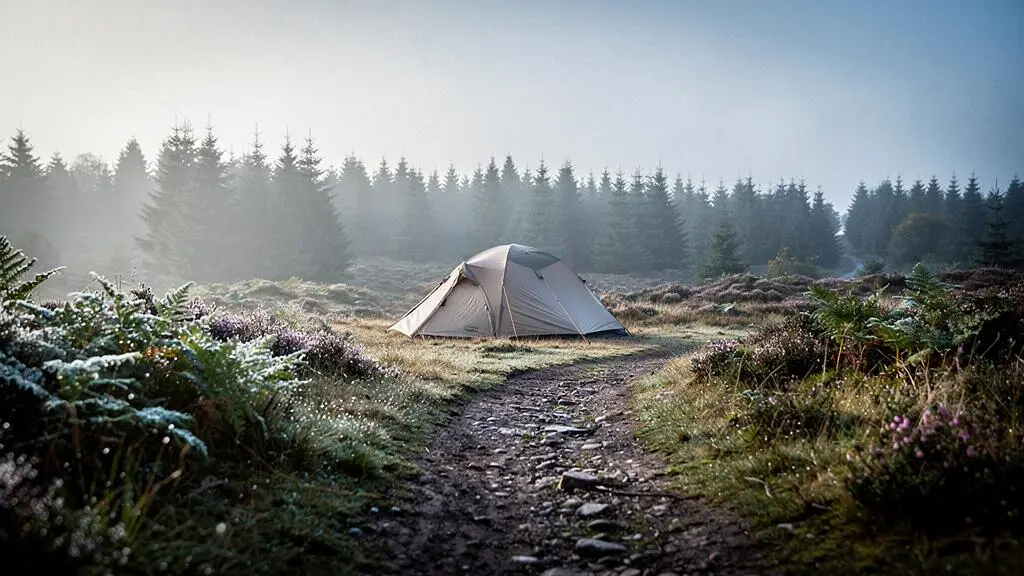
The frustration of navigating the UK’s public land access rules stems from a simple but overlooked fact: not all public land is managed for the same purpose. The key to knowing your rights for camping or driving isn’t memorising endless local bylaws, but first understanding the specific land management mandate of the owner—be it commercial forestry, heritage conservation, or designated public recreation. This guide decodes those mandates, giving you the framework to make informed, legal access decisions.
For any outdoor enthusiast in the UK, the scene is frustratingly familiar: a promising track leading into a forest, but a sign that leaves you full of doubt. Can you walk here? Can you cycle? Could you pitch a tent far from view? The common advice to “follow the rules” or “seek landowner permission” is often impractical when faced with a vast, seemingly empty landscape. The uncertainty forces many to turn back, missing out on the deep connection with nature they seek.
Many people try to navigate this by learning about broad legislation like the Countryside and Rights of Way (CROW) Act, but soon find its promises of “Right to Roam” have significant limitations. The core of the confusion isn’t just the rules themselves, but the patchwork of different organisations managing the land, from the National Trust and Ministry of Defence to various National Park Authorities and commercial forestry bodies like Forestry England. Each has a different primary purpose, and their access rules reflect that.
But what if the real key wasn’t about memorising a thousand different restrictions, but understanding the handful of principles that create them? The fundamental truth is that a landowner’s primary mandate—whether for timber production, historical preservation, or public enjoyment— dictates every access rule. By learning to identify the type of land you are on, you can predict the likely restrictions and freedoms you will have.
This article will equip you with that framework. We will decode the differing mandates of major UK landholders, explore the crucial legal distinctions that govern access in England, Wales, and Scotland, and provide clear, actionable guidance to help you explore the UK’s wild spaces confidently and legally, without fear of fines or conflict.
Summary: How to Understand Public Land Access Rules for Camping and Driving in UK Forests
- Why You Can Camp in Some Forestry Commission Woods But Not National Trust Land
- How to Apply for Wild Camping or Event Permits on Public Land 6 Weeks in Advance
- Open Access Moorland or Forestry Plantations: Which Public Lands Permit Wild Camping
- The Off-Road Driving Mistake That Results in £5,000 Fines on Protected Public Land
- What Months Are Public Lands Closed to Camping for Bird Nesting and Deer Calving
- Why Wild Camping Is Legal in Scottish Hills But Illegal in English National Parks
- Why Orange Peels and Banana Skins Take 2 Years to Decompose in UK Uplands
- How to Wild Camp Legally in England, Scotland and Wales Without Fines or Conflict
Why You Can Camp in Some Forestry Commission Woods But Not National Trust Land
The reason you might be able to camp in a Forestry England plantation but not on a nearby National Trust estate comes down to one core concept: the land management mandate. These two organisations, while both managing huge swathes of the countryside, have fundamentally different primary objectives. Forestry England’s main role is commercial—to sustainably manage the nation’s timber. Their forests are working environments, and public access is often managed as a secondary benefit. This can sometimes mean a more permissive approach to activities like wild camping in remote areas, provided it doesn’t interfere with forestry operations.
Conversely, the National Trust’s mandate is one of conservation and preservation. Their properties are often managed to protect delicate ecosystems, historic parklands, and heritage sites for future generations. This conservation-led approach means access is often more strictly controlled to prevent damage and disturbance. Camping is typically restricted to designated, formal campsites to concentrate impact. The very idea of roaming freely and pitching a tent conflicts with the core mission of preserving a specific state of landscape and heritage. This distinction is crucial; it’s not arbitrary, but a direct reflection of why the land is being managed in the first place. This limited access is a widespread issue, as the British Mountaineering Council highlights that the CROW Act is a start, but it still only gives us access to 11% of England and Wales without fear of trespassing.
How to Apply for Wild Camping or Event Permits on Public Land 6 Weeks in Advance
The idea of applying for a “wild camping permit” seems contradictory, but it highlights a key aspect of UK land law: most access is permissive, not a statutory right. When land managers require permits for camping or events, they are exercising their right to control activities on their property. This process isn’t just bureaucracy; it’s often rooted in legal needs for land management, public safety, or nature conservation. An application gives the landowner the chance to assess the potential impact of your activity.
The reasons a land manager might restrict access or require permission are formally recognised. They often include essential land management needs, such as timber harvesting or peatland restoration, which require temporary closure for safety. A major reason for restriction, particularly in dry summer months, is fire prevention. A permit application process allows land managers to ensure that groups are aware of fire risks and to deny access altogether during high-risk periods. For events, permits are a way to manage numbers, ensure adequate facilities, and mitigate potential damage to the environment.
It’s also important to know that even on “Open Access” land, these rights are not absolute. The law provides mechanisms for landowners to manage their land effectively. For example, landowners and occupiers can suspend access rights for up to 28 days per year for any reason, without having to seek permission from an authority. This is often used for private events or sensitive agricultural activities. Therefore, “applying” is less about seeking permission for a right you hold, and more about requesting a temporary exception to the default rule of no camping on that specific parcel of land.
Open Access Moorland or Forestry Plantations: Which Public Lands Permit Wild Camping
A common and costly mistake is assuming the “Right to Roam” granted by the Countryside and Rights of Way (CROW) Act 2000 includes the right to camp. It does not. The CROW Act grants the public the right to access designated areas of “Open Access Land”—typically mountain, moor, heath, down, and common land—for recreation on foot. This includes walking, running, watching wildlife, and climbing. However, the Act explicitly excludes a list of activities from this statutory right.
As the Exmoor National Park Authority clarifies, activities such as camping, horse riding, swimming and cycling are not permitted by the CRoW Act. This means that while you can walk across a vast moorland, pitching a tent at night is, in the eyes of the law, an act of trespass unless the landowner has explicitly given permission. This is the default legal position across England and Wales. The only significant exception has been Dartmoor, where a historic right was established, but this is a unique case based on local legislation, not the CROW Act.
So, where does this leave forestry plantations? Since most commercial forestry land is not designated as “Open Access Land” under CROW, the Act doesn’t apply. Access to these forests is almost always permissive, granted by the landowner (e.g., Forestry England). In some cases, this can work in the camper’s favour. Because the land is managed for timber, and not primarily for conservation, the landowner might tolerate discreet, low-impact camping in remote areas. However, this is tolerance, not a right. It can be revoked at any time, and you are always expected to follow any posted rules and the “Leave No Trace” principles.
The Off-Road Driving Mistake That Results in £5,000 Fines on Protected Public Land
The most significant legal mistake an outdoor enthusiast with a 4×4 can make is assuming a “public” forest track or moorland path is open for vehicle use. In the UK, driving a vehicle off a public highway without lawful authority is a criminal offence, not a civil trespass. This distinction is critical. While a farmer might have to take you to civil court for walking across their field, driving onto that same field can involve the police and the criminal justice system.
The legal basis for this is clear and unambiguous. The act of driving off-road without authorisation is made illegal under Section 34 of the Road Traffic Act 1988. This legislation makes it an offence to drive a mechanically propelled vehicle on any land without permission, including common land, moorland, or any land that is not part of a road. This includes forest tracks, which are private roads owned by the land manager, not public highways. The only exceptions are if you are the landowner, have their express permission, or are using a “Byway Open to All Traffic” (BOAT), which is a public right of way for vehicles.
These BOATs are often referred to as “green lanes” and are the only legal way to drive on unsealed tracks in the countryside. However, they are few and far between, and their status can be complex and subject to local Traffic Regulation Orders (TROs). Mistaking a private forestry track for a BOAT is the fast track to a hefty fine, vehicle seizure, and a criminal record. The potential fine can reach up to £5,000, especially if the act causes damage to sensitive habitats like a Site of Special Scientific Interest (SSSI). Land managers and police are increasingly cracking down on illegal off-roading due to the significant environmental damage it can cause.
What Months Are Public Lands Closed to Camping for Bird Nesting and Deer Calving
While some land access restrictions can feel arbitrary, many are directly tied to the predictable, sensitive cycles of the natural world. Spring and early summer are critical periods for wildlife, and land managers have a responsibility—and often a legal obligation—to protect vulnerable species. The two most common reasons for seasonal closures are the bird nesting season and the deer calving season.
Many of the UK’s most cherished upland landscapes, such as moorlands and heathlands, are vital breeding grounds for rare, ground-nesting birds. Species like the curlew, hen harrier, merlin, and red grouse are extremely susceptible to disturbance. As Natural Resources Wales explains, in spring the affected moorland sees bird species such as cuckoo, curlew, hen harrier and merlin join resident red grouse and black grouse to nest on the heather-clad ground. The presence of humans and dogs, or the sudden appearance of a tent, can cause parent birds to abandon their nests, leaving eggs or chicks to fail. Even a brief disturbance during this period can cause distress to wildlife and far-reaching consequences for the environment by disrupting sensitive habitats.
To protect these species, land managers will often impose restrictions from roughly March to the end of July. This may involve closing specific areas, requiring dogs to be on a short lead, or prohibiting activities like wild camping altogether. Similarly, deer calving season, typically from May to late June, is another sensitive time. A mother deer who is disturbed may abandon her calf. For these reasons, organisations like the Forestry Commission and National Park Authorities will use their powers to temporarily restrict access. It’s a necessary measure to ensure the long-term health of the wildlife that makes these places so special.
Why Wild Camping Is Legal in Scottish Hills But Illegal in English National Parks
The stark difference in wild camping law between Scotland and England stems from two very different legislative paths. In Scotland, the right to wild camp is enshrined in law. The Land Reform (Scotland) Act 2003 established statutory public access rights to most land and inland water for recreation, including camping. This right is based on the principle of responsible access, meaning it comes with duties outlined in the Scottish Outdoor Access Code. It’s a modern, intentional piece of legislation designed to open up the countryside.
In England and Wales, the legal landscape is the complete opposite. There is no such statutory right. The default position is that all land is privately owned, and wild camping without the landowner’s permission is an act of civil trespass. The CROW Act 2000, while a step forward, only granted a right to roam on foot, not to camp. The situation in England’s National Parks is therefore legally identical to any other piece of land: wild camping is not a right. The only exception has been Dartmoor National Park, but this right was not based on modern access philosophy, but on a historic local law, the Dartmoor Commons Act 1985.
This unique Dartmoor right was recently subject to a major legal battle. The case of Darwall v Dartmoor National Park Authority nearly extinguished this last bastion of legal wild camping in England. As the Open Spaces Society reports, the Darwalls challenged the DNPA’s contention that there was a right to backpack camp… and they won in the High Court in January 2023. The right was only saved after the Court of Appeal ruled on 31 July 2023 that there was a right to camp, a decision which was ultimately upheld by the Supreme Court. This case highlights how fragile access rights are in England, resting on historic precedent rather than a universal legal right like that which exists in Scotland.
Why Orange Peels and Banana Skins Take 2 Years to Decompose in UK Uplands
A common misconception among well-intentioned walkers is that leaving behind “natural” food waste like a banana skin or orange peel is harmless. The logic seems sound: “it’s organic, it will biodegrade.” While true in a warm, rich garden compost heap, this assumption is dangerously false in the unique environment of the UK’s uplands. In the cold, wet, and acidic conditions of a peat bog or a high-altitude mountain, decomposition happens at a glacial pace.
The microbes and bacteria that efficiently break down organic matter in other environments struggle to survive in these harsh conditions. Peat bogs, for example, are anaerobic (lacking oxygen), highly acidic, and cold. An orange peel, designed by nature to protect its fruit, can take up to two years to disappear. A banana skin can last even longer. During this time, it’s not just an unsightly piece of litter; it’s an alien object in the landscape that can attract animals and habituate them to human food, which can be harmful to their health and behaviour.
This is a core tenet of the “Leave No Trace” philosophy. The goal is not just to avoid leaving plastic wrappers, but to leave the wild environment exactly as you found it. Every item you carry in, you must carry out. This includes all food scraps, no matter how small or “natural” they may seem. The cumulative impact of thousands of visitors each leaving a single piece of fruit peel would quickly transform a pristine wilderness into a rubbish dump. The slow-motion process of decomposition in these fragile habitats means that your small act of carelessness can blight the landscape for years to come, long after your footprints have faded.
Key takeaways
- The landowner’s primary mandate (e.g., conservation vs. commerce) is the single biggest predictor of public access rules.
- The “Right to Roam” in England and Wales does not include the right to camp, drive, or light fires; these are generally acts of trespass.
- Access rights are not uniform across the UK; Scotland operates under a fundamentally different and more permissive legal framework than England and Wales.
How to Wild Camp Legally in England, Scotland and Wales Without Fines or Conflict
Ultimately, wild camping legally and responsibly in the UK boils down to a combination of understanding the law and adhering to a strict ethical code. In Scotland, the legal foundation is the Land Reform Act, which grants you the right, provided you follow the Scottish Outdoor Access Code. In England and Wales, the legal position is simpler and more restrictive: you have no right to wild camp, and doing so is a civil trespass, unless you are in a specific area like Dartmoor where a local byelaw or Act permits it. Campaigners note that after the Dartmoor ruling, a legal right to camp still only exists on a tiny fraction of land; some estimates suggest only about 0.2% of English land carries a genuine legal camping right.
Where camping is a trespass (i.e., most of England and Wales), the traditional approach is to “wild camp” by seeking areas where it is tolerated. This often means high, remote fells in places like the Lake District or Snowdonia, far from roads and settlements, where the impact is minimal and the chances of objection are low. This is not a legal right, but a practice of tolerance based on a shared, unspoken etiquette. To engage in this without causing conflict, following a strict set of rules is non-negotiable.
This universal code of conduct is the key to minimising your impact and avoiding conflict with landowners, whether you are camping by right in Scotland or by tolerance in Wales. It is about being invisible, both visually and environmentally. The goal is to leave the land so undisturbed that nobody could ever know you were there.
Your action plan: The Universal Wild Camping Etiquette Checklist
- Choose a discreet pitch: Select a durable spot high on the hillside, well away from farmland, houses, roads, and water sources.
- Minimise your presence: Arrive late (at dusk) and leave early (at dawn), keeping your group small and using just one or two tents.
- No open fires: Never light a fire. Use a small, contained stove for cooking and be vigilant about fire risk, especially in dry weather.
- Manage waste properly: Carry out everything you bring in, including all food scraps. Bury human waste responsibly at least 30 metres from any water source.
- Leave no trace: Before you depart, scan your campsite to ensure it is exactly as you found it. Leave nothing behind but footprints.
By internalising these rules—both the legal frameworks and the ethical code—you can move from being an “access-uncertain” enthusiast to a confident and responsible explorer of the UK’s magnificent public lands.