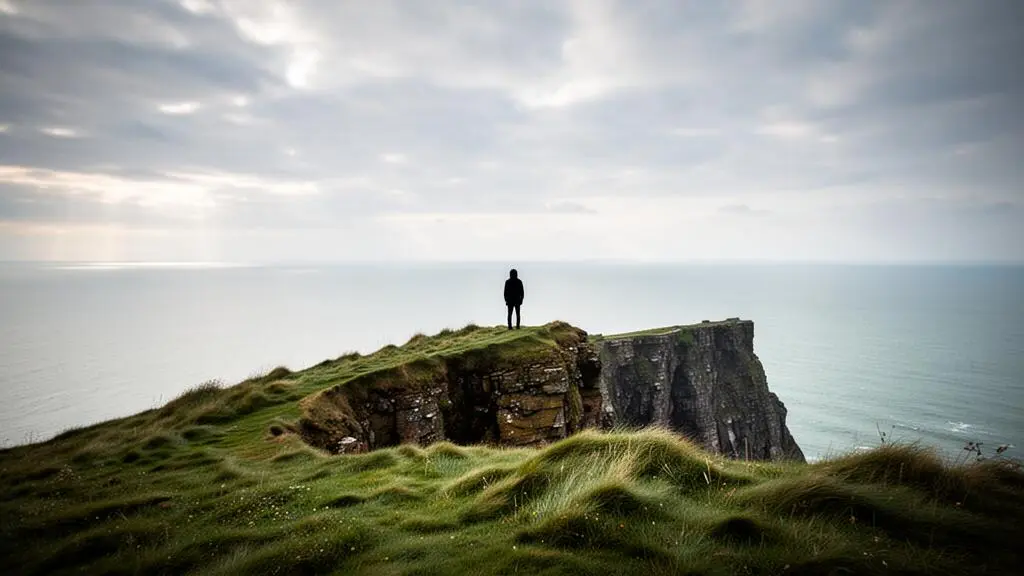
The true mental benefit of a panoramic view lies not in the location itself, but in how you engage with it to deliberately calm your nervous system.
- Vast, simple horizons trigger a state of “soft fascination,” which allows your brain’s directed attention to rest and has been shown to lower the stress hormone cortisol.
- A short, uninterrupted 20-30 minute session at a viewpoint delivers the most efficient stress-reduction benefits, a principle often negated by the rush to take photos or move on.
Recommendation: Structure your next UK trip around visiting one major viewpoint per day, prioritising time for quiet observation over covering maximum distance.
For the professional mind feeling caged by cityscapes and digital noise, the call of an open horizon is a primal urge. It’s a deep-seated need for visual and mental space. The common response is to create a bucket list of famous UK viewpoints, ticking them off in a hurried tour. We seek perspective but often only find a photo opportunity, returning home with our minds just as cluttered as when we left. This approach treats the landscape as a series of destinations to be conquered, rather than a therapeutic environment to be experienced.
But what if the key to a genuine mental reset wasn’t about the number of places you see, but about the quality of your attention in just one? What if a vast, empty horizon could be used as a specific tool for cognitive decluttering? This guide moves beyond simple lists of places. It delves into the science of why these views are so calming and provides a practical framework for using them to achieve a state of deep reflection and mental clarity. We will explore how to access these vistas, how long to spend there, and how to structure your time to ensure you leave with a quieter mind, not just a fuller camera roll.
This article breaks down the art and science of finding mental space in the UK’s vast landscapes. Discover why these views work, how to access them, and the common mistakes to avoid for a truly restorative experience.
Contents: Finding Clarity on the Horizon
- Why Panoramic Views Activate Brain Regions That Lower Cortisol by 25%
- How to Reach Horizon Viewpoints by Car When Mobility or Fitness Is Limited
- Ocean Horizons or Moorland Vistas: Which Open Views Suit Contemplative Needs
- The Distraction Mistake That Negates the Mental Benefits of Horizon Views
- How Long to Spend at a Panoramic Viewpoint for Genuine Mental Reset
- Why Visiting 5 Places Per Day Blocks the Reflective Brain States That Reduce Stress
- Why Coastal Air Contains Negative Ions That Reduce Stress Hormones by 30%
- How to Structure Road Trips for Deep Reflection Rather Than Destination-Chasing
Why Panoramic Views Activate Brain Regions That Lower Cortisol by 25%
The profound sense of calm that washes over you when gazing at an endless horizon is not just a poetic notion; it’s a measurable neurological event. Urban environments constantly demand our “directed attention” with traffic, signs, and crowds, keeping the brain in a state of low-grade vigilance. A vast, simple panorama—a sea meeting the sky, a rolling moorland—requires very little of this effortful focus. This is the core of Attention Restoration Theory (ART), which describes such scenes as being “softly fascinating.”
This state of soft fascination allows the over-taxed prefrontal cortex, responsible for executive functions and focus, to rest and recover. As it powers down, the body’s stress response follows suit. Scientific inquiry into ART confirms this, with research showing that undemanding views can lower cortisol levels by up to 29%. This isn’t just relaxation; it’s a genuine physiological reset, a process of cognitive decluttering where mental noise subsides, creating space for deeper thoughts to surface.
The view essentially gives your brain permission to stop actively processing and simply *be*. Researchers in the field highlight this unique quality, explaining that it is this lack of demand that facilitates recovery. As leading academics on the topic note:
Attending to softly fascinating stimuli not only requires little effort but also leaves mental space for reflection.
– Avik Basu, Jason Duvall & Rachel Kaplan, Environment and Behavior (2019)
This “mental space” is the very thing stressed professionals crave. The horizon doesn’t give you answers; it creates the quiet internal conditions where you can find your own.
How to Reach Horizon Viewpoints by Car When Mobility or Fitness Is Limited
The romantic image of earning a view after a gruelling hike is a significant barrier for many. The belief that profound connection with nature requires peak physical fitness is a myth. A contemplative break should reduce stress, not add to it. Fortunately, the UK is crisscrossed with roads that offer breathtaking, accessible panoramas for those with limited mobility, time, or fitness.
The key is strategic planning. Instead of searching for “hikes,” search for “scenic drives” or “roadside viewpoints.” Many of the UK’s National Parks, such as the Peak District (e.g., Mam Tor’s roadside views) or the Yorkshire Dales, have well-maintained roads that climb to high elevations. Use Ordnance Survey maps (or their digital equivalents) and look for roads that run along high contour lines, often marked with viewpoint symbols (a camera icon in a black box).
Consider these practical approaches:
- “Car Park Summits”: Many popular hills have car parks located near the top, requiring only a short, manageable walk for a 360-degree view. Locations like the Malvern Hills or Dunstable Downs are excellent examples.
- Coastal Drives: The UK’s coastline offers some of the most dramatic and accessible horizons. Drives along the North Coast 500 in Scotland, the B3306 from St Ives to St Just in Cornwall, or the Marine Drive on Great Orme in Wales provide endless opportunities to pull over and simply gaze out to sea.
- Accessibility Guides: Organisations like The National Trust and National Parks UK offer detailed accessibility guides on their websites, often listing specific car parks and paths suitable for wheelchairs or those who need a level surface.
The goal is to find a place where you can step out of your car and immediately be immersed in the vista. The mental benefit comes from the view itself, not the effort expended to reach it. Prioritising ease of access ensures that the experience is restorative from the very beginning.
Ocean Horizons or Moorland Vistas: Which Open Views Suit Contemplative Needs
Not all horizons are created equal, and the type of landscape you choose can subtly influence the nature of your reflection. The two most dominant forms of vast, open vistas in the UK—the ocean horizon and the moorland expanse—offer different, though equally powerful, contemplative experiences. The choice between them depends on the kind of mental state you are seeking.
An ocean horizon is a dynamic, living line. It’s an experience of rhythm and infinity. The constant, gentle motion of the waves, the sound of the surf, and the subtle shifts in light on the water create a multi-sensory form of “soft fascination.” This is ideal for when your mind feels stuck or trapped in rigid thought patterns. The rhythmic input can help break up mental loops and induce a state of flow, encouraging more fluid, creative, and expansive thinking. It’s a landscape of constant change and immense power, which can help put personal problems into a grander perspective.
In contrast, a moorland vista, such as those found in Dartmoor, the Pennines, or the Scottish Highlands, offers an experience of profound stillness and silence. The horizon is static, the landscape ancient and unchanging. This environment is perfect for when your mind is overstimulated and chaotic. The sheer emptiness and silence of the moorland acts as a “sensory deprivation tank,” stripping away external noise and allowing the internal chatter to settle. It’s a landscape that encourages deep introspection, focus, and a feeling of being grounded. Where the ocean encourages your thoughts to flow outwards, the moors encourage them to settle inwards.
For a mind racing with “what-ifs,” the grounding silence of the moors may be most effective. For a mind feeling heavy and stagnant, the dynamic, rhythmic energy of the coast may be the better choice. Both offer the visual unloading the brain craves, but they tune the mind to a different reflective frequency.
The Distraction Mistake That Negates the Mental Benefits of Horizon Views
You’ve found the perfect, sweeping view. You’ve parked the car, stepped out, and the vast expanse is laid out before you. It’s at this critical moment that most people make a mistake that completely undermines the restorative purpose of the visit: they immediately *do* something. They reach for their phone to capture the perfect photo, they check their map, they start talking, or they begin identifying distant landmarks.
This impulse to engage actively with the view keeps your brain in the exact “directed attention” mode you are trying to escape. Taking a photo involves decisions about composition, lighting, and settings. Checking a map requires focused, analytical thought. These are all tasks. They prevent the shift into the passive, receptive state of soft fascination where the mind can truly rest and recover. You are looking at a relaxing scene, but your brain is still working, still processing, still ‘on’.
The antidote is a conscious, deliberate period of non-doing. The real benefit of the horizon view is unlocked in the first few minutes of silent, passive absorption. To avoid this common pitfall, adopt a simple arrival protocol:
- Arrive and Settle: Get out of the car, find a comfortable spot to stand or sit, and put your phone away. Do not take it out yet.
- Breathe and Arrive: Take three deep, slow breaths. Consciously feel your feet on the ground and acknowledge your physical presence in the landscape.
- Just Look: For the first 5 to 10 minutes, your only task is to look. Let your gaze soften and drift across the horizon. Don’t try to name anything or analyse what you’re seeing. Simply absorb the shapes, the colours, and the sense of space.
Only after this initial period of quiet observation should you consider taking a photograph or engaging in other activities. This small change in behaviour makes the difference between merely visiting a viewpoint and truly using it as a tool for mental decluttering. It ensures you receive the neurological benefits you came for before the cognitive load of ‘doing’ kicks back in.
How Long to Spend at a Panoramic Viewpoint for Genuine Mental Reset
While the urge might be to have a quick look and move on to the next spot, research into nature-based therapy provides a surprisingly specific and effective timeframe. To move beyond a fleeting moment of appreciation and trigger a measurable reduction in stress, you need to give your brain enough time to fully disengage from its high-alert state. The sweet spot, it turns out, is not hours, but minutes.
A landmark University of Michigan study found that cortisol drops most efficiently, at a rate of 18.5% per hour, when a nature experience lasts between 20 and 30 minutes. This is often referred to as a “nature pill.” Spending less time may not be enough to initiate the full physiological response, while spending significantly more time shows diminishing returns in terms of cortisol reduction efficiency.
This is a powerful insight for the time-poor professional. A full day’s hike is not necessary to achieve a significant mental reset. A short, focused, and uninterrupted 20-minute session at an accessible viewpoint can be profoundly effective. The lead author of the study emphasizes this practicality:
For the greatest payoff, in terms of efficiently lowering levels of the stress hormone cortisol, you should spend 20 to 30 minutes sitting or walking in a place that provides you with a sense of nature.
– Dr. MaryCarol Hunter, Frontiers in Psychology (2019)
The “uninterrupted” part is key. This 20-30 minute window should be free from conversation, phone notifications, or other distractions, allowing the principles of soft fascination to work their magic. This concept has been validated in other contexts, highlighting the power of a short but focused dose of nature.
Case Study: The 20-Minute Forest Reset
In a controlled trial by MedUni Vienna, healthy adults were monitored after spending 20 minutes in either a wooded area or an urban setting. The results were stark: the forest group showed a significant drop in salivary cortisol, demonstrating that even a brief, 20-minute immersion in a natural environment is enough to trigger a measurable calming of the body’s stress response.
The takeaway is clear: aim for a dedicated, distraction-free 20- to 30-minute session at your chosen viewpoint. Set a timer if you must. This transforms a simple stop into a deliberate, evidence-based therapeutic practice.
Why Visiting 5 Places Per Day Blocks the Reflective Brain States That Reduce Stress
The “more is better” mindset, so prevalent in our work lives, is deeply counterproductive when applied to contemplative travel. A road trip itinerary packed with five different viewpoints in a single day might seem efficient, but it creates a state of “destination-chasing” that actively blocks the very mental benefits you are seeking. Instead of reducing stress, this approach can inadvertently increase it.
Every time you switch locations, your brain is forced back into its active, problem-solving mode. It engages in a series of cognitively demanding tasks: navigating, watching the clock, making decisions about where to park, and processing a new and unfamiliar environment. This constant activity-switching keeps your prefrontal cortex in high gear, the very part of the brain that needs to rest for restoration to occur. You never give your mind the chance to settle into the state of soft fascination for a meaningful period.
This rushed approach fragments your attention. You arrive at a beautiful spot, but part of your mind is already thinking about the next destination on the list. You are physically present, but mentally, you are in transit. This creates a subtle but persistent cognitive load that prevents deep reflection. It’s the equivalent of trying to meditate while constantly being interrupted. You might experience fleeting moments of awe, but the cumulative, restorative effect that comes from sustained, peaceful observation is lost.
True mental decluttering requires depth, not breadth. The goal is to sink into one or two experiences deeply, rather than skimming the surface of many. By trying to “see it all,” you end up experiencing very little on a meaningful level and deny your brain the sustained period of quiet it needs to down-regulate and recover.
Why Coastal Air Contains Negative Ions That Reduce Stress Hormones by 30%
When choosing an ocean horizon for its contemplative benefits, you are getting more than just a beautiful view. The very air you breathe is biochemically different. The churning, crashing action of waves creates sea spray, a process that releases vast quantities of negative ions into the atmosphere. While the term “negative ions” sounds technical, their effect on mood and well-being is well-documented, providing an extra layer of stress reduction.
These invisible, odourless molecules are believed to increase the flow of oxygen to the brain, leading to higher alertness, decreased drowsiness, and more mental energy. More importantly, they are thought to boost levels of the neurotransmitter serotonin, a mood stabilizer that helps produce feelings of calm and happiness. This explains why a walk on a windswept beach often feels so uniquely invigorating and cleansing compared to a walk inland.
Research has quantified these effects, moving them from the realm of folklore to science. For example, a randomized controlled trial found that high-density negative ion exposure produced a 47.9% improvement in symptoms for individuals with seasonal affective disorder. While this is a specific condition, it points to the powerful mood-regulating potential of ion-rich air. The concentration of negative ions near a coastline is many times higher than in a typical urban or inland rural environment.
Case Study: The Serotonin-Boosting Power of Coastal Air
In an effort to understand these effects, researchers at the New York State Psychiatric Institute exposed patients with seasonal depression to varying concentrations of negative ions. Those who received higher doses, similar to what you’d find in fresh sea air, showed significant improvements in their symptoms. The scientists linked this outcome directly to the influence of negative ions on the body’s regulation of serotonin, confirming the biochemical basis for the “feel-good” effect of being by the sea.
Choosing a coastal viewpoint, therefore, becomes a two-pronged therapeutic approach. You are simultaneously giving your brain a visual-unloading experience with the simple horizon and a biochemical boost from the very air you inhale. It’s a powerful combination that enhances the overall restorative impact of your contemplative break.
Key Takeaways
- The goal of a contemplative break is not to see more, but to experience one place more deeply.
- The most efficient mental reset occurs within a 20-30 minute window of uninterrupted, passive observation.
- Resist the urge to immediately photograph or analyse a view; allow for 5-10 minutes of silent absorption first.
How to Structure Road Trips for Deep Reflection Rather Than Destination-Chasing
To truly embrace a reflective approach, the entire structure of a road trip needs to be re-imagined. The goal is to minimize cognitive load from travel logistics and maximize time for quiet immersion. This means abandoning the linear, A-to-B-to-C itinerary in favour of a more settled, hub-and-spoke model.
The principle is simple: choose a single base for two or three nights, and from there, make one deliberate, slow journey to a major viewpoint each day. This “one anchor” approach has several benefits. It eliminates the daily stress of packing, checking out, and navigating to a new hotel. Your accommodation becomes a familiar, grounding base camp rather than just another stop. Most importantly, it frees up your mental energy to be fully present in the landscape.
With only one destination for the day, the journey itself can become part of the contemplative experience. There is no rush. You can take meandering back roads, stop spontaneously, and arrive at your chosen viewpoint feeling relaxed, not harried. You can afford to spend a full hour or more there, allowing for the recommended 20-30 minutes of quiet observation plus extra time for a short walk or simply sitting with a flask of tea. This is reflective pacing in action—designing a trip that creates a rhythm of deep engagement followed by rest, rather than a frantic race against the clock.
Your Action Plan for a Reflective Road Trip
- Choose Your Anchor: Select one primary viewpoint or area and book accommodation nearby for at least two nights. This is your contemplative hub.
- Plan One Major Outing Per Day: Dedicate each day to visiting just one significant viewpoint. Research its accessibility and the best time to visit for quiet.
- Budget Time Generously: Allocate a minimum of two to three hours for each viewpoint visit. This includes travel, settling in, your 20-30 minute observation, and unhurried departure.
- Embrace “Empty” Time: Do not fill the rest of your day with activities. Allow for unscheduled time to read, walk locally, or simply do nothing. This is when the mind processes and integrates the experience.
- Pre-plan Logistics: Decide on food, fuel, and other necessities beforehand to minimize decision-making during your contemplative time. The goal is to free your mind from practical concerns.
By consciously designing a trip for depth over distance, you transform it from a stressful logistical exercise into a genuinely restorative retreat for the mind.
Your next trip to the great British outdoors is an opportunity to practice this new perspective. Plan less, experience more, and use the vast, beautiful horizons not as a backdrop for a selfie, but as a dedicated space to find clarity and quiet your mind.