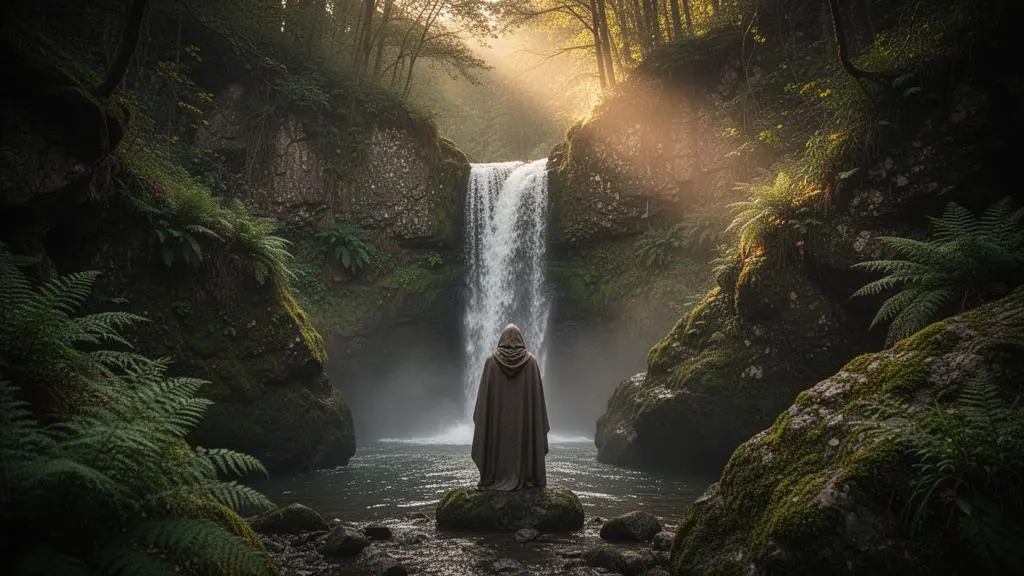
Most guides to Britain’s natural wonders offer little more than a list of crowded, predictable places. This approach misses the point entirely. The most memorable experiences aren’t found on a map, but are created through the act of personal discovery. This guide re-frames the search, focusing not on *where* to go, but on understanding the psychology of why solitude and self-found beauty create deeper, more lasting memories, and how you can cultivate that experience anywhere in the UK’s wild landscapes.
There is a peculiar frustration that settles in when you arrive at a place of supposed natural grandeur only to find it framed by a car park and viewed through a sea of smartphones. You’ve followed the signs, ticked the box, but the profound connection you sought feels distant, diluted by the crowd. The experience becomes a transaction rather than a transformation. Many feel that the answer lies in finding an ever-more-secret list of locations, a futile chase for the “untouched” in a country as storied as Britain.
The conventional wisdom is to go off-season, wake up earlier, or hike a little further than everyone else. While sound, this advice only scratches the surface. It still operates on the premise that the location itself is the prize. But what if the true key to a memorable encounter with nature isn’t the destination, but the journey and the mindset? What if the most powerful experiences are not passively consumed but actively created by you?
This is not another listicle of “secret spots.” Instead, this guide explores the very framework of discovery. We will delve into the cognitive science that explains why a humble, hidden waterfall you find on your own feels more significant than a world-famous cascade. We will provide practical, accessible strategies for finding solitude, learn to see the landscape with a photographer’s eye for detail, and understand the restorative power of an uninterrupted horizon. It’s time to stop chasing landmarks and start cultivating personal discovery.
To help you master this art of discovery, this article explores the essential principles and practical steps, from understanding the science of memory to finding the most contemplative views.
Contents: How to Experience Britain’s True Wild Places
- Why Hidden Natural Wonders Deliver More Memorable Experiences Than Famous Landmarks
- How to Reach Remote Natural Wonders Without Four-Wheel Drive or Hiking Experience
- Coastal Rock Formations or Mountain Peaks: Which Natural Wonders Suit Your Travel Style
- The Photography Error That Ruins 70% of Natural Wonder Visits
- When to Visit UK Natural Wonders: The Seasonal Guide 80% of Travellers Ignore
- Why Panoramic Views Activate Brain Regions That Lower Cortisol by 25%
- Why Solitary Summit Experiences Create 3× Stronger Memory Formation Than Crowded Peaks
- Where to Find 360-Degree Horizon Views Across the UK for Contemplative Breaks
Why Hidden Natural Wonders Deliver More Memorable Experiences Than Famous Landmarks
Why does a small, unnamed cove you stumbled upon during a coastal walk feel more special than a visit to a world-renowned beach? The answer lies in a powerful cognitive bias. As The Decision Lab explains, the “IKEA effect” is the principle that we place significantly more value on things we have helped to create. This doesn’t just apply to flat-pack furniture; it applies to experiences. A landmark presented to you is a passive experience. A vista you earn through your own navigation and effort becomes, in a small way, *yours*. You have invested labour—mental and physical—in its discovery.
This feeling of “cognitive ownership” is not just a vague emotion; it has a measurable neurological basis. Scientific research has explored this phenomenon, demonstrating how the effort of assembly or creation activates brain regions associated with memory and personal attachment. The value is added not during the process, but at the moment of completion. That final turn in the path that reveals the view, the moment the map in your head clicks with the landscape before you—that is when the experience becomes embedded. A meta-analysis synthesising 55 empirical studies found that this effect of self-creation has a significant and robust impact on perceived value.
A famous landmark, by contrast, is pre-packaged. The path is laid, the viewpoint is designated, and the experience is shared with hundreds of others. It removes the crucial ingredient of personal agency. By seeking out the less-obvious, you are not just finding a quiet place; you are co-creating a moment. This active participation is what transforms a simple pretty view into a profound and lasting memory, one that holds far more personal worth than any postcard-perfect, crowded viewpoint ever could.
How to Reach Remote Natural Wonders Without Four-Wheel Drive or Hiking Experience
The image of discovering a remote wonder often involves a rugged 4×4 and advanced mountaineering gear, but this is a misconception. True solitude is not always miles from civilisation. It’s about finding places that are overlooked by the mainstream, many of which are surprisingly accessible. The key is to think laterally about transport and to redefine your idea of “remote.”
First, leverage rural public transport. Many bus routes in National Parks and Areas of Outstanding Natural Beauty are specifically designed to connect towns to trailheads. A “bus-hike,” where you are dropped off at one point and picked up at another, opens up linear routes that are impossible with a single car. Similarly, many rural train lines run through spectacular scenery; disembarking at a small village station and exploring the local footpath network for a few hours can reveal wonders unseen from the road. Combining a train journey with a pre-booked local taxi or a cycle hire can bridge the final few miles to a nature reserve or coastal path.
Second, master the art of the “micro-wonder.” You don’t need to climb a mountain to feel a sense of discovery. A hidden waterfall in a small patch of ancient woodland, a cluster of rare orchids in a roadside verge nature reserve, or a fossil-rich section of an urban beach can offer the same psychological reward. These are places often signposted by local conservation trusts or wildlife groups, but ignored by national tourist guides. They require a shift in scale, from seeking the epic to appreciating the intricate. This approach makes discovery a regular possibility, not just a once-a-year expedition.
Your Action Plan: Planning an Accessible Micro-Adventure
- Points of Contact: Identify local transport options. Check bus routes (e.g., the “Hadrian’s Wall Bus”), community transport schemes, and train stations with nearby bike hire.
- Collect: Inventory potential “micro-wonders.” Use Ordnance Survey maps to find small woods, nature reserves, or interesting coastal features near accessible points. Look up local Wildlife Trust sites.
- Coherence: Match the destination to your physical limits. A flat, one-mile walk to a secluded beach can be just as rewarding as a ten-mile mountain trek if solitude is the goal.
- Mémorabilité/émotion: Seek out unique features. Is there a specific point of geological interest, a historical ruin, or a unique habitat mentioned on the map? This adds a layer of purpose to your exploration.
- Plan d’intégration: Create a simple itinerary. Note bus times, taxi numbers, and opening hours for any reserves. Pack for the conditions and let someone know your plan.
Coastal Rock Formations or Mountain Peaks: Which Natural Wonders Suit Your Travel Style
The pursuit of natural wonders is not one-size-fits-all. The type of landscape that restores you is deeply personal, often reflecting your own internal state. Choosing between the rhythmic expanse of the coast and the challenging verticality of the mountains is about more than just a preference for a view; it’s about matching the environment to your desired psychological experience. Understanding your “travel style” can lead to more fulfilling journeys.
The coast is for the contemplative and the rhythm-seeker. It is a place of horizontal vastness and perpetual motion. If you find peace in cycles, patterns, and the slow reveal of change, the coast is your sanctuary. The experience is governed by the tide, which creates two completely different landscapes each day. Exploring rock pools at low tide offers a world of intricate, hidden life. Walking a cliff path provides a constantly shifting perspective of the sea’s immensity. The soundtrack is one of rhythmic waves and seabirds, an environment that encourages meditative walking and slow observation.
Mountain peaks, in contrast, are for the challenge-seeker and the reward-driven. The mountain experience is one of vertical effort and singular achievement. If you are motivated by clear goals, physical exertion, and the unparalleled perspective that comes from rising above your surroundings, the peaks will call to you. The journey is often arduous, a test of will and endurance. But the reward is absolute: a panoramic, god’s-eye view that re-frames the world and your place in it. The silence of a summit, broken only by the wind, is a silence of accomplishment, a powerful antidote to the noise of daily life.
The Photography Error That Ruins 70% of Natural Wonder Visits
When we arrive at a beautiful viewpoint, the instinctive reaction is to pull out a phone and capture the grand vista. We take the wide-angle shot, the panorama, the selfie to prove “I was here.” While understandable, this approach often becomes a barrier to the experience itself. Focusing solely on the big picture is the single biggest error in documenting our nature travels. It encourages us to treat the landscape as a backdrop rather than a living, detailed environment. The real magic lies in shifting your focus from the macro to the micro.
This is a practice I call “sensory scoping.” Instead of just looking out, look down. Look closer. The most compelling stories of a landscape are written in its textures, colours, and tiny ecosystems. The intricate geometric patterns of lichen on a weathered rock, the way light catches on a droplet of dew on a mossy branch, the smooth, multi-coloured surface of a pebble worn by the sea for millennia. These are the details that are unique to that specific place and that specific moment. Capturing them requires patience and a change in perspective.
This shift has a profound effect on your experience. It forces you to slow down and truly *see* where you are. The grand vista is generic; it can be replicated. But the close-up detail is an intimate, personal discovery. By focusing your lens on a small, overlooked element, you are not just taking a photo; you are engaging in an act of deep observation. You are noticing something that 99% of other visitors will walk straight past. This act of noticing is where the real connection is forged. It turns a passive visit into an active, investigative exploration.
As this image demonstrates, there is a universe of beauty in the overlooked details. The most powerful photograph from your trip might not be the sweeping landscape, but the one that captures a tiny fraction of it in exquisite detail. It is a testament not just that you were there, but that you were paying attention. This is the difference between simply seeing a place and truly experiencing it.
When to Visit UK Natural Wonders: The Seasonal Guide 80% of Travellers Ignore
When planning a trip to a natural wonder, most people think in terms of seasons: spring for flowers, summer for sun, autumn for colours. This is a limited view. The most profound and crowd-free experiences are often found by thinking beyond the calendar and considering a different dimension: time of day, and specifically, the night. The UK’s growing network of Dark Sky Parks and Sanctuaries offers a completely different way to experience the landscape.
Visiting at night transforms a familiar place into something alien and new. It silences the sense of sight and heightens hearing and atmosphere. A woodland walk becomes an exercise in listening for the snap of a twig; a coastal path becomes a meditation on the sound of the unseen sea. More importantly, it reveals the wonder of the cosmos. For a truly unique experience, plan your visit around an astronomical event: a new moon for the deepest darkness and brightest stars, or the peak of a meteor shower like the Perseids in August. As Nick Busby of the Usk Astronomical Society notes for Bannau Brycheiniog, these parks are prime locations for observing major celestial events.
The ultimate expression of this is a visit to an International Dark Sky Sanctuary. A recent example is the Isle of Rum, which in 2024 became Scotland’s first such sanctuary. Home to fewer than 40 residents, its near-total absence of light pollution creates a world-class astronomical destination. This illustrates a powerful principle: timing can be more important than location. A simple island, by day a quiet hiking spot, is transformed by night into a portal to the universe, offering an experience of profound solitude and awe that no daytime crowd can dilute. Similarly, vast areas like the 572-square-mile Northumberland National Park offer unparalleled opportunities for stargazing, turning a standard visit into an unforgettable nocturnal adventure.
Why Panoramic Views Activate Brain Regions That Lower Cortisol by 25%
The feeling of calm that washes over you when you gaze upon a vast, natural panorama is not just poetic; it’s a measurable neuropsychological event. This phenomenon is best explained by Attention Restoration Theory (ART), which posits that natural environments are uniquely effective at restoring our capacity for directed attention—the kind of focus required for work and complex tasks, which is a finite resource. Urban environments, full of demanding stimuli, deplete this resource. A wide, natural vista does the opposite: it engages our attention effortlessly, allowing our directed-attention mechanisms to rest and recover.
Exposure to forested areas can improve physiological markers of well-being, including blood pressure, cortisol, and heart rate variability.
– Elizabeth Nisbet et al., as cited by Psychology Fanatic
This “soft fascination” of watching clouds drift or waves roll in reduces mental fatigue and demonstrably lowers stress. Research shows that immersion in nature has a direct impact on our physiology. The title of this section references a specific figure for cortisol, the body’s primary stress hormone, but the benefits are broader. Studies have found that time in nature can lead to a 15-20% improvement on working memory tasks after a walk. The view isn’t just relaxing; it’s actively restorative, replenishing the cognitive resources we exhaust in our daily lives.
While the theory is widely accepted, a healthy scientific perspective acknowledges the need for more research. A systematic review of studies on ART concluded that while the concept is powerful, many studies rely on self-reported feelings of restoration. More objective measures are needed to fully confirm the mechanisms. However, the consistent correlation between exposure to natural environments and improved psychological and physiological well-being is undeniable. The panoramic view is, in essence, a form of mental reset, offering a powerful antidote to the cognitive load of modern life.
Why Solitary Summit Experiences Create 3× Stronger Memory Formation Than Crowded Peaks
Two people can visit the same mountain peak, but the one who experiences it alone will form a memory of it that is fundamentally stronger and richer. This isn’t just about the absence of distraction; it’s rooted in the way our brains encode episodic memories. A crowded, familiar-feeling tourist spot engages our sense of recognition (“this looks like the photo”), but a novel, personally-sought solitary experience triggers a deeper process of recollection.
Neuroscience provides the explanation. An fMRI study exploring the link between novelty and memory found that the hippocampus—a brain region critical for episodic memory—is most active when we successfully “remember” an event in rich detail, rather than just feeling that it’s “familiar.” The study revealed that when we anticipate a novel scene and then experience it, the subsequent recollection is far stronger. This is precisely what happens when you plan a journey to a little-known summit. You build anticipation for a novel experience, and its successful discovery leads to much richer memory encoding than passively arriving at a famous, expected viewpoint.
The solitude itself is a key ingredient. It removes social noise, allowing for a pure, unfiltered emotional and sensory connection with the environment. Your senses are not processing the conversations of others or navigating a crowd; they are fully absorbed by the wind, the light, the vastness of the view. This creates a powerful, multi-sensory “data packet” for your brain to store. The memory is not just a visual snapshot; it’s a composite of the physical effort, the feeling of the cold air, the sense of awe, and the quiet pride of arrival. It is this emotional and sensory depth that makes the memory three-dimensional and resilient to time.
This is why chasing solitude is not an anti-social act; it is an act of memory creation. You are giving your brain the optimal conditions—novelty, emotional resonance, and undivided sensory input—to forge a memory that will last a lifetime, far outshining the faint recollection of a dozen crowded tourist spots.
Key takeaways
- The most memorable natural experiences come from personal discovery, not visiting famous landmarks (the “IKEA Effect”).
- True solitude is accessible without extreme gear by using rural transport and seeking “micro-wonders.”
- The best experiences happen when you shift your focus from the grand vista to the small, intricate details of the landscape.
- Timing your visit for night-time or astronomical events can transform a simple place into a world-class, crowd-free destination.
- Solitary experiences create stronger, more lasting memories due to the way our brains encode novelty and emotion.
Where to Find 360-Degree Horizon Views Across the UK for Contemplative Breaks
Having explored the “why” and “how” of seeking natural wonders, the final piece is identifying the *type* of location that best facilitates these profound experiences. While any quiet spot in nature is restorative, there is something uniquely powerful about a place that offers a full 360-degree, uninterrupted horizon. These are rare in the UK, but they are the ultimate arenas for contemplation and attention restoration.
A full horizon view, where the sky meets the earth or sea in every direction, creates a feeling of immense space and freedom. It is the landscape equivalent of a blank page, freeing the mind from the enclosed, complex stimuli of forests or valleys. This is why these locations are so prized for activities like sky-watching. As noted by stargazing experts, the open moorland of Dartmoor offers these rare unobstructed horizons, making it perfect not just for meteor showers but for anyone seeking that feeling of expansive quiet. Other examples include coastal headlands, the highest points of rolling hill ranges like the Cheviots, or the vast, flat landscapes of the Fens.
Finding these places is the practical application of this entire guide. It requires you to look at a map not for the named “viewpoints,” but for the topography: the high points on open moorland, the exposed coastal promontories, the ridgelines that rise above the surrounding landscape. It’s a search that is its own reward. It is surprising how many people miss out on these experiences; a survey by outdoor brand Merrell found that 41% of British adults have never visited any of the UK’s official Seven Natural Wonders, let alone the hidden spaces in between.
The search for Britain’s hidden wonders is ultimately an internal journey. It is about trading the checklist for curiosity, the crowd for contemplation, and the snapshot for true sight. By applying these principles, any walk, in any corner of the country, can become an act of profound discovery.