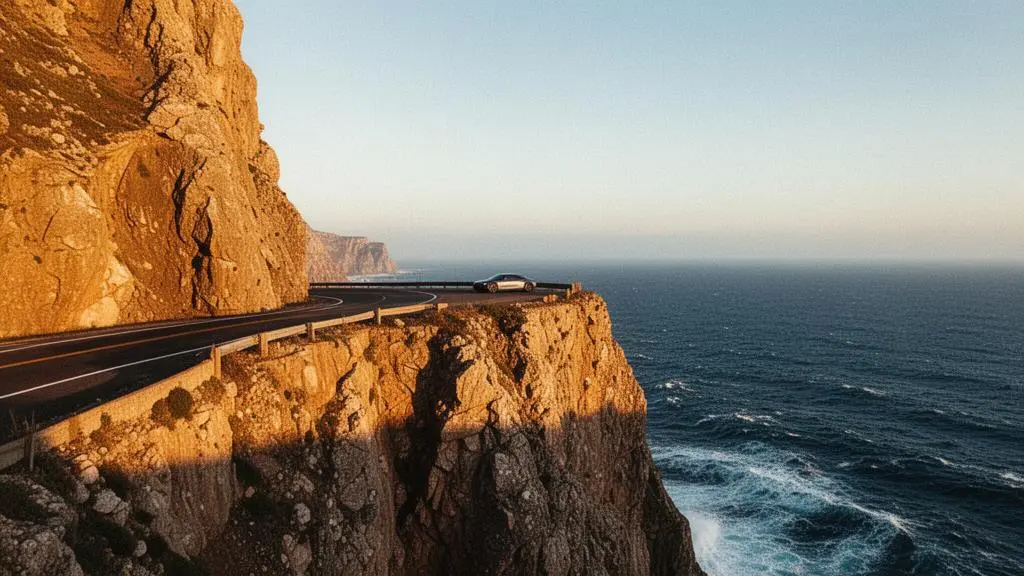
The key to conquering coastal road anxiety is not timidness, but proactive control; understanding the unique physics and psychology of cliffside driving transforms fear into focused confidence.
- Mastering vehicle dynamics like engine braking and weight distribution is more crucial than on flat roads.
- A disciplined system for managing scenic distractions prevents the most common and dangerous errors.
Recommendation: Adopt a defensive driver’s mindset—anticipate hazards, manage your space precisely, and prioritize control over speed to make every coastal drive both safe and spectacular.
The allure of a coastal drive is undeniable: the endless blue horizon on one side, the rugged landscape on the other. Yet for many drivers, this dream can quickly turn into a white-knuckle ordeal. The narrow lanes, sheer drops, and the constant threat of oncoming traffic can trigger a deep-seated anxiety that eclipses any enjoyment of the view. The feeling of being trapped between a stone wall and a steep drop is a real and valid fear.
Most advice boils down to generic tips like “drive slowly” or “be careful.” While well-intentioned, this doesn’t address the core problem. It doesn’t equip you with the specific skills needed for this unique environment. Relying on standard city or motorway habits on a winding clifftop road is like using a dinner fork to row a boat—it’s the wrong tool for the job. True confidence doesn’t come from just reducing speed; it comes from understanding *why* these roads are different and mastering the techniques to handle them.
But what if the secret wasn’t about being more scared, but about being more skilled? This guide takes a different approach. We will move beyond the platitudes and into the mindset of a defensive driving expert. We’ll break down the specific challenges of coastal routes—from sun glare and single-track etiquette to managing steep gradients and the psychology of distraction. You will learn not just what to do, but the fundamental principles behind each action.
By the end of this article, you will have a clear, actionable framework for proactive hazard management. The goal is to replace your anxiety with a calm, focused control that allows you to navigate these beautiful roads safely and, finally, enjoy the breathtaking views you came to see.
This comprehensive guide is structured to build your confidence step-by-step. Each section tackles a specific challenge of coastal driving, providing practical techniques and expert insights to help you master the art of the scenic route.
Summary: A Defensive Driving Masterclass for Scenic Coastal Routes
- Why Standard Driving Habits Become Dangerous on Coastal Cliff Roads
- How to Navigate Single-Track Clifftop Routes Without Stress or Standoffs
- Morning or Afternoon Coastal Drives: Which Direction Avoids Blinding Sun Glare
- The Viewpoint Distraction That Causes 40% of Coastal Road Incidents
- How Often to Stop on a 60-Mile Coastal Drive to Stay Alert and Safe
- Why Tucking Mirrors and Driving at 8mph Saves Your Paintwork in Tight Villages
- Why One-Pedal Mode Adds 15 Miles Range Compared to Using Brake Pedal Normally
- How to Handle Steep Gradients and Narrow Verges on Clifftop Roads Without Fear
Why Standard Driving Habits Become Dangerous on Coastal Cliff Roads
On a predictable motorway, modern driving habits—and the driver-assist technologies that enable them—work beautifully. You maintain a steady speed, stay in your lane, and trust the car’s systems. On a coastal road, this reliance becomes a liability. These routes are unpredictable by nature, featuring variable surfaces, tight, un-cambered turns, and sudden changes in gradient that can confuse even sophisticated systems.
The primary danger lies in a false sense of security. A driver accustomed to a lane-keeping assistant might subconsciously relax their grip and attention, assuming the car will self-correct. However, these systems rely on clear, consistent markings. As road maintenance can be inconsistent in remote areas, this creates a significant risk. Research into Advanced Driver-Assistance Systems (ADAS) highlights this exact issue.
Rural roadways frequently suffer from inconsistent maintenance, including faded or absent lane markings, uneven pavement surfaces, and limited use of reflective materials, placing rural regions at a significant disadvantage for ADAS performance.
– OpenLKA Research Team, OpenLKA: an open dataset of lane keeping assist from market autonomous vehicles
This means the system could disengage without warning right at the entrance to a sharp bend or a narrow section. On a clifftop road, the margin for error is zero. The key is to switch off this automation, both mentally and physically. Your hands must be the primary control system, feeling the road and making constant, subtle adjustments. Proactive manual control is not just a suggestion; it’s a fundamental requirement for safety.
Furthermore, standard speed management is inadequate. A constant 40 mph might feel safe, but coastal driving demands a dynamic approach. You must adjust your speed *before* each new hazard: a blind corner, a narrowing of the road, or a patch of gravel. This is proactive hazard management, a core tenet of defensive driving where you actively anticipate and prepare for risks rather than reacting to them as they appear.
How to Navigate Single-Track Clifftop Routes Without Stress or Standoffs
Few driving scenarios create more anxiety than meeting another vehicle on a road barely wide enough for one. The single-track clifftop route is the ultimate test of patience and spatial awareness. The key to navigating these without stress is to abandon any sense of haste and adopt a cooperative, forward-thinking mindset. Your primary goal is to avoid a head-to-head standoff by identifying and using passing places *before* you need them.
As you drive, your eyes should be scanning far ahead, not just for oncoming traffic, but for the diamond-shaped signs or widened verges that indicate a passing place. If you see an approaching car and a passing place is on your side, pull in early and wait. It is far less stressful to wait for 10 seconds in a designated spot than to be forced into a dangerous reversing manoeuvre. A crucial and often forgotten rule of the road applies here: uphill traffic has the right of way. As one legal expert notes:
Remember that uphill traffic has the right of way, and watch for hairpin turns, steep cliffs, and other unexpected shifts in terrain.
– Myers Legal, Stay Safe: 9 Tips for Driving Through Mountains and Hills
This is because it is significantly more difficult and dangerous for the vehicle heading uphill to stop and then restart its momentum. If you are travelling downhill, you have greater control and it is your responsibility to yield. If you are the one who has to reverse, do it slowly and calmly, using your mirrors constantly. If a passenger can safely get out to guide you, even better.
Finally, remember that you are part of a temporary, moving community. If you are driving slower than the traffic behind you, use the next available pullout to let them pass. This isn’t an admission of defeat; it’s a courtesy that reduces pressure on everyone, including yourself. A patient and courteous driver experiences far less stress. This etiquette includes:
- When two or three vehicles stack up behind you, find a safe, legal spot to pull over and let them pass.
- Pulling over reduces the risk of impatient drivers attempting unsafe passes on tight sections.
- If you are behind a slower driver, wait for clear visibility and ample room before overtaking.
- Treat pulling over as a courtesy that makes the drive less stressful for everyone on the road.
Morning or Afternoon Coastal Drives: Which Direction Avoids Blinding Sun Glare
Blinding sun glare is more than an annoyance; it’s a serious safety hazard that can completely obscure your view of the road, oncoming traffic, and pedestrians. On a coastal road with sheer drops, this momentary blindness can be catastrophic. The good news is that with a little planning based on basic astronomy, you can almost entirely eliminate this risk.
The sun rises in the east and sets in the west. This simple fact is the key to planning your drive. Your goal is to keep the sun behind you or to your side, never directly in your eyes. Here’s how to apply this principle:
- Driving Eastbound: To avoid the rising sun, plan your drive for the afternoon. In the morning, you will be driving directly into the low, intense glare.
- Driving Westbound: To avoid the setting sun, plan your drive for the morning. An afternoon drive will have you squinting into the sunset for the entire journey.
- Driving Northbound or Southbound: Your direction is less critical, but the time of day still matters. In the morning, the sun will be on your right (if northbound) or left (if southbound). In the afternoon, it will be the opposite. While not as direct as an eastbound/westbound route, the glare can still be intense as the road curves.
Think of your car’s sun visor as an emergency tool, not your primary strategy. It can help with high-angle sun, but it’s often useless against the low-angle glare of sunrise and sunset. A good pair of polarized sunglasses is your most effective piece of equipment. Unlike regular sunglasses, polarized lenses are specifically designed to cut intense, reflected glare from surfaces like the road or the sea, providing much clearer vision.
Even with perfect planning, a sudden turn can bring the sun into your field of view. When this happens, your first action should be to increase the distance to the car in front of you and reduce your speed. This gives you more time to react to hazards that are suddenly invisible. Do not fixate on the sun; instead, focus on the painted lines on the road edge to guide your position until your vision clears.
The Viewpoint Distraction That Causes 40% of Coastal Road Incidents
The very reason you’re on a coastal road—the stunning scenery—is also one of its greatest dangers. The temptation to glance at a dramatic cliff-face or a sparkling bay is immense, but even a two-second look away from the road at 40 mph means you’ve travelled over 115 feet blind. This is a phenomenon known as visual tunneling, where your focus on a distant object causes you to lose peripheral awareness of the road’s edge and oncoming traffic. It’s a leading contributor to accidents, as confirmed by federal data showing that in the US, 3,208 deaths in 2024 were linked to distraction-affected crashes.
The myth is that you can safely multi-task between watching the road and watching the view. The reality is that the brain can only truly focus on one task at a time. The solution is not to ignore the scenery, but to create a strict discipline for when and how you enjoy it. Your rule should be simple: when the car is moving, your eyes are on the road. The view is reserved for when you are safely stopped.
This requires a conscious separation of the tasks of ‘driving’ and ‘sightseeing’. Actively seek out designated viewpoints and pullouts. Make them a planned part of your journey, not an impulsive reaction to a beautiful vista. When you decide to stop, signal early and pull completely off the road. Turn off the engine. Only then can you fully and safely immerse yourself in the landscape.
If you are the driver, entrust the role of ‘spotter’ to your passenger. They can point out upcoming viewpoints and enjoy the scenery on your behalf while you focus on navigating the tarmac. This removes the temptation and keeps your attention where it needs to be: on the road ahead.
Action Plan: Staying Focused and Avoiding Viewpoint Distraction
- Maintain Lane Discipline: Stay alert and keep an even distance between the road lines, especially when the scenery is tempting. Your primary job is driving.
- Acknowledge the Risk: Recognize that even the briefest moment of distraction can cause you to drift toward oncoming traffic or the cliff edge.
- Use Designated Pullouts: Use official roadside pullouts for all scenery stops. Never slow down or stop in a live traffic lane to take a photo.
- Practice Road Courtesy: If a queue of vehicles builds up behind you because of your cautious speed, let them pass at the next safe and legal pullout.
How Often to Stop on a 60-Mile Coastal Drive to Stay Alert and Safe
A 60-mile drive might sound short, but on a demanding coastal road, it’s a marathon, not a sprint. The constant need for high concentration, frequent gear changes, and precise steering is far more mentally and physically taxing than driving the same distance on a motorway. Driver fatigue is a subtle but potent threat, as the European Commission’s road safety observatory notes that 10-20% of all road crashes are linked to fatigue. Pushing through to “get there sooner” is a dangerous fallacy.
For a high-concentration drive like a 60-mile coastal route, a rigid “drive for two hours, stop for 15 minutes” rule is insufficient. Instead, you should plan for shorter, more frequent breaks. A good rule of thumb is to take a 10-15 minute break at least every hour. This isn’t just about resting your eyes; it’s about resetting your concentration. Get out of the car, stretch your legs, breathe in the sea air, and consciously detach from the task of driving. This allows your brain to recover, ensuring you return to the wheel with renewed focus.
Recognizing the early signs of fatigue is a critical skill. It’s not just about yawning. Look out for these red flags:
- Difficulty focusing or keeping your eyes open.
- Drifting from your lane or hitting the shoulder rumble strips.
- Missing turns or road signs.
- Slower reaction times to hazards.
- Feeling irritable or impatient with other road users.
If you experience any of these, it is not a signal to “power through.” It is an urgent command to pull over at the next safe location. The danger of drowsy driving is stark, with its effects on the body being comparable to alcohol.
A person who drives after being awake for 17 hours has a risk of crashing equivalent to being at the 0.05 blood alcohol level.
– European Commission Road Safety Observatory, Fatigue – Road Safety – European Commission
These short, regular stops do more than just combat fatigue. They break the journey into manageable segments, making the drive feel less daunting. They also provide the perfect, safe opportunity to enjoy the views you would otherwise miss. Plan your stops at designated viewpoints to combine safety with sightseeing.
Why Tucking Mirrors and Driving at 8mph Saves Your Paintwork in Tight Villages
Many of the most charming coastal routes pass through historic fishing villages, where the streets were built for carts, not cars. These sections can be the most intimidating part of the drive, with stone walls that feel close enough to touch on both sides. The secret to navigating these without a single scratch is a combination of two things: extreme low speed and temporarily reducing your car’s width. This is the art of spatial discipline.
Your first and most important adjustment is to reduce your speed to a crawl—think 5-8 mph. This isn’t just about safety; it’s about giving your brain enough time to process the tiny space you’re in. At this speed, you can make minute steering adjustments and react instantly if you misjudge the gap. Trying to rush through at 15-20 mph creates immense pressure and dramatically increases the likelihood of a costly scrape against a wall or another vehicle.
Your second action, before entering the narrowest section, is to tuck in your wing mirrors. On many modern cars, this can be done with the press of a button. This simple action can shave several inches off your car’s total width, which can be the difference between a smooth passage and a damaged mirror. Remember to fold them back out as soon as you are clear of the tight spot.
As you move through the village, your focus should be on your car’s position within the lane. A common mistake is to fixate on the obstacle on one side, which can cause you to drift towards it. Instead, aim to keep the car perfectly centered. Look far ahead down the lane to your “exit point” rather than at the walls directly beside you. This helps you maintain a straight line. If you are unsure, it is always better to stop, assess the gap, and then proceed slowly than to risk it.
Why One-Pedal Mode Adds 15 Miles Range Compared to Using Brake Pedal Normally
For electric vehicle (EV) drivers, coastal roads present a unique opportunity to maximize range and enhance safety through a feature known as “one-pedal driving.” This mode dramatically increases the effect of regenerative braking, where the electric motor acts as a generator, slowing the car down and sending energy back to the battery. On a route with constant ups and downs, this is a game-changer. Engineers estimate that in many driving scenarios, around 20% of the vehicle’s range can come from regenerative braking alone.
In standard drive modes, regeneration only kicks in when you press the brake pedal. In one-pedal mode, the car begins to brake firmly as soon as you lift your foot off the accelerator. This allows for incredibly smooth and efficient driving. As you approach a corner or begin a descent, you simply ease off the accelerator to slow down, capturing energy that would otherwise be wasted as heat by traditional friction brakes. This captured energy directly translates to more miles in your battery, reducing range anxiety on remote routes where chargers can be scarce.
The benefits are not just about efficiency; they are also about safety and control. On long, steep descents, one-pedal driving acts like aggressive engine braking in a petrol car, keeping your speed in check without you ever needing to touch the brake pedal. This prevents your friction brakes from overheating and failing—a critical safety benefit on mountainous coastal roads. The effect is so significant that it can add substantial mileage over the course of a journey.
For the similar system in the i3, BMW claimed the added brake energy recuperation increased range by up to 25 miles.
– Motoring Electric, How does regenerative braking boost your electric car’s range?
Mastering one-pedal driving takes a little practice. The key is to be smooth with your accelerator inputs. Rather than abruptly taking your foot off the pedal, learn to “feather” it, modulating the pressure to achieve the exact amount of braking you need. Once mastered, it provides a calmer, more controlled, and significantly more efficient driving experience, perfectly suited to the rhythm of a coastal road.
Key Takeaways
- Proactive Control, Not Timidity: True coastal road safety comes from anticipating hazards and managing your vehicle’s dynamics, not just driving slowly.
- Discipline Over Distraction: The driver’s only job is to drive. Scenery is for designated, safe pullouts when the vehicle is stopped.
- Master Your Space: On single-track roads and in tight villages, slow speed, courtesy, and precise positioning are your most important tools.
How to Handle Steep Gradients and Narrow Verges on Clifftop Roads Without Fear
The dual challenge of a steep downhill grade combined with a narrow verge is where driver anxiety peaks. It’s the moment you feel the car accelerating under its own weight, pulling you towards that unnervingly close edge. The instinct is to ride the brakes, but this is the most dangerous thing you can do. Continuous braking on a long descent can lead to brake fade, where the brakes overheat and lose their stopping power entirely.
The professional technique is to use your engine and gearbox to control your speed. Before you even begin the descent, shift down to a lower gear (or select ‘B’ mode or a low-gear equivalent in an automatic or EV). This forces the engine to run at higher RPMs, creating “engine braking,” which naturally slows the vehicle without you ever touching the brake pedal. Your brakes should be reserved for short, firm applications to shed excess speed, not for continuous pressure.
This management of vehicle dynamics is paramount on such terrain. As experts on challenging routes point out, physics is in command here.
In these sectors, vehicle weight distribution and braking efficiency are paramount, especially during rapid descents into hidden coves.
– Dangerous Roads, Coastal Roads: Technical Driving and Photography Strategies for Shoreline Routes
When dealing with a narrow verge, road positioning is everything. Your goal is to maximize the buffer between your car and the drop. Look well ahead and position your car as far to the non-cliff side of your lane as is safely possible, giving yourself the largest margin for error. Avoid fixating on the edge; this can cause you to subconsciously steer towards it. Instead, keep your eyes focused on your intended path in the center of your lane. This simple list of actions can prevent brake failure:
- On long descents, avoid riding the brakes continuously to prevent overheating.
- Downshift to use engine braking and let the transmission help control your speed.
- If you suspect brakes are overheating (a spongy feel or a burning smell), stop safely and allow them to cool for 20-30 minutes.
- Maintain a steady, moderate pace rather than alternating between sudden acceleration and hard braking.
Now that you are equipped with the core defensive driving techniques for every major coastal road challenge, the final step is to integrate them into a holistic, confident driving style. This isn’t about memorizing a list of rules, but about adopting a mindset of proactive control, spatial awareness, and calm anticipation. Revisit the foundational principles of why standard habits fail on these roads, and you will solidify your understanding and be ready to tackle any scenic route with skill and enjoyment.