In summary:
- Mastering narrow lanes is less about speed and more about understanding your car’s physical footprint and the unwritten rules of courtesy.
- Proactively use passing places, always give way to uphill traffic, and learn to identify points of no return to avoid reversing long distances.
- Tucking mirrors and controlling speed to a crawl isn’t timid; it’s a professional technique to prevent costly damage.
- Your vehicle’s wheelbase is the single biggest factor in its agility; knowing this helps you assess whether to drive in or walk.
- Driving during off-peak hours (mid-morning or late afternoon) drastically reduces the chance of stressful encounters.
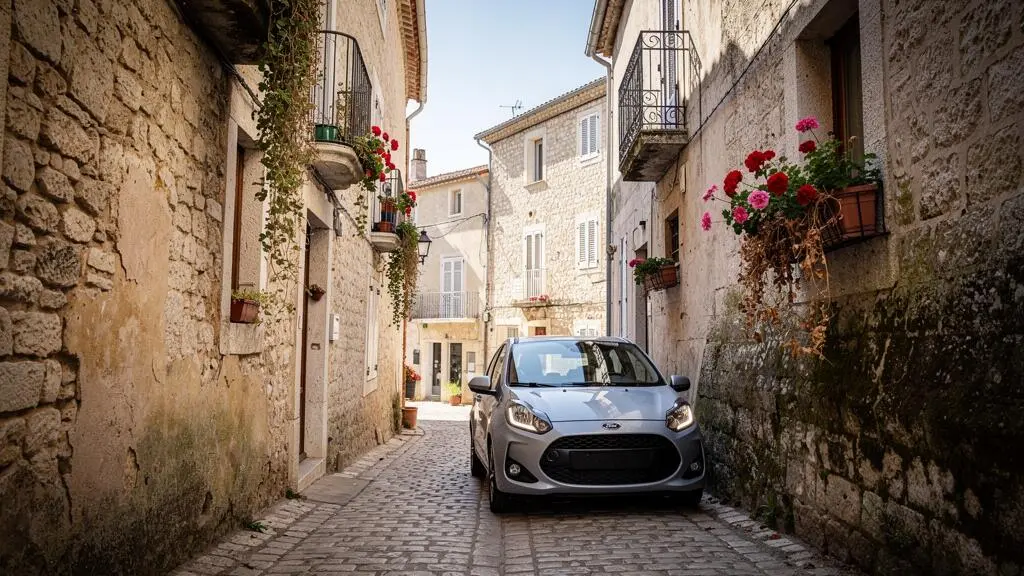
That familiar clench in your stomach as the road narrows to a sliver, stone walls closing in on either side. For many urban drivers, the idyllic image of a historic village is shattered by the reality of navigating lanes built for carts, not cars. The common advice is to “be careful” or “drive slowly,” but this vague counsel does little to build real confidence. It leaves you reacting to problems rather than preventing them, leading to stressful standoffs, or worse, the sickening scrape of paint on ancient stone.
The panic that sets in when you meet another car head-on is real. Who should reverse? Is that gap big enough? Will the residents be annoyed? This anxiety stems from a lack of a clear system. But what if the solution wasn’t just about being cautious, but about being tactical? What if you could replace fear with a clear understanding of spatial intelligence and a simple, effective courtesy protocol?
This guide moves beyond generic tips. We will deconstruct the art of rural lane navigation into a series of learnable skills. We’ll explore the micro-techniques that protect your vehicle, the unwritten social rules of passing places, and the fundamental physics that dictates why some cars glide through tight spaces while others get stuck. This is your coaching manual for turning rural driving anxiety into assertive, calm, and confident control.
This article breaks down the essential skills for mastering narrow roads. The following sections provide a complete roadmap, from basic vehicle protection to advanced strategic decisions, ensuring you can enjoy the beauty of rural and historic areas without the stress.
Summary: Your Guide to Mastering Narrow Village Roads
- Why Tucking Mirrors and Driving at 8mph Saves Your Paintwork in Tight Villages
- How to Use Village Passing Places Correctly Without Angering Residents
- Morning or Late Afternoon: When Are Village Streets Clearest for Nervous Drivers
- The Backup Mistake That Traps 20% of Visitors in Dead-End Village Lanes
- When Should You Park Outside and Walk Into Villages Rather Than Drive Through
- Why a 2.4m Wheelbase Turns in 4m Less Space Than a 2.8m Wheelbase Vehicle
- How to Navigate Single-Track Clifftop Routes Without Stress or Standoffs
- How Short-Wheelbase Vehicles Navigate Historic Towns 3× Faster Than Standard Cars
Why Tucking Mirrors and Driving at 8mph Saves Your Paintwork in Tight Villages
The single greatest cause of anxiety in tight lanes is the fear of contact. The sound of a wing mirror scraping against a stone wall is a universally dreaded experience. The solution is a two-part technique: proactively managing your vehicle’s width and mastering a crawl speed. Tucking in your mirrors isn’t a sign of defeat; it’s an act of professional spatial intelligence. Before you even enter a visibly tight section, fold them in. This simple action can instantly gain you several crucial inches of clearance and, more importantly, removes the widest, most vulnerable part of your car from the danger zone.
Next is speed. An 8mph (or roughly 13km/h) crawl isn’t just about being “slow”; it’s about matching your speed to your processing power. At this pace, your brain can accurately judge distances, spot hazards, and make micro-adjustments to your steering. It turns a panicked reaction into a calm, controlled process. Official guidance reinforces this, advising drivers to reduce speed at approaches to bends, which can be sharper than they appear, and at hidden junctions. This isn’t just a suggestion; it’s the foundation of defensive driving in environments where visibility is limited and every inch matters.
By making these two actions—tucking mirrors and maintaining a crawl—an automatic habit, you fundamentally change the experience from a gamble to a calculated maneuver.
How to Use Village Passing Places Correctly Without Angering Residents
Passing places are the grammar of single-track roads, but many visitors don’t know how to speak the language, leading to frustration and conflict. Using them correctly is about following a clear “courtesy protocol” that goes beyond the basic rules. The official guidance provides the foundation.
Single-track roads. These are only wide enough for one vehicle. They may have special passing places. If you see a vehicle coming towards you, or the driver behind wants to overtake, pull into a passing place on your left, or wait opposite a passing place on your right. Give way to road users coming uphill whenever you can. If necessary, reverse until you reach a passing place to let the other vehicle pass.
– Highway Code, Rule 155, The Highway Code – General advice
While the rule is clear, the etiquette is what maintains goodwill. The most critical, unspoken rule is to anticipate and commit early. As soon as you see an oncoming vehicle, identify the nearest passing place. If it’s on your left, pull in. If it’s on your right, stop opposite it, leaving the space clear for the other driver. This decisiveness prevents the awkward, hesitant dance that blocks traffic. Locals would rather reverse a hundred yards themselves than deal with a visitor blocking the lane because they failed to use an available space.
Action Plan: Passing-Place Etiquette Checklist
- Never Park: Passing places are strictly for passing. Never use them for parking, even for a moment, as this can cause a complete obstruction.
- Slow Down Early: When you spot an oncoming car, reduce your speed gradually instead of braking sharply at the last second. This signals your awareness and intent.
- Signal Your Intention: Position your car clearly to show you intend to stop. Keep your wheels straight and leave ample room for the other vehicle to maneuver.
- Avoid Soft Verges: Be wary of pulling onto grass verges next to passing places. They can be soft, collapse under the weight of a car, or conceal deep drainage ditches.
- Acknowledge with a Wave: Once the other vehicle has passed, a simple wave of the hand is the universal sign of thanks on rural roads. It’s a small gesture that builds immense goodwill.
By treating passing places not just as a rule but as a communication tool, you demonstrate respect and competence, ensuring a smooth flow for everyone.
Morning or Late Afternoon: When Are Village Streets Clearest for Nervous Drivers
For an anxious driver, the number of potential conflicts is directly proportional to the amount of traffic. Therefore, the most powerful strategy you can employ is timing. Driving through a popular village at midday on a summer Saturday is a recipe for stress. You’ll encounter a constant stream of other visitors, delivery vans, and local traffic. The key is to schedule your passage for the “golden hours” when the lanes are quietest.
The two best windows are typically early morning (before 10:00 AM) and late afternoon (after 4:00 PM). In the morning, you are ahead of the day-trippers and delivery schedules. The light is often better for visibility, and the atmosphere is calmer, allowing you to navigate at your own pace without feeling pressured from behind. In the late afternoon, the crowds have begun to disperse, and you’re more likely to have the roads to yourself. These quiet periods transform a stressful obstacle course into a pleasant, scenic drive.
Conversely, avoid the peak window between 11:00 AM and 3:00 PM, as well as the local school run times, which can create surprising bottlenecks even in the smallest villages. Choosing your time is a proactive measure that prevents problems before they can even begin.
The Backup Mistake That Traps 20% of Visitors in Dead-End Village Lanes
The ultimate nightmare scenario is not just meeting another car, but finding yourself at a dead end or a turn too tight to make, with a long, difficult reverse as your only way out. This is often not the driver’s fault but a consequence of over-reliance on satellite navigation systems that lack nuance. In fact, research shows that sat-navs are a major contributor to this problem, with one study finding 42% of drivers have been rerouted onto narrow country lanes by their devices trying to find a shortcut.
The critical mistake is reversing with poor reference points. Many drivers, in a panic, fixate on their rearview mirror. This provides a very narrow, distorted field of view. The correct technique is to use your side mirrors as your primary guide. Adjust your driver’s side mirror down so you can clearly see your rear wheel and the kerb or wall. Then, make tiny, slow steering adjustments to maintain a consistent gap between your wheel and the edge. Look in the rearview mirror only for a moment to check for obstacles far behind you, then immediately return your focus to the side mirror. This method is slower but infinitely more precise and safer.
Before committing to a lane that looks questionable, check your map. If the road is unclassified (a white road on most maps) and not your intended destination, treat your sat-nav’s suggestion with suspicion. Trust a paper map or the road signs over a GPS determined to save you thirty seconds by sending you down a tractor path.
When Should You Park Outside and Walk Into Villages Rather Than Drive Through
The smartest move in rural navigation is sometimes not to navigate at all. Knowing when to park and walk is a sign of an experienced, confident driver, not a timid one. It’s a strategic decision that eliminates 100% of the stress. But how do you make that call? There are three key factors to consider: your vehicle, the time of day, and the village’s reputation.
First, be honest about your vehicle. If you’re driving a large SUV, a long-wheelbase sedan, or a campervan, your margin for error is virtually zero. Many historic villages have designated car parks on their outskirts for this very reason. Using them is the expected and courteous thing to do. Second, consider the timing. Arriving at a famously picturesque village like Castle Combe or Polperro at noon on a bank holiday? Even in a small car, the sheer volume of traffic and pedestrians will make the drive a miserable, stop-start ordeal. The ten-minute walk from the car park will be far more pleasant. Finally, do a quick search beforehand. Local forums or travel blogs will often have candid advice about the feasibility of driving through a particular village center.
If you see signs for a “Village Car Park” on the approach, take it as a strong hint from the locals. Choosing to walk demonstrates respect for the historic environment and for the residents who live there, and it guarantees your visit starts and ends on a positive, stress-free note.
Why a 2.4m Wheelbase Turns in 4m Less Space Than a 2.8m Wheelbase Vehicle
Why do small city cars seem to pivot effortlessly in tight spaces while larger cars require awkward three-point turns? The answer lies in a single, crucial metric: the wheelbase. This is the distance between the center of the front wheels and the center of the rear wheels. It is the dominant factor in determining a car’s turning circle—the smallest space it needs to complete a U-turn. Understanding this concept of “mechanical empathy” is key to assessing your car’s capabilities.
The relationship is surprisingly direct. As the underlying physics confirms, turning radius equals wheelbase divided by the sine of the steering angle. This means for the same steering lock, a car with a 10% shorter wheelbase will have a 10% tighter turning circle. A compact car with a 2.4-meter wheelbase can have a turning circle diameter of under 10 meters, while a large sedan with a 2.8-meter wheelbase might need over 12 meters. That two-meter difference is the gap between a smooth turn and getting stuck against a medieval wall.
| Vehicle Category | Typical Wheelbase | Curb-to-Curb Turning Diameter |
|---|---|---|
| Compact city car | Under 100 in (2.5m) | 30–35 ft (9.1–10.7m) |
| Mid-size sedan / crossover | 105–115 in (2.7–2.9m) | 37–41 ft (11.3–12.5m) |
| Full-size sedan / large SUV | Over 115 in (2.9m+) | 43 ft+ (13.1m+) |
Knowing your car’s approximate wheelbase and turning circle transforms you from a hopeful driver to an informed strategist. It allows you to look at a narrow street and make a realistic judgment call before you commit.
How to Navigate Single-Track Clifftop Routes Without Stress or Standoffs
Single-track coastal roads add a new layer of psychological pressure: the sheer drop. While the principles are the same as in a village, the stakes feel higher. The key to managing these routes is an exaggerated form of defensive patience and an unwavering adherence to the rule of braking in a straight line. You must scrub off all your excess speed *before* you enter a blind bend, not during it.
Physics dictates that you should perform your braking before you actually begin the turn. Attempting to slow down while already deep into a sharp corner puts excessive strain on your tires and can lead to skidding, especially if the surface is damp.
– Central Towing, How To Drive Safely Through Mountain Passes
On clifftop or mountain roads, the “courtesy protocol” has a crucial addition: uphill traffic has priority. It is significantly more difficult and dangerous for a driver to restart a car on a steep incline, especially with a manual transmission, than it is for the downhill driver to pause. If you are heading downhill and see a car coming up, you must be the one to find a passing place and wait. Furthermore, on blind bends where you cannot see what’s coming, a short tap of the horn is not aggressive; it is a standard, accepted safety procedure in many rural areas to announce your presence.
Finally, always keep your car positioned towards the rock face side of your lane, not the cliff edge. This gives you a crucial buffer of space and a solid reference point, maximizing both your actual and perceived safety.
Key Takeaways
- Confidence on narrow roads comes from a learned system of spatial awareness and clear etiquette, not just slow speed.
- Proactive use of passing places, including stopping opposite them, is the cornerstone of a smooth traffic flow and resident goodwill.
- A vehicle’s wheelbase is the primary determinant of its agility. Knowing your car’s turning limitations allows you to make strategic choices, including when to park and walk.
How Short-Wheelbase Vehicles Navigate Historic Towns 3× Faster Than Standard Cars
Bringing all these concepts together, we see a clear conclusion: in the constrained environment of a historic town, a vehicle’s agility is its most valuable asset. The “3x faster” isn’t about raw speed; it’s about flow. A driver in a short-wheelbase car eliminates the stop-assess-maneuver cycles that plague larger vehicles. Every turn that is completed in one motion, every gap that is taken without hesitation, and every U-turn that doesn’t become a five-point turn saves precious time and, more importantly, mental energy.
The difference is not trivial. A compact car like a Kia Soul can boast a turning radius of just 5.3 meters, allowing it to pivot with ease. Compare this to a large SUV, and the practical implications become stark. A long vehicle forces its driver to pre-think every single maneuver in a residential or historic setting, constantly scanning for escape routes.
Case Study: The Full-Size SUV Gridlock
Consider the Chevrolet Suburban, a vehicle built for open roads. With a wheelbase stretching over 130 inches (3.3m), it demands a turning circle of over 43 feet (13.1m). In a narrow village lane, encountering a tight 90-degree turn becomes a logistical puzzle. The driver must stop, assess if the turn is even possible, and likely perform a multi-point turn, blocking the lane for the duration. This is the “stop-assess-maneuver” cycle that a short-wheelbase vehicle completely avoids.
Ultimately, choosing the right vehicle for the environment—or choosing to leave a large vehicle parked—is the final and most powerful expression of a confident, strategic driver. It’s the ultimate application of mechanical empathy, transforming a potentially stressful encounter into a simple, effortless experience.