In summary:
- Overcome fear on clifftop roads not by being timid, but by using a system of proactive control.
- Master descents by using low gears for engine braking, not by constantly riding the foot brakes, which leads to failure.
- Navigate hairpin bends safely by adopting a wide-in, tight-apex, wide-out line, keeping your speed managed before the turn.
- Use a “snub braking” technique—firm braking then full release—to manage speed without overheating your brakes.
- On loose surfaces, momentum and correct tyre pressure are more important than four-wheel drive.
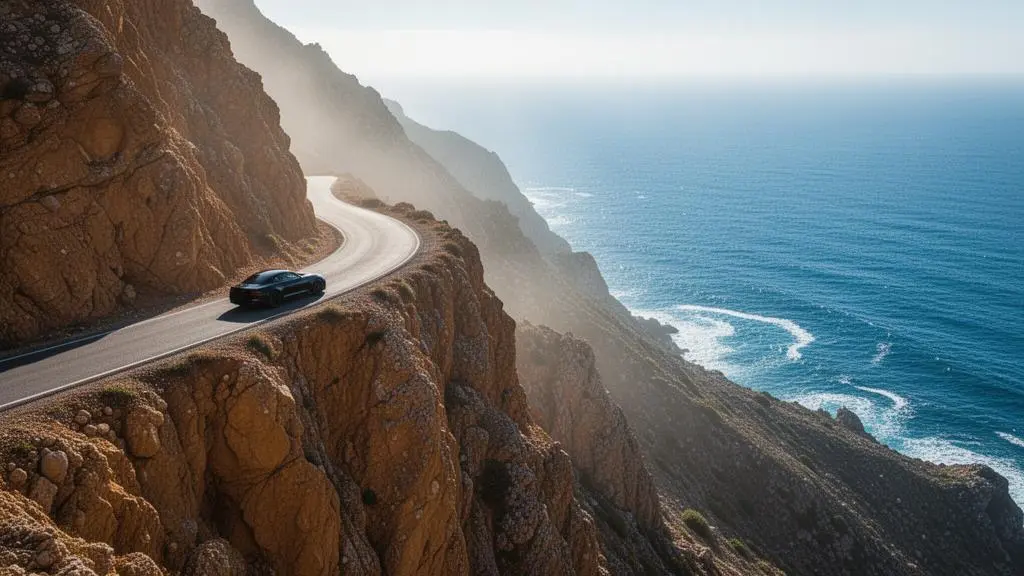
The view from a clifftop road is a reward, but for many drivers, the journey feels more like a risk. The combination of a steep drop, a narrow verge, and a seemingly endless series of sharp bends can trigger a primal fear that paralyzes skill. The common advice to simply “drive slowly” or “be careful” is not only unhelpful; it’s often wrong. A hesitant driver reacting to fear is unpredictable and unsafe. True confidence on these challenging roads doesn’t come from timidity, but from understanding vehicle dynamics and applying a systematic approach to control.
The key is to shift your mindset from being a passive passenger, reacting to the road’s challenges, to being a proactive pilot in command of your vehicle. This isn’t about speed; it’s about precision. It involves learning how to manage your car’s energy, not just its direction. Instead of fearing brake failure or the edge of the road, you will learn the specific, repeatable techniques that high-performance drivers use to maintain a margin of safety, regardless of the gradient or the sharpness of the curve. This guide will equip you with that system, breaking down the professional techniques for braking, cornering, and managing different road surfaces, turning anxiety into empowered, confident execution.
This comprehensive guide provides a structured approach to mastering these environments. We will deconstruct the forces at play and provide you with a clear, actionable toolkit to transform your driving experience from stressful to spectacular.
Summary: How to Drive Gravel and Dirt Tracks Confidently Without Four-Wheel Drive
- Why Standard Braking Fails on 15% Downhill Coastal Gradients
- How to Take Clifftop Hairpin Bends Without Crossing the Centreline or Edging Off
- Manual or Automatic: Which Gearbox Handles Clifftop Descents More Safely
- The Downhill Speed Mistake That Leads to Brake Fade in 8 Out of 10 Cases
- What Weather Signs Mean You Should Postpone a Clifftop Drive for Safety
- Why Techniques That Work on Gravel Fail Completely on Loose Sand Tracks
- How to Configure Regen Levels for Maximum Recovery on Descents Without Discomfort
- How to Drive Gravel and Dirt Tracks Confidently Without Four-Wheel Drive
Why Standard Braking Fails on 15% Downhill Coastal Gradients
On a steep, winding descent, your foot brake is not your primary tool for speed control; it’s your emergency backup. The common mistake is “riding the brakes”—applying light, constant pressure to maintain a slow speed. This single error is the fastest way to induce brake fade, a terrifying phenomenon where your brakes simply stop working. On a 15% gradient, gravity is constantly working to accelerate your vehicle, and your brakes must convert that kinetic energy into heat. Constant application prevents them from cooling, causing the brake fluid to boil or the pads to glaze over and lose their grip.
As expert John Fuller notes, “Brake fade is a critical issue that drivers must understand, especially when navigating long downhill grades.” The solution is to use your engine as the primary brake. By selecting a low gear (1st or 2nd in a manual, or L/2 in an automatic), you force the engine to run at high RPMs, creating a powerful retarding force known as engine braking. This technique controls your speed without ever touching the brake pedal, keeping your friction brakes cool and ready for when you truly need them. A simple rule: if you have to keep your foot on the brake to maintain speed, you are in too high a gear. You must downshift until the car holds a safe speed on its own.
Developing a feel for this is key to proactive control. You need to recognize the early sensory warnings of overheating brakes. Pay attention to a spongy or soft feeling in the brake pedal, a grinding or squealing noise that wasn’t there before, or a noticeable smell of burning. These are all signs that your brakes are approaching their thermal limit. If you notice any of them, you must pull over at the next safe opportunity and let the system cool down completely.
How to Take Clifftop Hairpin Bends Without Crossing the Centreline or Edging Off
A hairpin bend on a clifftop is a pure test of car control, demanding a precise sequence of actions. Fear causes drivers to hug the inside or brake mid-corner—both are dangerous errors that destabilize the car. The professional technique is to use a “safety racing line,” which maximizes visibility and grip while minimizing steering input. This involves using the full width of your lane in a wide-in, tight-apex, wide-out trajectory. The geometry of some roads can be extreme; for instance, one of the steepest roads in Northern Europe demonstrates that drivers may face gradients over 20% combined with repeated hairpins.
The sequence is everything. Your speed must be set before you begin to turn. This is the most critical part of the process. As you approach the bend:
- Position Wide: Position your car on the outside of your lane (e.g., close to the centreline for a right-hand bend). This gives you the best possible view into the corner.
- Brake in a Straight Line: Complete all your braking while the car is still travelling straight. The car is most stable under braking when the wheels are not turned.
- Turn-In and Aim for the Apex: As you start to steer, release the brake. Guide the car smoothly towards the inside of the bend, known as the apex. This is the tightest point of the corner.
- Look Through the Corner to the Exit: From the apex, look where you want to go—to the outside of your lane at the corner’s exit. Gently begin to apply power to stabilize the car and transfer weight to the rear wheels. This is the “wide-out” phase.
This wide-tight-wide line effectively makes the corner’s radius larger, which means less steering is required and the car remains more stable. It prevents the panicked, jerky steering inputs that can lead to crossing the centreline or, worse, edging off the road.
As this visualization shows, the line is a smooth, deliberate arc, not a series of sharp, reactive adjustments. By consciously practicing this technique on wider, safer corners, you build the muscle memory and confidence to execute it perfectly when the stakes are high. It transforms a fearful experience into a calculated, controlled manoeuvre.
Manual or Automatic: Which Gearbox Handles Clifftop Descents More Safely
When it comes to safely managing a clifftop descent, the type of gearbox is less important than the driver’s ability to use it correctly for engine braking. Both manual and modern automatic transmissions are fully capable of providing the necessary control, but they require different inputs from the driver. The myth that automatics are unsafe on hills is outdated; modern systems offer a high degree of manual-style control if you know how to access it. The goal is the same for both: select and hold a low gear to let the engine, not the brakes, control your speed.
In a manual car, the driver has the highest level of control. Before the descent begins, you must proactively select 1st or 2nd gear. If you find yourself needing to brake constantly, you are in too high a gear and must shift down again. The correct gear is the one that holds the car at a safe, steady speed (e.g., 15-20 MPH) with your feet off all pedals. In a modern automatic, you can achieve the same effect by using the paddle shifters or the sequential +/- gate on the shifter to lock the transmission in a low gear (‘1’ or ‘2’). For older automatics or CVTs, there is often an ‘L’ (Low) or ‘2’ position on the shifter that serves the same purpose, holding the engine at higher RPMs to create braking force.
This table breaks down how engine braking is achieved with different gearbox types, providing a clear comparison of the control each one offers.
| Gearbox Type | How Engine Braking Is Achieved | Driver Control Level |
|---|---|---|
| Manual | Driver selects and holds a low gear proactively before the descent begins | Highest — full control over exact gear and RPM |
| Modern Automatic | Paddle shifters, +/- manual mode, or a locked ‘3/2/1’ position simulate manual gear holding | High — near-manual control once engaged |
| CVT | ‘L’ mode or pre-set virtual steps simulate discrete gears and hold higher RPM | Moderate — simulated rather than true gear holding |
| EV / Electric | Regenerative braking levels replace mechanical engine braking | Variable — depends on selectable regen strength |
Ultimately, safety isn’t determined by the transmission but by the driver’s knowledge. Understanding how to command your specific gearbox to provide engine braking is a non-negotiable skill for tackling steep gradients. It’s the core of a proactive, systematic approach to driving challenging terrain.
The Downhill Speed Mistake That Leads to Brake Fade in 8 Out of 10 Cases
The single most common and dangerous mistake on a long downhill stretch is incorrect braking technique. It’s not about braking too hard, but braking *improperly*. The typical anxious driver defaults to a “yo-yo” cycle: they ride the brake, feel the car slowing, release, feel it speeding up, and brake again. This constant on-off friction generates immense, continuous heat without any significant time for the brake components to cool. This is the fast track to brake fade. The correct professional technique is the complete opposite: it’s called intermittent braking, or “snub braking”.
Snub braking is a deliberate, two-stage process. First, let the car’s speed increase slightly above your target (while in a low gear for engine braking). Then, apply the brakes firmly and decisively—not an emergency stop, but a confident application—to bring the speed down well *below* your target. Then, completely release the brake pedal. This creates a longer period where the brakes are off entirely, allowing air to flow over them and dissipate heat. This firm-on, fully-off cycle is far more effective at managing both speed and temperature than the constant, light-pressure “riding” that causes overheating. If you feel any signs of brake fade, you must pull over safely. In fact, brake specialists note that even a stop of 10 minutes can allow an overheated system to recover significantly.
This technique requires confidence but it is the foundation of safe descending. It keeps your brakes in their optimal temperature range, ensuring they are ready to provide full power if an unexpected hazard appears. Mastering snub braking means you are no longer reacting to your speed; you are actively and systematically managing it. It’s a crucial shift from a mindset of fear to one of proactive control.
Your Action Plan: Implementing the Snub Braking System
- Gear Selection: Before the descent, select a low gear (1st/2nd) that allows the engine to hold a slow, steady speed without braking.
- Set Speed Brackets: Define your safe speed range (e.g., between 15 and 25 MPH). Do not touch the brakes while within this range.
- Execute the “Snub”: When speed naturally drifts above your upper limit (25 MPH), apply brakes firmly to bring it below your lower limit (15 MPH).
- Full Release: Immediately and completely release the brake pedal. Allow the car to coast, using only engine braking, until the speed again drifts above the upper limit.
- Monitor and Repeat: Continue this “on-off” cycle for the entire descent, ensuring the brakes have maximum time to cool between applications.
What Weather Signs Mean You Should Postpone a Clifftop Drive for Safety
A high-performance driver knows that the most important safety decision is sometimes the one to not drive at all. Clifftop roads are uniquely exposed to rapid and dramatic weather changes that can transform a scenic drive into a high-risk situation. Your ability to read the early warning signs in the environment is just as crucial as your ability to handle the car. Relying solely on a weather app is a mistake; you must learn to interpret the visual cues around you. Three conditions in particular demand extreme caution or postponement: high winds, sudden fog, and heavy rain.
Crosswinds are especially dangerous on exposed cliffs. They can be strong enough to physically push your vehicle towards the verge or into the oncoming lane. Look for signs of wind strength before you get to the most exposed sections: are trees and bushes bent over? Are there whitecaps on the sea below? A sudden gust in a tight corner can be severely destabilizing. If the wind is strong enough to make you fight the steering wheel on a straight section, it is too strong for the drive. Sea fog can roll in with breathtaking speed, reducing visibility to near zero in minutes. Look for a low, solid-looking “wall” of cloud on the horizon over the water. If it appears to be moving towards the coast, your window of opportunity to drive safely is closing rapidly. Never try to “outrun” it; it’s better to wait it out or turn back.
Finally, heavy rain on a clifftop road presents multiple threats. It reduces visibility, dramatically increases braking distances, and can cause localized flooding or washouts. Pay attention to the road surface. Is it just damp, or is there standing water? A glossy sheen on the asphalt at night can indicate “black ice” in colder temperatures, a nearly invisible layer of ice that offers almost zero grip. Proactive control means recognizing these elevated risks and making the conservative choice. The road will still be there tomorrow when conditions are safe.
Why Techniques That Work on Gravel Fail Completely on Loose Sand Tracks
Driving on unpaved surfaces requires a completely different approach from tarmac, and critically, not all loose surfaces are the same. The techniques that give you control on a compacted gravel track will get you hopelessly stuck on loose beach sand. Understanding the physics of each surface is key to adapting your technique. Gravel offers a relatively high-friction surface where sharp, decisive steering and braking inputs can work. Sand, however, is a low-friction, high-drag environment where control is all about flotation and momentum.
On gravel, your tyres can bite into the surface for grip. On sand, your tyres need to float on top of it. Attempting to accelerate or turn sharply on sand causes the wheels to dig in, instantly burying the car. The primary technique for sand is to lower your tyre pressures significantly. This increases the length of the tyre’s footprint, turning it from a “knife” that cuts into the sand into a “ski” that glides over it. As tyre specialists explain, the surface area nearly doubles when pressure drops to around 15 PSI, providing the necessary flotation. The second key is momentum. You must build up a steady speed *before* entering the softest sections and maintain it with smooth, gentle inputs to the throttle and steering. Any sudden change in speed or direction will break that flotation and bring you to a halt.
In short, the contrast is stark:
- Gravel Driving: Relies on grip. Allows for more aggressive inputs. Tolerates changes in speed.
- Sand Driving: Relies on flotation and momentum. Requires extremely smooth, gentle inputs. Punishes any sudden change in speed.
Failing to recognize this fundamental difference is why so many two-wheel-drive cars that could easily handle a dirt track end up needing a tow on the beach. It’s not about the car’s drivetrain; it’s about the driver’s understanding of the surface.
How to Configure Regen Levels for Maximum Recovery on Descents Without Discomfort
For electric vehicle (EV) drivers, the concept of engine braking is replaced by regenerative braking (“regen”). This system uses the electric motor as a generator during deceleration, converting the car’s kinetic energy back into battery charge. While this is a highly efficient feature, configuring it for a steep, winding clifftop descent requires a nuanced approach that balances energy recovery with driver comfort and safety. The temptation is to set the regen to its maximum level to recover the most energy, often enabling “one-pedal driving” (OPD) where lifting off the accelerator produces strong braking.
However, maximum regen is not always the optimal setting. On a very steep gradient, even the strongest regen may not be enough to control the car’s speed, still requiring use of the friction brakes. More importantly, aggressive regen can feel jerky and unsettling to passengers, and it can disrupt the car’s balance mid-corner if the driver lifts off the accelerator abruptly. This is not just a comfort issue; it can be a safety concern. A driving-simulator study comparing one-pedal and two-pedal driving safety found that while OPD was simpler, it could lead to compromised performance and reduced safety margins in certain situations, particularly in how drivers react to unexpected events.
Case Study: The One-Pedal Driving Trade-Off
A driving-simulator study with 26 participants compared one-pedal (OPD) and two-pedal (TPD) modes. The results revealed a significant trade-off: while OPD simplified operation, it led to compromised driving performance and delayed braking reactions in specific contexts compared to TPD. This indicates that relying solely on aggressive regen for all deceleration may introduce potential safety risks by blurring the line between coasting and braking.
The professional approach is to use a blended technique. Select a moderate level of regen that provides a smooth, consistent retarding force, similar to being in a low gear in a conventional car. This provides the primary control. You then use your foot brake for additional braking when needed, just as you would with the “snub braking” technique. This approach provides smooth, predictable, and comfortable control, keeps the friction brakes cool, and still recovers a significant amount of energy, without the potential downsides of an overly aggressive one-pedal setup.
Key takeaways
- Proactive control, not fear, is the key to safely navigating challenging roads. Master the system, master the drive.
- Your engine and gearbox are your primary brakes on a descent. Use low gears to control speed and save your foot brake for when it’s truly needed.
- The correct line through a corner (wide-in, tight-apex, wide-out) is a non-negotiable safety technique that maximizes visibility and stability.
How to Drive Gravel and Dirt Tracks Confidently Without Four-Wheel Drive
Confidence on gravel and dirt roads has less to do with having four-wheel drive and more to do with understanding one crucial principle: tyre pressure and traction. A standard road car can handle a surprising amount of loose-surface driving if prepared correctly. The biggest mistake drivers make is attempting these tracks with their tyres inflated to road pressures (e.g., 35 PSI or higher). At this pressure, the tyre is hard and unyielding. It cannot mould to the uneven surface, causing it to skip over the top of gravel and lose traction easily.
The solution is to “air down.” By significantly reducing your tyre pressure, you transform the tyre’s behaviour. A softer tyre has a larger contact patch and can deform around rocks and ruts, dramatically increasing grip. While specific pressures vary, off-road tyre guidance recommends a range of 15–18 PSI for general loose surfaces. This single adjustment makes a world of difference. It’s crucial, however, to have a portable air compressor to re-inflate your tyres before returning to paved roads. Driving at speed on tarmac with low-pressure tyres is extremely dangerous and can cause a blowout.
Beyond tyre pressure, your driving style must adapt. All inputs—steering, braking, and acceleration—must be smoother and more deliberate than on pavement. Look much further ahead to anticipate changes in the road surface. A patch of deep, loose gravel or a series of potholes requires you to have your speed already adjusted before you reach it. By combining the right tyre pressure with a smooth, forward-looking driving style, you give your two-wheel-drive car the best possible chance to maintain traction, allowing you to explore with confidence.
Now that you are equipped with these professional techniques, the next step is to put them into practice in a controlled environment. Start on wide, open roads with gentle slopes to build muscle memory and confidence before tackling that spectacular coastal route you’ve been avoiding.