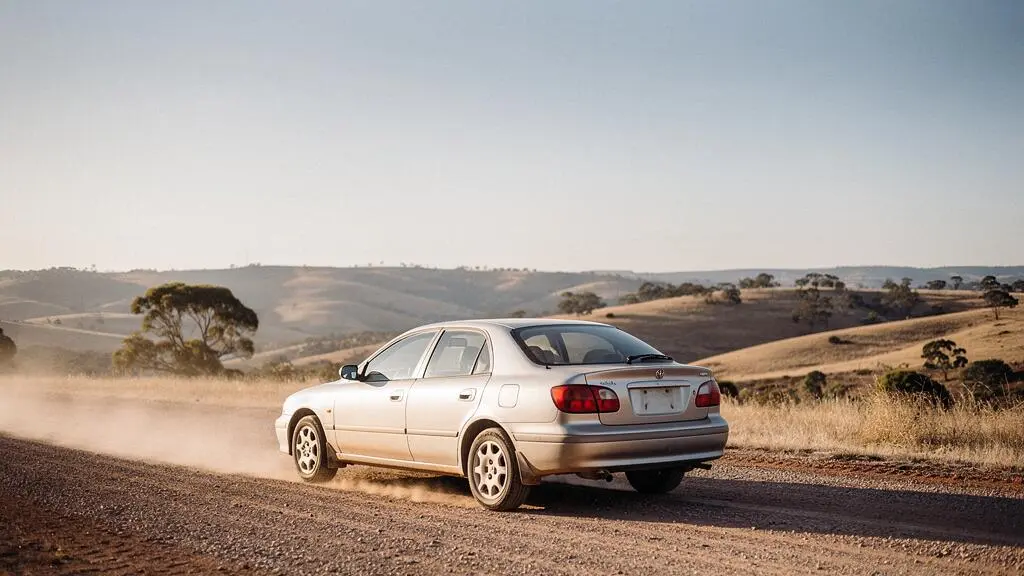
In summary:
- Driving a 2WD on unpaved roads is about technique, not just vehicle type. The key is understanding how your car interacts with different surfaces.
- Mastering throttle control and momentum is crucial for maintaining traction and avoiding the common mistakes that lead to getting stuck.
- Your choice of tyres often has a greater impact on safety and performance in loose conditions than whether you have all-wheel drive.
- Recognising hazardous track conditions and knowing when it’s safer to turn back is a critical skill for any adventurer in a standard car.
The allure of a backcountry trail or a secluded beach is often tempered by the road that leads to it—a stretch of gravel, a sandy track, or a muddy lane. For drivers of standard two-wheel-drive cars, this is where the adventure often stops. The fear of a damaged suspension, a punctured tyre, or the definitive nightmare of getting hopelessly stuck keeps most vehicles glued to the tarmac. Common wisdom suggests two solutions: go painfully slow and hope for the best, or accept that these roads are the exclusive domain of rugged four-wheel-drive vehicles. This mindset, however, overlooks a fundamental truth.
Confidence on unpaved surfaces doesn’t come from an extra set of driven wheels; it comes from knowledge. Specifically, it’s about understanding the unique physics of each surface and adapting your driving technique accordingly. Gravel, sand, mud, and snow are not a monolithic “bad road”—they are distinct environments that demand different inputs for throttle, steering, and braking. The mistake most drivers make is applying the same cautious-but-uninformed approach to all of them, which is precisely what gets them into trouble. A technique that provides excellent grip on gravel can cause you to dig into sand instantly.
This guide is designed to act as your personal off-pavement instructor. We will deconstruct the interaction between your standard car and the ground beneath it. By learning to “read” the surface and apply the correct techniques, you will expand your vehicle’s capabilities far beyond what you thought possible. We will cover the critical differences between surfaces, the crucial role of tyres, the single biggest throttle mistake in mud, and the essential skill of knowing when the safest move is to turn back. It’s time to unlock the full potential of the car you already own.
Table of Contents: A Guide to All-Surface Driving in a Standard Car
- Why Techniques That Work on Gravel Fail Completely on Loose Sand Tracks
- How to Drive Corrugated Gravel Roads Without Losing Control or Damaging Suspension
- All-Season or Summer Tyres: Which Grip Gravel and Dirt Tracks More Safely
- The Throttle Mistake That Gets 60% of Two-Wheel-Drive Cars Stuck in Mud
- What Track Conditions Mean You Should Turn Back With a Standard Car
- Saloon Car or Crossover: Which Ground Clearance Handles Grass Car Parks and Gravel
- Why Front-Wheel Drive With Winter Tyres Outperforms 4WD on Summer Tyres in Snow
- How to Tackle Remote Backcountry Trails Without Recovery Service or Mobile Signal
Why Techniques That Work on Gravel Fail Completely on Loose Sand Tracks
The most common mistake drivers make is treating all unpaved surfaces as one. The key to confident driving lies in understanding the fundamental difference in how your tyres generate grip on varying terrain. On a typical gravel road, the stones are relatively coarse and angular. Here, your tyres need to dig in slightly to find purchase. A firm, properly inflated tyre allows the tread blocks to press into the surface, using the edges of the gravel for traction. This is why a steady, controlled application of power works well; it allows the tyre to maintain its grip.
Loose sand is the complete opposite. It’s a fluid medium. If you apply the same technique—using firm tyres and assertive throttle—the wheels will instantly dig down, burying themselves until the car’s underbelly rests on the sand, completely immobilising you. On sand, the goal is not to dig in, but to float on top. This requires maximising the surface area of your tyre’s footprint. By lowering tyre pressure by roughly 3 to 5 psi, you create a wider, more flexible contact patch. This, combined with maintaining momentum and using exceptionally smooth, light throttle inputs, allows the car to glide over the surface rather than trenching into it.
This principle of surface-specific physics is the foundation of capable off-pavement driving. Aggressive inputs that work on a high-traction surface like packed gravel will instantly overwhelm the low-traction, fluid nature of sand. Understanding this distinction is the first step from being a passenger to your fear to being an in-control driver.
How to Drive Corrugated Gravel Roads Without Losing Control or Damaging Suspension
Few surfaces are as jarring and unsettling as a “washboard” or corrugated gravel road. These high-frequency ripples can make the car feel like it’s shaking itself apart, causing the steering to go light and the rear end to feel unstable. This phenomenon is a direct result of vehicle traffic; it’s known that washboarding occurs in dry, granular road material with repeated traffic travelling at speeds above 8.0 kilometres per hour (5 mph). Trying to fight it by simply slowing down can often make the shaking worse, while going too fast can lead to a complete loss of control.
The solution is to find the “resonance window”—a specific speed where the suspension’s natural frequency allows the wheels to skim over the tops of the ripples instead of dropping into each trough. This speed is typically faster than you might feel comfortable with initially, often between 60-80 km/h (40-50 mph), depending on the car and the spacing of the corrugations. As you accelerate gently, you’ll feel the violent shaking smooth out into a gentle hum and a slightly “floaty” sensation. This is the sweet spot. The key is to maintain this speed with minimal steering and throttle inputs.
As guidance from road maintenance experts suggests, finding this window requires careful attention. According to the Jackson County Roads Department, a safe approach involves a few key steps:
- Slow down significantly, ideally to less than 32 km/h (20 mph), and minimise acceleration and braking when approaching a corrugated section.
- Avoid rapid acceleration on hills or in and out of corners, as these are the spots most prone to severe corrugation.
- Treat any excessive ‘floaty’ or drifting sensation as a sign you have overshot the safe resonance window and should ease off the throttle rather than pushing faster.
Mastering corrugated roads is less about brute force and more about finesse. It’s about using speed strategically to work *with* the road surface, not against it, thereby protecting both your control and your vehicle’s suspension components.
All-Season or Summer Tyres: Which Grip Gravel and Dirt Tracks More Safely
While driving technique is paramount, your tyres are the only part of the car in contact with the ground. Their design dramatically influences your safety and capability on unpaved tracks. The debate between summer and all-season tyres isn’t straightforward, as each has distinct advantages and disadvantages on loose surfaces.
Summer tyres are designed for optimal performance in warm, dry, and wet conditions on tarmac. They typically feature large, solid tread blocks and a relatively low void ratio (the amount of open space in the tread). On a packed-dirt or fine-gravel road, these stiff tread blocks can provide excellent stability and a connected feel. However, their harder rubber compound can struggle to conform to larger, irregular stones, and their tread pattern is not designed to effectively clear mud or loose sand. They can quickly become “slicks” when the going gets messy.
All-season tyres are a compromise by design. Their tread pattern features more sipes—small slits in the tread blocks—which provide thousands of extra biting edges. These are highly effective for gripping looser material like light gravel, dirt, and even light snow. The rubber compound is also designed to remain more flexible in a wider range of temperatures. This makes them a more versatile and generally safer choice for a driver who occasionally ventures onto forestry roads or farm tracks. Their main drawback is a slight reduction in ultimate grip and steering precision on dry tarmac compared to a dedicated summer tyre.
For the average adventure-seeker in a standard car, a good quality all-season tyre offers the best balance of on-road civility and off-pavement capability. It provides a crucial safety margin when a paved road unexpectedly turns to dirt, without the significant on-road compromises of a dedicated off-road tyre.
The Throttle Mistake That Gets 60% of Two-Wheel-Drive Cars Stuck in Mud
Mud is the great equaliser. It can immobilise a powerful 4×4 as easily as a city hatchback, and the primary culprit is almost always the driver’s right foot. When a wheel starts to slip in mud, the instinctive reaction is to apply more throttle—a panicked stab to power through. This is the single most effective way to get stuck. Mud has extremely low friction, and any sudden application of torque instantly overwhelms the available grip. The spinning wheel becomes a drill, digging itself deeper into the mire until the vehicle is high-centred on its frame.
The correct technique is entirely counter-intuitive: use less power and maintain momentum. The goal is to keep the wheels turning just enough to find traction without breaking it. This requires smooth, deliberate throttle inputs. As one off-road driving guide puts it, the approach must be one of finesse.
Use smooth throttle inputs to avoid wheel spin and maintain traction.
– Dialed Outdoor off-road driving guide, Off-Road Driving Techniques (Sand, Rock, Mud, Snow, Gravel)
To execute this correctly, you must retrain your instincts. Here is the proper sequence for navigating a muddy patch in a 2WD car:
- Reduce speed even further than on dry gravel roads the moment you see mud ahead. Momentum is your friend, but excessive entry speed is not.
- Select a higher gear than you normally would (e.g., 2nd instead of 1st). This reduces the amount of torque sent to the wheels, making it harder to spin them.
- Apply the throttle with extreme gentleness. Imagine an egg under the pedal. The goal is to avoid any sudden surge of power that could break traction.
- If the wheels do start to spin, ease off the throttle immediately. Don’t push through it. A slight reduction in power is often all it takes for the tyre to regain its bite.
This disciplined use of the throttle transforms it from a tool for getting stuck into a tool for maintaining grip. It’s about managing your limited traction budget wisely, a skill that separates capable drivers from stranded ones.
What Track Conditions Mean You Should Turn Back With a Standard Car
The most important skill in off-pavement driving isn’t knowing how to get through an obstacle, but knowing which obstacles to avoid altogether. Confidence grows from successful experiences, not from costly recovery operations. For a standard 2WD saloon or crossover without specialised recovery gear, the decision to turn back is a sign of intelligence, not defeat. You must learn to read the track ahead for warning signs that the risk is escalating beyond your vehicle’s capabilities.
Look for deep, parallel ruts. If they are deeper than your car’s ground clearance, your vehicle’s underbelly will drag, potentially causing damage and leaving your drive wheels suspended with no traction. Similarly, approach any water crossing with extreme caution. A puddle of unknown depth can hide a chassis-swallowing hole or flood your engine’s air intake. Another major red flag is a steep, loose incline. Without 4WD, attempting a climb where your wheels can’t find consistent grip will only result in spinning tyres and an uncontrolled slide backward.
Finally, be wary of severe side slopes (off-camber tracks). These can unbalance a vehicle with a higher centre of gravity and put immense stress on the downhill tyres. Before you commit to a challenging section, it’s wise to stop, get out, and walk it first. This gives you a true sense of the surface and potential hazards that are invisible from the driver’s seat.
Action Plan: Your Pre-Emptive Retreat Checklist
- Assess Rut Depth: Stop before entering deep ruts. Are they deeper than the lowest point of your car’s underbody? If yes, the risk of getting high-centred is too great.
- Probe Water Crossings: Never drive into murky water. Use a stick to check the depth across the entire path you intend to take. If it’s deeper than the middle of your wheel hub, turn back.
- Analyse Incline vs. Surface: Look at steep hills. Is the surface loose gravel, wet grass, or mud? If you don’t have enough momentum and the surface is slick, you won’t make it up.
- Evaluate Off-Camber Slopes: Does the track tilt severely to one side? For a standard car, especially a taller crossover, this poses a rollover risk. If it feels unnervingly tilted, it is.
- Consider Your Turnaround Point: Is there a safe, wide spot ahead to turn around? If the track is narrowing and you’re unsure what’s next, it’s better to reverse out or use the last good spot.
Saloon Car or Crossover: Which Ground Clearance Handles Grass Car Parks and Gravel
The choice between a traditional saloon and a crossover has a significant impact on your ability to tackle unpaved surfaces, and the deciding factor often comes down to a few critical inches. The most obvious advantage of a crossover is its superior ground clearance—the distance between the lowest point of the undercarriage and the ground. While a typical saloon might have 5-6 inches of clearance, it’s not uncommon for even a mainstream crossover lineup to be built with a minimum ground clearance of 8.3 inches. This extra height is the difference between clearing a hidden rock on a gravel track and suffering a catastrophic oil sump puncture.
Beyond simple clearance, the vehicle’s geometry—its approach, breakover, and departure angles—plays a vital role. A saloon’s long front overhang is highly susceptible to scraping on the transition from a flat road to a steep driveway or the entrance of a rutted field. A crossover’s shorter overhangs and higher nose allow it to tackle these inclines without expensive plastic-on-ground contact. This is particularly relevant for navigating the lumpy, unpredictable terrain of a grass car park at a country fair or event.
However, it’s a mistake to think ground clearance is everything. Most crossovers are still front-wheel drive. While they sit higher, their fundamental traction mechanics are the same as a saloon’s. An FWD crossover still benefits from having the engine’s weight over the drive wheels, which helps them “claw” their way up moderate, slippery inclines. Ultimately, the crossover’s primary advantage is defensive; its height provides a crucial buffer against damage from unseen obstacles, making it a more forgiving and less stressful vehicle for casual unpaved exploration.
Why Front-Wheel Drive With Winter Tyres Outperforms 4WD on Summer Tyres in Snow
One of the most persistent myths in motoring is that all-wheel drive (AWD) is an automatic “I win” button for snow and ice. While AWD provides a clear advantage in acceleration from a standstill, it does absolutely nothing to improve a car’s ability to turn or, most critically, to stop. Braking and steering rely entirely on the grip provided by your four tyre contact patches. This is where the tyre-versus-drivetrain debate becomes a matter of life and death. As a leading tyre manufacturer states unequivocally:
A front-wheel-drive car with winter tires will stop and handle better than an AWD vehicle on all-season tires.
– Michelin USA, AWD vs Winter Tires: The Truth About Safety
This isn’t just marketing; it’s physics. Winter tyres use a special rubber compound that stays soft and pliable at low temperatures, allowing them to conform to road imperfections. Their tread is covered in thousands of “sipes” that act like squeegees to clear water and provide biting edges on ice. All-season tyres, by contrast, use a harder compound that becomes stiff and ineffective in the cold, drastically reducing grip. The result is that an AWD vehicle on the wrong tyres may get you going faster, but it won’t help you stop before sliding into an intersection.
Case Study: Mini Cooper FWD-on-Winters vs AWD-on-All-Seasons
A controlled test provides stark evidence. In a comparison between two Mini Coopers—one AWD on all-season tyres and one FWD on dedicated winter tyres—the results were revealing. In a snow-covered braking test, the FWD Mini on winter tyres stopped a full car-length shorter than its AWD counterpart. A test summary confirms that in two out of three driving metrics, FWD on snow tyres outperformed AWD with all-season tyres. The only area where AWD had a clear advantage was in pure acceleration from a stop. This demonstrates that for overall winter safety, the correct surface-specific equipment (tyres) is far more important than the drivetrain.
This principle reinforces the core message: your vehicle’s capability is determined by its point of contact with the ground. Investing in the right tyres for the conditions is a more effective safety measure than relying on the false security of AWD.
Key Takeaways
- Technique Over Hardware: Confident driving on unpaved surfaces comes from understanding surface physics and mastering throttle control, not just from owning a 4×4.
- Tyres Are Your First Priority: Your tyres are the most critical component for safety and traction. The right tyre for the condition (e.g., winter tyres in snow) will outperform a superior drivetrain on the wrong tyres.
- Retreat is a Skill: Learning to recognise hazardous conditions like deep ruts, unknown water depth, or severe side slopes and choosing to turn back is a sign of an intelligent and safe driver.
How to Tackle Remote Backcountry Trails Without Recovery Service or Mobile Signal
The techniques discussed so far will dramatically increase your capability and reduce the likelihood of getting stuck. However, when you venture into areas with no mobile signal, you become your own recovery service. True confidence in the backcountry comes from a combination of skilled driving and being properly equipped to self-rescue from a minor mishap. For a standard car, this doesn’t mean a heavy winch and complex gear; it means carrying a few simple, effective tools and knowing how to use them.
The “holy trinity” of basic solo recovery gear consists of three items. First, a sturdy, full-size shovel. A small folding trowel is inadequate for moving the amount of earth required to clear a high-centred vehicle. As one experienced traveller noted about recovery tools, skimping on size is a false economy. Second, a pair of traction boards. These are arguably the single most effective recovery device for a solo driver, able to provide immediate grip in mud, sand, or snow. Third, a reliable tyre inflator that runs off your car’s 12V socket. This allows you to safely air down your tyres for increased traction and, crucially, air them back up before returning to the pavement.
“These certainly work, but my personal policy is ‘bigger the better'” – a solo traveller explaining why a full-size shovel, not a compact folding one, has repeatedly gotten their vehicle unstuck on remote trails.
– Solo Traveller, RVshare Blog
Being prepared also means having a plan. Always tell someone where you are going and when you expect to return. Pack basic survival essentials like extra water, food, and warm clothing, even for a short day trip. A simple mistake can turn into an overnight situation, and being prepared for that possibility is the ultimate form of confidence. This preparation transforms anxiety about the unknown into a calm readiness to handle challenges as they arise.
Now that you possess the knowledge to read the terrain and control your vehicle, the final step is to put it into practice. Begin with a well-maintained, easy gravel road to build your feel for the car’s responses. Gradually expand your comfort zone, applying these principles to different surfaces one at a time. This methodical approach is how you build true, lasting confidence and unlock a world of adventure that was previously out of reach.