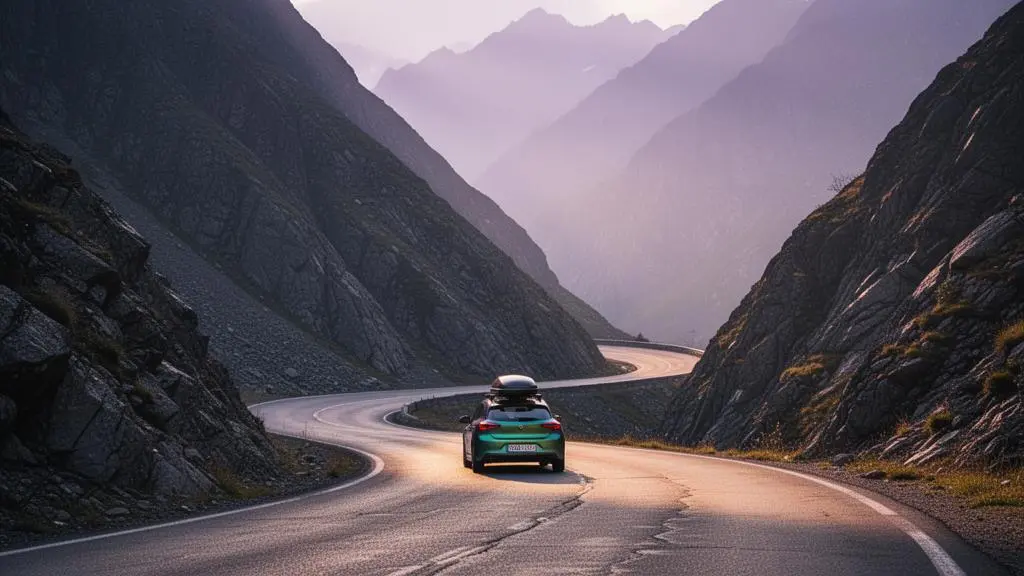
Your car’s ability to climb a steep, loaded mountain pass depends less on its advertised engine size and more on its calculated, real-world power-to-weight ratio and engine type.
- A vehicle’s climbing force is determined by torque multiplied by gearing, not raw displacement; a small engine can fail on a 12% grade if overloaded.
- Naturally aspirated engines lose approximately 3% of their power for every 1,000 feet of elevation gain, a penalty that turbocharged engines largely negate.
Recommendation: Before any challenging trip, calculate your vehicle’s ‘fully-loaded’ BHP-per-tonne. A figure below 100 BHP/tonne signals a high risk of struggling on steep, sustained gradients.
The anxiety is a familiar one for any driver planning an ambitious road trip: staring at a steep mountain pass on a map, then at the family and a pile of luggage, and wondering, “Is my car actually up to this?” The common advice is often vague, revolving around engine size or simply hoping for the best. This leads to stressful situations on the road, with engines screaming in low gear, clutches overheating, and the unnerving feeling of being underpowered and unsafe miles from assistance.
Most guides will offer simplistic tips like “downshift early” or “don’t overload the car.” While not incorrect, this advice fails to address the core engineering question: what is the actual physical capability of *my specific vehicle* under *my specific load* on *that specific route*? The truth is that assessing your car’s suitability for demanding terrain is not a matter of guesswork. It is a process of objective evaluation, rooted in the fundamental principles of vehicle dynamics. It involves understanding the critical relationship between power, weight, altitude, and even your car’s physical geometry.
Forget the simplistic notion that a “2.0-litre is good” and a “1.2-litre is bad.” The real key lies in understanding concepts like loaded power-to-weight ratio, the performance penalty of altitude on different engine types, and the mechanical stresses you are placing on components like the clutch. This guide provides the engineering framework to move from anxious speculation to confident assessment. We will equip you with the tools to calculate your car’s true performance envelope and make an informed decision about whether to proceed, pack lighter, or consider a more capable rental vehicle.
This article will guide you through the essential engineering checks to determine if your vehicle is truly prepared for the demands of mountain travel. By understanding these principles, you can ensure your journey is defined by breathtaking views, not by mechanical strain and roadside trouble.
Summary: A Practical Engineering Guide to Your Car’s Mountain-Climbing Capability
- Why a 1.2L Engine Fails on 12% Gradients When Carrying 4 Passengers and Luggage
- How to Calculate if Your Car’s BHP-Per-Tonne Suits Your Planned Mountain Route
- Naturally Aspirated or Turbocharged: Which Engine Breathes Better at 2,000 Metres
- The Weight Mistake That Burns Out Clutches on 1 in 5 Mountain Road Trips
- When Should You Rent a Larger Engine Rather Than Risk Your Own Car
- Why 200mm Ground Clearance Fails if Your Bumpers Overhang and Hit Ramps
- The Engine Size Mistake That Leaves Compact Cars Crawling Up 12% Gradients
- When Do You Actually Need Four-Wheel Drive Versus Front-Wheel Drive in the UK
Why a 1.2L Engine Fails on 12% Gradients When Carrying 4 Passengers and Luggage
The sight of a small-engined car struggling, or even failing, to climb a steep holiday route is a common one. The engine wails at high RPM, speed bleeds away, and the driver is forced to make a series of frantic, straining downshifts. This scenario is not simply about an engine being “too small.” It is a lesson in a fundamental concept of vehicle physics: tractive effort. This is the actual force the engine can deliver to the road surface via the transmission and tyres to overcome gravity, rolling resistance, and air resistance.
A 1.2-litre engine might feel perfectly adequate around town, but a 12% gradient (a climb of 12 metres for every 100 metres travelled horizontally) combined with the weight of four adults and their luggage dramatically increases the force required. The engine’s peak power is often only available in a narrow band of high RPMs. If the car’s gearing is not short enough in lower gears, the engine may be unable to reach this power band, or “bog down,” when faced with such a heavy load and steep incline. It runs out of the torque necessary to keep the crankshaft spinning against the immense resistance.
The ability to climb is a function of torque multiplied by gearing. A real-world physics analysis shows that this is not just a modern problem. For instance, a historic Volkswagen Beetle with a 1600cc engine could theoretically climb a staggering 48% gradient in first gear with two occupants. This demonstrates that a well-geared, albeit modest, engine can produce immense tractive effort. The failure of a modern 1.2L car on a 12% gradient is therefore a failure of the entire powertrain system to deliver sufficient torque to the wheels under a heavy-load, high-resistance condition.
If you find your vehicle in this situation, immediate action is required to prevent overheating or excessive strain. Monitor the engine temperature gauge closely and downshift manually before the engine labours. Remember that a lower gear delivers more usable power and torque to the wheels, allowing the engine to operate in its more efficient RPM range instead of struggling in a gear that is too high for the load.
Ultimately, this failure is predictable. It highlights the critical need to assess not just the engine’s size, but its ability to function as part of a system under the specific load you intend to carry.
How to Calculate if Your Car’s BHP-Per-Tonne Suits Your Planned Mountain Route
While tractive effort is the precise engineering metric, a more accessible and powerful tool for any driver is the power-to-weight ratio, specifically calculated as Brake Horsepower (BHP) per tonne. This figure gives you a clear, comparable number that represents your car’s ability to accelerate its own mass. A generic figure is useless, however. You must calculate the ‘fully-loaded’ ratio to understand how your car will perform on a demanding route, not how it performs leaving the showroom.
To do this, you need three pieces of information: your car’s kerb weight (the weight of the car with all fluids but without passengers or cargo), its engine BHP, and a realistic estimate of the weight of your passengers and luggage. A typical adult can be estimated at 75-80kg, and a full boot of luggage can easily add another 80-100kg. A roof box and its contents can add a further 50-75kg. Summing these provides your Gross Vehicle Weight for the trip.
Furthermore, to increase accuracy, expert engineers recommend correcting for parasitic drivetrain loss—the power consumed by the transmission and other components before it reaches the wheels. A good rule of thumb is to multiply your engine’s quoted BHP by 0.88 for a rear-wheel-drive (RWD) car or 0.85 for an all-wheel-drive (AWD) vehicle to get a more realistic ‘at the wheels’ figure.
Your Action Plan: Calculate Your Loaded BHP-Per-Tonne
- Find Kerb Weight: Locate your car’s published kerb weight (in kg) from the manufacturer’s specification sheet or your vehicle’s V5C document.
- Calculate Total Load: Add the estimated weight of all passengers, luggage, and any roof-box gear to the kerb weight. This is your total real-world mass.
- Convert to Tonnes: Divide the total weight in kg by 1,000 to get the weight in metric tonnes. For example, 1,750kg becomes 1.75 tonnes.
- Find Engine Power: Note your engine’s official flywheel BHP from the manufacturer’s specifications.
- Calculate the Ratio: Divide the engine’s BHP by your loaded weight in tonnes. (e.g., 150 BHP / 1.75 tonnes = 85.7 BHP-per-tonne).
Once you have your number, you can compare it to established benchmarks to understand what it means for on-road performance. This allows you to quantify that ‘sluggish’ or ‘quick’ feeling.
| BHP per Tonne | Typical Performance Feel |
|---|---|
| 80–120 | Typical for many everyday cars |
| 150–200 | Often feels quick |
| 200–300 | Very fast for the road |
| 300+ | High-performance or supercar territory |
A car that feels adequate with a driver alone at 120 BHP/tonne might drop below the 90 BHP/tonne mark when fully loaded, turning it from a competent vehicle into a struggling one on a steep incline. This simple calculation is your first and best indicator of potential trouble.
Naturally Aspirated or Turbocharged: Which Engine Breathes Better at 2,000 Metres
Your calculated BHP-per-tonne is an excellent sea-level benchmark, but it doesn’t tell the whole story. The moment you begin to climb, another critical factor comes into play: altitude. As you ascend, air density decreases. This means for every combustion cycle, your engine takes in less oxygen. Less oxygen results in less power, but how much power is lost depends entirely on your engine’s type: naturally aspirated (NA) or turbocharged.
A naturally aspirated engine relies on atmospheric pressure alone to push the air-fuel mixture into its cylinders. As this pressure drops with altitude, the engine’s ability to ‘breathe’ is directly compromised. A widely accepted engineering rule of thumb, as turbocharger manufacturer Garrett Motion explains, is that an NA engine will suffer an approximate 3% power loss for every 1,000 ft (about 300m) of elevation gain. A trip to a mountain pass at 2,000 metres (approx. 6,500 ft) could therefore rob your engine of nearly 20% of its power—a catastrophic loss for a vehicle that is already heavily loaded.
Case Study: Horsepower Loss in the Rockies
The effect of altitude is not theoretical. At the mountain town of Jackson Hole, Wyoming, situated at 6,200 feet, naturally aspirated engines already produce 18-20% less power than at sea level. For a driver heading higher over the nearby Togwotee Pass at 9,658 feet, that power loss climbs to nearly 30%. In practical terms, a 300hp truck engine effectively becomes a 240hp unit just by being in town, and significantly less on the pass itself. This turns a capable vehicle into a laboured one.
A turbocharged engine, however, behaves very differently. A turbocharger uses exhaust gases to spin a turbine, which in turn spins a compressor that forces air into the engine at a pressure higher than the surrounding atmosphere. It creates its own ‘sea-level’ environment. While it will still experience some minor efficiency loss, a turbo can largely compensate for the drop in ambient air pressure. This means a modern 1.4-litre turbocharged engine could maintain most of its 150 BHP at 2,000 metres, while a 2.0-litre NA engine that also produces 150 BHP at sea level might only be delivering 120 BHP at the same altitude, completely changing the performance dynamic.
Therefore, when assessing your car for a mountain route, knowing your engine is turbocharged provides a significant degree of confidence. If you have a naturally aspirated engine, you must factor in this inevitable power loss as part of your overall capability assessment.
The Weight Mistake That Burns Out Clutches on 1 in 5 Mountain Road Trips
An underpowered engine on a steep gradient doesn’t just result in slow progress; it places enormous stress on the drivetrain, particularly the clutch in a manual-transmission car. The “weight mistake” is assuming that the only penalty for overloading your vehicle is sluggish performance. The reality is a significantly increased risk of catastrophic clutch failure. When a driver tries to hold a heavy car on a steep hill using the clutch pedal, or allows for excessive clutch slip during a hill start, they are generating immense frictional heat.
A clutch works by pressing a friction plate against a flywheel. A small amount of slip is normal during engagement, but holding the car in the ‘biting point’ for extended periods or repeatedly slipping it under high load (like in stop-start traffic on an incline) causes the temperature to skyrocket. The acrid, burning smell is the clutch’s friction material literally vaporising. While a brief smell might not cause lasting harm, sustained abuse is fatal. In fact, engineering analysis shows that as little as 5 to 6 minutes of continuous slip can destroy a clutch that would otherwise last for over 100,000 miles of normal use.
Knowing the difference between a minor issue and a critical one is key, as one driver’s experience illustrates:
If you notice a brief burning clutch smell during a hill start or in heavy traffic, and it goes away quickly, you’re likely fine — your clutch got hot but wasn’t damaged. However, a persistent or recurring smell, especially with a softer or higher clutch pedal, means you should stop driving and get the vehicle inspected.
– Chloe’s Auto Repair, Blog Post
The single most important skill to prevent this is the handbrake hill start. This technique eliminates rollback and minimises the duration of clutch slip to almost zero. The process is simple: apply the handbrake fully, select first gear, bring the clutch to the biting point, and as you feel the car want to pull forward, simultaneously apply revs while releasing the handbrake and clutch. This ensures the car moves off the instant the clutch engages, placing minimal thermal load on the component.
This is not just about driving technique; it’s about understanding the direct link between the weight in your car and the life of your clutch. A heavy load on a steep hill is the component’s worst enemy.
When Should You Rent a Larger Engine Rather Than Risk Your Own Car
After assessing your loaded BHP-per-tonne, factoring in altitude effects, and considering the strain on your drivetrain, you may conclude that your own car is a marginal or high-risk choice for your planned mountain adventure. At this point, the most sensible engineering decision is to mitigate the risk entirely by renting a more suitable vehicle. This is not an admission of defeat; it is a strategic choice to preserve your own car and ensure a safer, more enjoyable trip.
However, “larger” doesn’t always mean “better.” Traveller experiences show that even small-engined rental cars can be surprisingly capable if driven correctly. In a dedicated mountain-driving forum, travellers reported that economy rental cars with 1.4-litre manual engines successfully navigated nearly all the Dolomite passes in Italy and the famous Grossglockner High Alpine Road. The key to their success was not raw power, but the active use of the manual gearbox to keep the engine in its power band, a testament to driver skill compensating for modest specifications.
The decision to rent should be based on a clear-eyed assessment of your needs. If your trip involves a full load of passengers and luggage on sustained, steep passes, moving up a class from an ‘Economy’ to an ‘Intermediate’ or ‘Standard’ model provides a crucial buffer of power and torque. This extra performance reserve means less strain on the engine, more confidence when overtaking, and a quieter, more relaxed cabin environment.
This table provides a general framework for matching rental car classes to your travel needs, helping you make an informed choice at the rental desk.
| Rental Class | Typical Passenger/Cargo Fit | Mountain Suitability |
|---|---|---|
| Economy / Compact | 2-4 passengers, limited luggage | Lower engine reserve, avoid for heavy loads on steep passes |
| Intermediate / Midsize | Up to 5 passengers, moderate luggage | Reasonable balance of power and load capacity |
| Standard / Full-size | 5+ passengers, ample luggage | More power reserve, better suited to loaded mountain routes |
| Intermediate/Standard SUV | 5 passengers plus cargo | Added ground clearance and available AWD for rougher mountain roads |
Renting a vehicle with a more robust powertrain or, for certain routes, the added benefit of an SUV’s ground clearance, can transform a potentially stressful journey into the relaxing holiday it was meant to be.
Why 200mm Ground Clearance Fails if Your Bumpers Overhang and Hit Ramps
Powertrain assessment is only half the battle. A car can have all the power in the world but still be defeated by a steep ramp if its physical geometry is unsuitable. A common but misleading specification is ground clearance, often quoted as a single number (e.g., 200mm). This figure measures the distance from the ground to the lowest point of the car’s main body, typically between the axles. However, it completely ignores the parts of the car that extend beyond the wheels: the front and rear bumpers.
The critical metrics for navigating sharp changes in gradient are the approach and departure angles. The approach angle is the maximum incline a vehicle can climb from a flat surface without its front bumper or spoiler scraping the ground. The departure angle is the same for the rear bumper when descending. A long front overhang, common on many modern sedans and estate cars for aerodynamic reasons, drastically reduces the effective approach angle, regardless of the central ground clearance.
This paragraph introduces the geometric problem. For a clear understanding, it’s helpful to visualise the components. The illustration below breaks down how a long overhang negates high central ground clearance.
As this diagram highlights, the front wheel may be able to mount the ramp, but the extended nose of the car will make contact first, resulting in costly damage. This is a frequent issue on steep ferry ramps, multi-storey car park entrances, and uneven rural tracks. A vehicle with 200mm of clearance but long overhangs can be less capable in these specific situations than an SUV with only 180mm of clearance but very short overhangs, which give it superior approach and departure angles.
Therefore, your assessment must include a visual inspection of your car’s front and rear overhangs. If you have a low-slung front spoiler or a long rear end, you must be exceptionally cautious with sharp crests and dips, approaching them slowly and at an angle where possible to effectively increase the clearance for one wheel at a time.
The Engine Size Mistake That Leaves Compact Cars Crawling Up 12% Gradients
We return to the compact car, not because it is inherently flawed, but because its limitations require a higher degree of driver skill and mechanical sympathy. The mistake is not in owning a compact car, but in driving it with the same technique as a large-engined vehicle and expecting the same result. When a compact car, especially one loaded for a holiday, begins to crawl up a 12% gradient, it is often due to the driver failing to adapt their technique to the vehicle’s characteristics.
The primary adjustment is to be proactive, not reactive, with the gearbox. You must downshift manually as soon as the car shows the first sign of struggling to hold speed, rather than waiting for the RPM to sag significantly. In an automatic, this means using the manual override. For many drivers, the sound of the engine at 4,000 or 5,000 RPM is alarming, but for a small engine under heavy load, this is its ‘sweet spot’ where it produces maximum power. Running at high RPM on a climb is normal, necessary operation; labouring the engine at low RPM in a high gear is abuse.
Furthermore, small cars have smaller cooling systems. A sustained, loaded climb generates a massive amount of heat. You must watch the temperature gauge closely. As experts from DriversEd.com advise in their Mountain Driving Guide, a simple but effective technique is to reduce the thermal load on the system: “You should avoid overheating the engine by not using the air conditioner and driving more slowly.” Turning off the A/C frees up a small amount of engine power and, more importantly, reduces the heat being transferred into the engine’s cooling system from the A/C condenser.
On the descent, the same principle of using lower gears applies. Relying solely on the brakes will quickly lead to brake fade, a dangerous condition where overheated brakes lose their effectiveness. Instead, select a low gear and use engine braking to control your speed, using the brakes only for short, firm applications.
By anticipating the car’s needs and not being afraid to use the engine’s full RPM range, a driver can often coax a surprising level of performance out of a compact car, turning a struggle into a manageable climb.
Key Takeaways
- Your car’s real-world climbing ability is best measured by its ‘fully-loaded’ BHP-per-tonne, not its engine size.
- Naturally aspirated engines suffer significant, predictable power loss at altitude, which turbocharged engines largely avoid.
- Driver skill, particularly proactive gear use and clutch-saving techniques, is as critical as hardware specifications.
When Do You Actually Need Four-Wheel Drive Versus Front-Wheel Drive in the UK
The conversation around mountain driving invariably turns to Four-Wheel Drive (4WD) or All-Wheel Drive (AWD). It is often presented as a panacea for challenging routes, but its role is frequently misunderstood. For the vast majority of mountain driving on paved roads, even steep ones, a standard Front-Wheel Drive (FWD) car with appropriate tyres is perfectly adequate. The primary challenge on a dry, paved 12% gradient is overcoming gravity, which is a task for the engine’s power and the transmission’s gearing, not the number of driven wheels.
An FWD car can maintain sufficient traction for climbing in these conditions. Where AWD becomes a significant advantage, or even a necessity, is when the road surface itself is compromised. This includes situations common on smaller rural or high-altitude roads in the UK:
- Loose Surfaces: Gravel tracks or roads with significant loose chippings where a FWD car might spin its wheels.
- Wet, Grassy Verges: Pulling over onto a soft, wet verge where an FWD car could easily get stuck.
- Icy Patches or Snow: The most obvious use case, where AWD provides a critical improvement in traction for both accelerating and stability.
The decision to opt for an AWD vehicle should be based on an assessment of the *surface*, not just the *gradient*. Will your route take you off tarmac? Are you travelling in winter conditions? Are you likely to need to park on unpaved surfaces? If the answer to any of these is yes, then AWD provides a valuable layer of security and capability. However, it is not a substitute for a capable engine.
It’s also important to remember that AWD systems add weight and increase drivetrain power loss, slightly reducing your effective power-to-weight ratio. The choice is a trade-off. For a summer trip on the main Alpine passes, a powerful FWD car is often a better choice than a lower-powered AWD SUV. Conversely, for exploring the unpaved forest tracks of Scotland in autumn, that same AWD SUV is the superior tool for the job.
Assess your route honestly. If your journey is confined to well-maintained A-roads and motorways, save the extra cost and fuel of an AWD system. If you’re venturing onto the unknown, it becomes an essential piece of equipment.