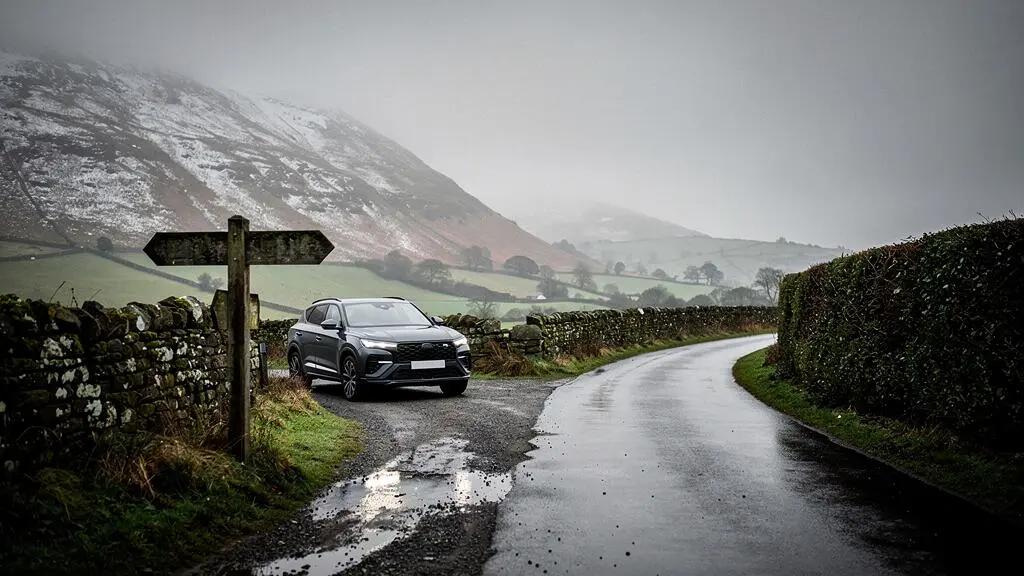
The default assumption that you need four-wheel drive for UK winters is fundamentally flawed and costly; superior grip comes from tyres, not your drivetrain.
- A front-wheel drive car on proper winter tyres consistently outperforms a four-wheel drive car on summer tyres for braking and turning in snow.
- The £4,000 average upfront cost and 15% fuel penalty of 4WD are only justifiable if you face 30+ days of heavy snow or have essential off-road access needs.
Recommendation: Invest in a second set of wheels with quality winter tyres for your 2WD car before even considering the expense of a 4WD system.
The decision looms for many UK drivers, particularly those living outside major cities: is this the year to finally switch to a four-wheel drive vehicle? The sales pitch is seductive, filled with images of effortless progress through snow-dusted country lanes and muddy fields. We’re told that 4WD, or its modern sibling all-wheel drive (AWD), is the ultimate solution for safety and mobility when the weather turns or the tarmac ends. This leads to a persistent anxiety that a standard front-wheel drive (FWD) car is somehow inadequate, a liability waiting for the first frost or flooded backroad.
Conventional wisdom suggests that if you live rurally, tow a caravan, or simply want peace of mind, 4WD is a must-have. This often leads to drivers paying a significant premium for a capability they may never truly need, while overlooking a far more critical factor in vehicle safety: the four small patches of rubber connecting the car to the road. The debate is often framed as a simple binary choice between 2WD and 4WD, ignoring the pivotal role of tyre choice and driving technique.
But what if the key to all-weather confidence isn’t about powering all four wheels, but about maximising the grip of the ones you have? This guide challenges the default thinking. It’s not an argument against 4WD, but a demand for its justification. We will dissect the performance myths, quantify the real-world costs, and demonstrate how a well-equipped FWD vehicle is not only sufficient for most UK conditions but often superior. It’s time to move beyond the marketing and determine whether you’re solving a genuine problem or just buying into a very expensive security blanket.
To navigate this complex decision, this article breaks down the essential factors you must consider. We will analyse the critical interplay between drivetrains and tyres, define the specific conditions that might justify the 4WD premium, and equip you with the knowledge to drive confidently, regardless of how many wheels are powered.
Contents: A Justification-Based Guide to Drivetrain Choice
- Why Front-Wheel Drive With Winter Tyres Outperforms 4WD on Summer Tyres in Snow
- What Conditions Make Four-Wheel Drive Worth the £4,000 Premium and 15% Fuel Penalty
- Part-Time or Full-Time Four-Wheel Drive: Which System Suits Occasional Off-Road Use
- The Four-Wheel Drive Mistake That Digs You Deeper Into Mud Than 2WD Cars
- How Many Days Per Year of Snow or Off-Road Justify Owning Four-Wheel Drive
- All-Season or Summer Tyres: Which Grip Gravel and Dirt Tracks More Safely
- Why a 1.2L Engine Fails on 12% Gradients When Carrying 4 Passengers and Luggage
- How to Drive Gravel and Dirt Tracks Confidently Without Four-Wheel Drive
Why Front-Wheel Drive With Winter Tyres Outperforms 4WD on Summer Tyres in Snow
The single most pervasive myth in motoring is that four-wheel drive equals invincible snow performance. While it’s true that sending power to all four wheels provides a significant advantage in getting a vehicle moving from a standstill, this is only one part of the safety equation. The critical ability to steer and, most importantly, to stop, is governed almost entirely by tyre grip. This is where the concept of Tyre Supremacy becomes non-negotiable. A 4WD system cannot create traction where none exists; it can only exploit the traction provided by the tyres.
Summer tyres, standard on most cars sold in the UK, have a rubber compound that becomes hard and inflexible below 7°C. Their tread patterns are designed to clear water on wet roads, not to bite into snow. On a snow-covered surface, a 4WD vehicle on summer tyres has four wheels spinning and slipping, offering little to no control. In stark contrast, a winter tyre is made from a silica-rich compound that stays soft and pliable in the cold, with a tread pattern full of ‘sipes’—tiny slits that act like thousands of small biting edges. This difference is not minor; it’s a night-and-day transformation in grip.
The data is unequivocal. According to independent TÜV SÜD testing cited by Michelin, a car’s braking distance on snow is roughly twice as long with summer tyres compared to winter tyres. This means that while a 4WD on summer tyres might accelerate away from a junction faster than a FWD car, it will sail straight past its intended stopping point. A real-world test by Tyre Reviews vividly illustrates this. When testing a Mini Countryman with AWD on all-season tyres against an identical FWD model on dedicated winter tyres, the results were telling. As documented by Motor1, while the AWD car won acceleration tests, the FWD car on winter tyres stopped a full car-length shorter in the snow braking test. As expert Antony Ingram noted for CarThrottle, the “winter tyres/four-wheel drive outperforms the 4WD/all-season combo significantly,” confirming that the hierarchy of safety is tyres first, drivetrain second.
What Conditions Make Four-Wheel Drive Worth the £4,000 Premium and 15% Fuel Penalty
Before signing on the dotted line for a 4WD vehicle, you must ask the £4,000 question: are my specific driving conditions so challenging that they justify the significant and ongoing costs? The figure isn’t arbitrary. It represents the typical price difference between a 2WD and its 4WD equivalent, before even considering the lifelong 10-15% fuel consumption penalty due to extra weight and mechanical drag. To this, you must add potentially higher insurance and maintenance costs. This is not a trivial expense, so the need must be genuine, not perceived.
The justification begins with a brutally honest assessment of your environment. Do you live at the top of a steep, ungritted hill in a region that sees significant, prolonged snowfall? Or do you live in a flatter area where snow is a newsworthy event that lasts for 48 hours? The difference is critical. You must establish your personal Justification Threshold based on data, not fear. A good starting point is the average number of days with snow on the ground where you live and drive.
This balance between cost and actual need is the core of the decision. For a driver in the Cairngorms, the scales clearly tip towards necessity. For a driver in Cornwall, they tip firmly towards cost. As data gathered by various UK meteorological sources shows, the variation across the country is immense. Consider the following data to locate yourself on the necessity scale.
| Location | Average snow days per year |
|---|---|
| UK national average | 13 days |
| Edinburgh | 22 days |
| Belfast | 19 days |
| Manchester | 20 days |
| Birmingham | 24 days |
| Scottish Highlands / Cairngorms (600m+) | 50+ days |
If your location sees fewer than 25-30 days of actual snow cover per year, it is extremely difficult to justify a 4WD system on the basis of winter driving alone, especially when the superior option of winter tyres on a 2WD vehicle exists. The same logic applies to off-road use. If “off-road” means a gravel track to a car park once a month, 4WD is overkill. If it means crossing a muddy, rutted field daily for work, the justification becomes much stronger.
Part-Time or Full-Time Four-Wheel Drive: Which System Suits Occasional Off-Road Use
The term ‘four-wheel drive’ is often used as a catch-all, but the technology varies significantly. The two primary types are ‘full-time’ systems, commonly labelled All-Wheel Drive (AWD), and ‘part-time’ 4WD systems found on more rugged SUVs and pickup trucks. Choosing the right one depends entirely on your expected use case, and choosing the wrong one can be both inefficient and mechanically damaging. A lack of mechanical sympathy—understanding how the system works—can lead to expensive repairs.
Most modern SUVs sold in the UK use an automated AWD system. These are typically FWD-based, running as a two-wheel drive car for maximum efficiency until sensors detect wheel slip. At that point, a clutch pack or viscous coupling engages to send a portion of the engine’s power to the rear wheels. This is a brilliant system for on-road driving in variable conditions—a sudden downpour, an icy patch on a B-road. It’s seamless and requires no driver input. However, these systems are not designed for severe, prolonged off-road use, as the clutch packs can overheat.
Part-time 4WD is a more traditional, robust system. The driver must manually engage it via a button or lever, which locks the front and rear driveshafts to rotate at the same speed. This provides incredible traction on loose surfaces like mud, sand, or deep snow. However, engaging this system on a high-grip surface like dry tarmac is a critical mistake. Because the wheels on the inside and outside of a turn need to rotate at different speeds, the locked drivetrain creates immense stress, a phenomenon known as ‘driveline bind’ or ‘wind-up’, which can cause catastrophic damage to the transmission. Therefore, it is only suitable for occasional, deliberate use on slippery surfaces.
The following overview, based on information from resources like automotive service experts at Autozone, clarifies the key distinctions and appropriate uses for each drivetrain.
| System | How power is delivered | Key caution |
|---|---|---|
| RWD | Power to rear wheels only; front wheels steer | Excellent dry handling, trickier on snow |
| FWD | Power to front wheels, which also steer | Good traction from engine weight over driven wheels |
| AWD | Primarily FWD-based, automatically sends power rearward when slippage detected | Best for everyday variable-traction driving |
| 4WD (part-time) | Manually engaged, equal power to all four wheels | Can cause drivetrain damage if engaged on dry pavement |
The Four-Wheel Drive Mistake That Digs You Deeper Into Mud Than 2WD Cars
One of the most counter-intuitive realities of off-roading is that the brute force of a four-wheel drive system can be your worst enemy in mud. When a 2WD car gets stuck, the two driven wheels spin, and the car generally stays put. A 4WD vehicle, however, has the ability to spin all four wheels. The common novice mistake is to keep the accelerator pressed, believing more power is the solution. In reality, as the off-road experts at WeAirDown warn, “you’ll probably just dig yourself in deeper.” Each spinning tyre acts like a shovel, excavating the mud from beneath it, quickly burying the chassis and differentials until the vehicle is firmly beached.
This is where technique and patience become far more valuable than horsepower. The goal when stuck is not to overpower the obstacle, but to regain traction. The moment the wheels start to spin without forward progress, you must stop. Continuing to accelerate is the single biggest mistake you can make. A 2WD driver, with less potential for digging, is often forced to adopt a smarter strategy sooner. A 4WD driver, armed with a false sense of security, can make the situation significantly worse in seconds.
The correct approach involves finesse, not force. It requires getting out of the car, assessing the situation, and manually improving the conditions for traction. This could involve clearing mud from around the tyres or placing traction aids like recovery boards or even old floor mats under the drive wheels. Only then should power be reapplied, gently. The rocking technique—alternating between drive and reverse—can help build momentum to climb out of the ruts you’ve created, but it must be done with minimal wheelspin.
Action Plan: Getting Unstuck from Mud Without Brute Force
- Stop Immediately: The instant you feel the wheels spinning without moving forward, take your foot off the accelerator. Continuing will only dig deeper ruts.
- Clear a Path: Get out and assess. Use a shovel or your hands to clear mud and debris from in front of and behind all four tyres.
- Improve Grip: Place traction aids (recovery boards, floor mats, branches) directly in the path of the drive wheels to give them something solid to bite into.
- Engage 4-Low & Rock Gently: If you have a part-time system, engage 4WD Low range for maximum torque at low speed. Gently apply power to rock the vehicle forward and back, building momentum rather than spinning the wheels.
How Many Days Per Year of Snow or Off-Road Justify Owning Four-Wheel Drive
The decision to buy a 4WD vehicle should be an investment decision. And like any investment, it requires a calculation of return. In this case, the return is ‘necessary use’. The core of the justification is to move from a vague feeling of “it might be useful” to a concrete number: how many days per year will I be unable to complete an essential journey without it? If that number is zero, the decision is easy. If it’s 365, the decision is also easy. The difficulty lies in the grey area between these extremes.
Let’s establish a baseline. Referring back to the table of snow days, if you live in Birmingham and face an average of 24 days with snow, that doesn’t mean 24 days of impassable roads. Many of those days will involve a light dusting that melts by midday. The number of ‘critical days’ where a 2WD car on all-season tyres might struggle is likely less than a week per year. Is that week worth a £4,000 premium and a permanent increase in your fuel bills? For most, the answer is no, especially when winter tyres on a 2WD car would solve the problem for a fraction of the cost.
A reasonable Justification Threshold for a purely winter-based decision might be 30-40 days of *genuinely disruptive* snow or ice per year. This level is really only consistently reached in the UK’s most mountainous regions, like the Scottish Highlands or parts of the Pennines. For off-road use, the calculation is similar. If you need to cross a muddy field to check on livestock twice a day, every day, 4WD is a tool of your trade. If you want to go green-laning as a hobby three times a year, it’s far more economical to join a club or hire a suitable vehicle. Furthermore, as The Conversation points out in its climate analysis, “winter is warming faster than any other season,” suggesting that the number of snow days in many parts of the UK is likely to decrease over the vehicle’s lifespan, further weakening the justification.
All-Season or Summer Tyres: Which Grip Gravel and Dirt Tracks More Safely
For many UK drivers, ‘off-road’ driving doesn’t mean climbing mountains but navigating the thousands of miles of unpaved gravel and dirt tracks that lead to rural homes, farm shops, and walking trail car parks. The question of 4WD is often raised for these surfaces, but once again, the answer lies more with the tyres. On a loose surface like gravel, traction is about a tyre’s ability to conform to the surface and maintain contact without excessive slip, especially under braking and cornering.
Summer tyres, with their stiffer compounds and less aggressive tread patterns, can struggle on loose gravel. They tend to ‘skate’ over the stones rather than gripping them, which can lead to longer braking distances and a feeling of instability. All-season tyres represent a significant step up in this environment. Their softer compound and more intricate tread patterns, including more sipes, provide better purchase on uneven, loose material. They are designed to be a compromise, offering better performance than summer tyres in colder temperatures and on light snow, which also translates to better grip on surfaces like gravel.
However, this compromise comes with a trade-off. The very softness that helps on a gravel track can be a slight disadvantage on a warm, dry road. As manufacturer testing indicates, all-season tyres show a slightly greater braking distance than dedicated summer tyres once temperatures rise above 7°C. For the driver who spends 99% of their time on tarmac, this is a factor to consider. But for the rural driver who regularly uses gravel tracks, the enhanced safety and confidence provided by all-season tyres far outweigh the minimal reduction in peak summer performance. In almost all cases, a 2WD car on good quality all-season tyres is more than capable of handling any public-access gravel or dirt track in the UK.
Why a 1.2L Engine Fails on 12% Gradients When Carrying 4 Passengers and Luggage
The drivetrain is only half the story; the engine is the other. A common and frustrating scenario for drivers of small-engined cars is the struggle up a steep gradient, especially when fully loaded. The belief that 4WD would solve this problem is a misunderstanding of physics. The issue here isn’t a lack of traction; it’s a lack of torque and an unfavourable power-to-weight ratio. A 4WD system can’t help if the engine itself is running out of breath.
Imagine a family of four heading for a holiday in the Peak District in a popular 1.2-litre hatchback. The car, with passengers and a boot full of luggage, might weigh close to 1,800kg. As it starts to climb a steep 12% (or 1-in-8) hill, the force of gravity pulling it backwards becomes immense. The small engine, designed for city driving and fuel efficiency, has to work incredibly hard. The driver has to shift down to second, or even first gear, to multiply the engine’s torque enough to overcome the incline. The engine roars at high revs, yet the car barely maintains speed. This is a failure of power, not grip.
Adding a 4WD system to this scenario would actually make it worse. The extra 100kg of weight from the drivetrain components would increase the overall mass the engine has to haul uphill, further blunting its performance. This is why you see larger, more powerful engines in vehicles designed for towing and rugged use. They produce more torque at lower engine speeds, allowing them to pull heavy loads up steep gradients without strain. If your daily commute involves a 12% gradient and you regularly carry heavy loads, the solution isn’t 4WD; it’s a vehicle with a more powerful engine, regardless of how many wheels it drives.
Key Takeaways
- Tyres are the #1 factor for grip; winter tyres on a 2WD car are safer than summer tyres on a 4WD in snow.
- The £4,000+ cost and 15% fuel penalty of 4WD is only justifiable for those facing 30+ days of severe snow or daily, essential off-road use.
- Gentle inputs and maintaining momentum are more effective than brute force on any loose surface, from mud to gravel.
How to Drive Gravel and Dirt Tracks Confidently Without Four-Wheel Drive
Confidence in driving on unpaved surfaces comes not from complex machinery, but from simple technique. A standard front-wheel drive car can handle the vast majority of UK’s gravel and dirt tracks with ease, provided the driver adapts their approach. The key is to be smooth, deliberate, and to prioritise the preservation of momentum. These surfaces are less forgiving of sudden inputs, whether it’s braking, accelerating, or steering.
Your speed should be dictated by your ability to stop within the distance you can see to be clear. On loose gravel, braking distances are increased, so maintain a larger gap from any vehicle in front and approach blind corners with caution. All inputs should be gentle. Squeeze the brake rather than stamping on it to avoid locking the wheels and skidding. Steer in smooth, fluid motions to avoid unsettling the car’s balance. When you need to accelerate, do so progressively to prevent the driven wheels from spinning and losing traction.
Reading the road ahead is a critical skill. Look for deeper potholes, larger rocks, or patches of wet mud and try to steer a course around them. On corrugated or ‘washboard’ sections, slowing down can sometimes make the ride worse; experiment with a slightly higher speed (within safe limits) which can allow the suspension to ‘skim’ over the tops of the bumps. Maintaining a steady, controlled momentum is your best tool. It’s much easier to keep the car moving through a soft or sandy patch than it is to get it moving again from a standstill.
By adopting these simple techniques, you will find that a 2WD vehicle is remarkably capable. It transforms the experience from a stressful ordeal into a pleasant, engaging drive, proving that driver skill is the most sophisticated system of all. This mindful approach is the final piece of the puzzle in making an informed decision about your vehicle needs.
The choice is ultimately a personal one, but it should be based on a rigorous and honest evaluation of need versus cost. By prioritising the correct tyres for the conditions and mastering basic driving techniques, most UK drivers will find that a front-wheel drive vehicle is more than adequate, freeing up thousands of pounds that would otherwise be spent on an unnecessary and underutilised 4WD system. Apply this justification framework to your own driving patterns and budget to make a financially sound and mechanically sensible decision.