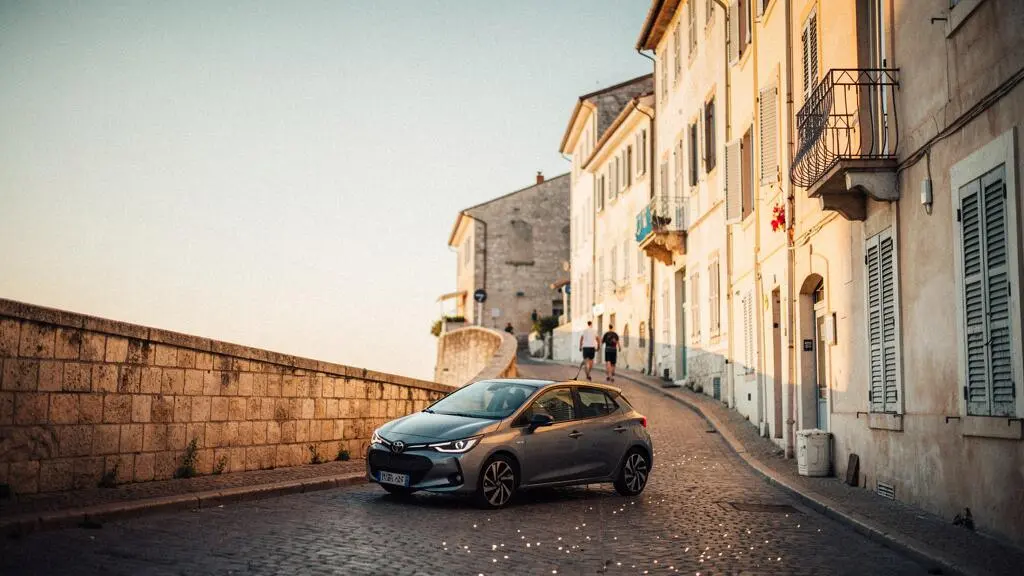
The ability to navigate tight historic towns isn’t just about a car’s size; it’s about mastering the geometric advantages of a short wheelbase and applying specific, low-speed driving techniques.
- A vehicle’s turning circle is dictated by both its wheelbase and its maximum steering angle, allowing some cars to be far more agile than their dimensions suggest.
- Success in confined spaces relies on proactive driving: reducing speed to under 8mph, using mirrors as precise alignment tools, and understanding single-track road etiquette.
Recommendation: Before your next trip to a historic region, prioritise vehicle choice not on passenger count alone, but on its wheelbase and turning circle specifications to avoid costly damage and fines.
The familiar, gut-wrenching scrape of an alloy wheel against a 500-year-old kerb. The heart-stopping moment you realise the stone walls of a medieval alley are closer than your wing mirrors. For drivers of standard or large vehicles, exploring historic towns often feels like a battle against the environment itself. The common advice is simply to “get a smaller car,” but this overlooks the fundamental physics and specific techniques that separate a stressful crawl from a confident, efficient navigation.
The true key to unlocking these confined spaces lies not just in a vehicle’s overall length, but in a more critical dimension: its wheelbase. However, even this is only half the story. The secret to exceptional manoeuvrability is the interplay between this geometric foundation and a driver’s skilled application of low-speed dynamics. It’s about transforming the vehicle from a blunt instrument into a precision tool.
This guide moves beyond generic advice. We will deconstruct the science behind the turning circle, analyse which compact vehicles master both tight corners and steep gradients, and provide actionable driving strategies. By understanding these principles, you can navigate the most challenging village streets not just without damage, but with a speed and confidence that seems impossible in a standard car.
This article provides a detailed breakdown of the critical factors that give short-wheelbase vehicles a decisive edge in complex environments. Explore each section to build your expertise, from the underlying physics to practical on-road tactics.
Summary: How Short-Wheelbase Vehicles Conquer Confined Spaces
- Why a 2.4m Wheelbase Turns in 4m Less Space Than a 2.8m Wheelbase Vehicle
- How to Find Compact Cars That Fit 4 Adults Comfortably Despite Short Wheelbases
- City Hatchback or Compact SUV: Which Short Wheelbase Handles Cobbled Streets Better
- The Engine Size Mistake That Leaves Compact Cars Crawling Up 12% Gradients
- What UK and European Towns Are Impossible to Navigate Without Compact Vehicles
- Why Tucking Mirrors and Driving at 8mph Saves Your Paintwork in Tight Villages
- Why Using Wing Mirror Alignment Doubles Your Tight Parking Success Rate
- How to Drive Through Single-Track Village Streets Without Blocking or Damaging Your Car
Why a 2.4m Wheelbase Turns in 4m Less Space Than a 2.8m Wheelbase Vehicle
At its core, a vehicle’s manoeuvrability is governed by its turning circle, the smallest space required to complete a U-turn. The most significant factor influencing this is the wheelbase—the distance between the front and rear axles. A shorter wheelbase allows the rear wheels to follow a tighter path behind the turning front wheels, dramatically reducing the turning radius. However, wheelbase is not the only variable. The maximum steering angle of the front wheels plays an equally critical, and often overlooked, role in achieving exceptional agility.
This explains why some vehicles can turn far tighter than their dimensions would suggest. Consider the following data, which highlights this principle in action. While a shorter wheelbase generally correlates with a smaller turning circle, clever engineering can produce surprising results.
| Vehicle | Wheelbase | Turning circle |
|---|---|---|
| Fiat Panda Cross 1.2 8V LPG | 2.30 m | 9.0 m |
| Fiat Grande Panda 1.2 Hybrid | 2.54 m | 10.0 m |
| London Black Cab (TX, regulatory limit) | Not disclosed publicly (RWD, extreme-angle steering) | ≤ 8.535 m |
The iconic London Black Cab is the ultimate case study. Despite being a significantly larger and heavier vehicle than a city car, it is mandated by regulation to have an astonishingly small turning circle of no more than 8.535 metres. This is achieved through engineering that allows for an extreme front-wheel steering angle. As one automotive journalist noted when describing the system, “That’s the kind of steering angle you find in professional drift cars, not your average car on the road.” This proves that while a short wheelbase provides a fundamental advantage, it is the combination with a high steering angle that creates a truly supreme urban navigator.
How to Find Compact Cars That Fit 4 Adults Comfortably Despite Short Wheelbases
The assumption that a short wheelbase automatically means a cramped interior is a common misconception. The reality of passenger space is determined by clever design and packaging, not just external dimensions. The most successful “Tardis-like” compact cars employ specific strategies to maximise interior volume, proving that you don’t have to sacrifice comfort for manoeuvrability. The key is to look beyond the overall length and analyse the interior architecture.
One of the most effective strategies is an upright seating position. By designing the cabin with a taller “H-point” (the position of a seated occupant’s hip), manufacturers allow passengers to sit more vertically. This significantly reduces the need for horizontal legroom, much like sitting on a dining chair versus lounging on a sofa. Vehicles like the Honda Jazz have perfected this, creating surprising rear-seat space within a small footprint. Another critical element is the use of thin-backed front seats, which can add precious inches of knee room for rear passengers without compromising front occupant comfort.
Furthermore, look for intelligent component placement. Some models, for instance, position the fuel tank under the front seats rather than the rear, freeing up floor space for passengers’ feet and creating a flat loading bay when seats are folded. In contrast, many sporty hatchbacks prioritise a low, sleek roofline and a low-slung driving position, which inherently eats into rear headroom and legroom. When evaluating a compact car for passenger comfort, ignore the exterior styling and focus on these practical design choices that create space where it’s needed most.
City Hatchback or Compact SUV: Which Short Wheelbase Handles Cobbled Streets Better
Navigating historic towns isn’t just about tight turns; it’s about handling surfaces that are actively hostile to modern vehicles. Cobbled streets, with their uneven, high-frequency bumps, pose a unique challenge. The choice between a city hatchback and a compact SUV, even with similar wheelbases, comes down to a trade-off between suspension travel and centre of gravity. Both have distinct advantages and disadvantages when dealing with rough, ancient pavement.
A traditional city hatchback typically has a lower centre of gravity, which provides a more stable and planted feel. With less body roll, it can feel more direct and reassuring to the driver on uneven surfaces. However, its shorter suspension travel means it can struggle with sharper impacts, transmitting more of the shock into the cabin. The key to a comfortable hatchback on cobbles is the tyre profile. A smaller wheel diameter (e.g., 15-inch) with a higher-profile tyre (more rubber sidewall) acts as a crucial primary shock absorber, smoothing out the ride significantly more than a fashionable low-profile tyre on a large 17-inch wheel.
A compact SUV, by contrast, offers more suspension travel and typically comes standard with higher-profile tyres. This combination is inherently better at soaking up the bumps and jolts of a cobbled road, providing a more isolated and comfortable ride. The downside is its higher centre of gravity. On undulating or off-camber cobbled sections, this can lead to more body roll and a “head toss” effect for occupants, feeling less connected to the road. Ultimately, for pure cobbled street performance, a well-damped hatchback equipped with sensible, high-profile tyres often strikes the best balance between comfort and stability.
The Engine Size Mistake That Leaves Compact Cars Crawling Up 12% Gradients
The most common powertrain mistake when choosing a compact car for challenging terrain is focusing on horsepower. On the steep, 12% or greater gradients found in hillside villages, from a standing start or at low speeds, horsepower is almost irrelevant. The critical metric is low-end torque and how it’s delivered by the gearing. An engine that produces its peak pulling power at low RPMs will feel effortless, while a high-horsepower but low-torque engine will struggle and strain.
Think of torque as the twisting force, or the initial muscle that gets the car moving, while horsepower is the measure of how quickly that work can be done (torque x RPM). When starting on a steep incline, you need a strong initial push, not high-speed performance. This is where modern, small-capacity turbocharged engines excel. A 1.0-litre three-cylinder turbo engine can produce its maximum torque from as low as 1,500 RPM, providing the instant grunt needed to pull away cleanly up a steep hill. In contrast, a larger, non-turbo 1.6-litre engine might have more peak horsepower, but it may need to be revved to 4,000 RPM or more to deliver its peak torque, which is impractical and stressful in a tight, slow-moving situation.
This is why simply looking at the engine size in litres is a mistake. A “downsized” turbo engine will almost always outperform a larger naturally-aspirated one in low-speed, high-load scenarios. The gearing also plays a crucial role, with a short first gear acting as a torque multiplier. Before choosing a vehicle, don’t just look at the 0-60 mph time; look at the engine’s torque figure and, more importantly, the RPM at which that peak torque is available. A lower number here is a clear indicator of a car that can handle gradients with ease.
What UK and European Towns Are Impossible to Navigate Without Compact Vehicles
For many historic towns across the UK and Europe, a compact vehicle isn’t a recommendation; it’s a practical necessity. These are places where the infrastructure was designed for feet and carts, not cars. Driving a standard-sized vehicle in these locations is not just difficult, but often financially punitive due to strict “Zona a Traffico Limitato” (ZTL) or Limited Traffic Zone regulations. In these cities, a wrong turn isn’t an inconvenience; it’s an expensive error. For instance, reports show that in 2024, the city of Florence collected an astonishing €61.6 million in traffic violations, a huge proportion of which came from tourists inadvertently entering a ZTL.
The risk is real and cumulative. As one traveller recounted after a trip to Italy, the camera-based enforcement means multiple passes can result in multiple fines: “One absent-minded afternoon circling in search of your hotel can lead to four tickets.” Beyond the legal restrictions, many towns are physically impossible to traverse. In the UK, coastal villages like Polperro in Cornwall or Staithes in North Yorkshire have streets so narrow that resident access is heavily restricted and visitor cars are banned from the core. In Italy, villages in the Cinque Terre are largely car-free for a reason. In France, the hilltop villages of Provence, like Gordes, feature circulatory systems that are a nightmare for anything larger than a Fiat Panda.
Navigating these places requires more than just a small car; it demands a vehicle with a sub-2.4m wheelbase and an excellent turning circle. These are not destinations for a family saloon or a mid-size SUV. Attempting to do so risks getting wedged, causing damage, or accumulating hundreds of euros in fines. The choice of a truly compact, agile vehicle is the first and most important step to a successful and stress-free visit.
Why Tucking Mirrors and Driving at 8mph Saves Your Paintwork in Tight Villages
In the tight confines of a historic village, speed is your enemy and proactive defence is your greatest ally. The two most powerful, yet counter-intuitive, techniques for protecting your vehicle are to manually tuck in your wing mirrors *before* you enter a tight squeeze and to consciously cap your speed at a walking pace, around 5-8 mph (8-13 km/h). This isn’t about being overly cautious; it’s about managing cognitive load and physical space with expert precision.
Tucking in a mirror, particularly the passenger side, can shave 20-30cm off your vehicle’s effective width. This is often the difference between a smooth pass and a costly scrape. Doing it pre-emptively, rather than as a reaction, turns it from a panic move into a strategic choice. It forces you to rely on other spatial cues and slow down, which is the primary goal. Driving at 8 mph or less is critical because it gives your brain enough time to process the flood of information from all sides. At this speed, you can make minute, smooth steering corrections instead of the jerky, over-correcting movements that happen when you’re going too fast for the space.
This low speed allows you to actively monitor multiple points simultaneously: the front corner clearing a post, the side mirror’s distance from a wall, and the rear wheel avoiding the kerb. It transforms driving from a two-dimensional task (looking forward) into a three-dimensional awareness of your vehicle’s entire volumetric footprint. This slow, deliberate pace isn’t a sign of a nervous driver; it is the hallmark of a professional who understands that in confined spaces, control, not momentum, is what ensures a clean exit.
Why Using Wing Mirror Alignment Doubles Your Tight Parking Success Rate
Expert drivers in confined spaces don’t guess; they use reference points. Your wing mirrors are not just for checking traffic; they are powerful alignment tools that can be used to place your car with centimetre-level precision. By learning to use them as a gauging system, you can eliminate the anxiety and uncertainty of tight manoeuvres, effectively doubling your success rate by turning a visual estimate into a repeatable, geometric check.
The most critical technique is for parallel parking or reversing along a kerb or wall. Before you begin the manoeuvre, angle the passenger-side mirror down so that you have a clear view of your rear wheel and the bottom edge of the wall or kerb. This single adjustment changes everything. You are no longer guessing where your expensive alloy wheel is; you can see its exact relationship to the obstacle. You can guide the car back until the tyre is precisely where you want it, maintaining a consistent, safe gap. This eliminates the risk of scuffed wheels or scraped lower body panels.
For forward movements in narrow alleys, your mirrors become your width gauges. The trick is to judge the gap not by looking at the space in front of you, but by constantly flicking your eyes between the left and right mirrors. Learn how the reflection of the wall ‘moves’ across the mirror glass. If the gap in the reflection is shrinking on one side, you need to make a minute correction away from it. This allows you to ‘feel’ the car’s width through the mirrors. Combining the downward-angled passenger mirror for vertical clearance (kerbs) with a side-to-side scan for width clearance provides a complete, 360-degree picture that turns a high-stress guess into a low-stress, successful manoeuvre every time.
Key takeaways
- Manoeuvrability is a function of both wheelbase and steering angle; a short wheelbase alone is not the full story.
- For steep, low-speed gradients, prioritise an engine with strong low-end torque over one with high horsepower.
- Proactive driving techniques—reducing speed to under 8mph and using mirrors as alignment tools—are essential skills, not signs of weakness.
How to Drive Through Single-Track Village Streets Without Blocking or Damaging Your Car
Successfully navigating a single-track road is the final exam for the urban explorer. It’s here that all the principles of vehicle choice and driving technique converge. It is a cooperative, not competitive, environment where understanding etiquette is as important as driving skill. The fundamental goal is to maintain flow and avoid creating a blockage, which requires anticipation and a clear understanding of the rules of priority, both written and unwritten.
The most crucial element is the use of passing places. These small pull-outs are the lifeblood of single-track roads. Your eyes should always be scanning for the next one, not just looking at the road ahead. You must be prepared to reverse into a passing place you have already passed to let another vehicle through. The official UK Highway Code is unequivocal on who has priority. As Rule 155 states, you should ” give way to road users coming uphill whenever you can.” This is a rule based in physics: it is far more difficult and dangerous for a vehicle to restart on a steep incline than it is for a downhill vehicle to stop and wait.
Your action plan for navigating narrow passages
- Anticipate & Identify: Constantly scan ahead for the next passing place and identify oncoming traffic as early as possible.
- Assess Priority: Determine who should give way. If you are going downhill, prepare to yield to uphill traffic. If the passing place is on your side, prepare to pull in.
- Communicate Clearly: Use a quick flash of your headlights or a clear hand signal to indicate that you are waiting and yielding the right of way.
- Execute the Manoeuvre: Whether pulling into a passing place or reversing, use your mirrors (angled down) to position your vehicle accurately and efficiently, leaving maximum space.
- Proceed with Caution: Once the way is clear, proceed slowly, acknowledging the other driver with a wave. Remain vigilant for the next potential encounter.
Ultimately, driving on these roads is a form of communication. It requires applying the precise, low-speed control we’ve discussed, using your vehicle’s geometric advantages to tuck into tight spaces, and demonstrating a clear understanding of shared-space etiquette. By mastering these skills, you do more than just avoid damage; you become a seamless, efficient, and respected participant in the unique ecosystem of the historic village road.
Now that you understand the physics of manoeuvrability and the on-road techniques, the next logical step is to apply this knowledge to your next vehicle choice. Whether renting for a weekend or purchasing for years of exploration, prioritising a short wheelbase, high steering angle, and a torque-focused engine will fundamentally transform your ability to confidently access the world’s most beautiful and challenging historic locations.